

Concurrent validity asks how a measure relates to a relevant criterion assessed at roughly the same time. A study can show that two scores move together while leaving open whether one can replace the other. Read the timing, the reference score and the stated result before using the claim.
This guide shows how to turn those details into a cited note. The worked reading-test case is fictional; the physical-activity figure comes from a published study.

Check the evidence behind your criterion claim
Compare the measure, criterion and timing passages.
What concurrent validity means
The criterion is the reference used to judge the new measure. In this type of study, it is assessed at about the same time. Boateng and colleagues place this within criterion-related validity.
A short reading test could be compared with an established test given in the same session. If the outcome is next term's reading score, the question instead concerns predictive validity.
The open research-methods textbook explains why the reference must fit the claim. Write down what it measures, who takes it and why the authors chose it. A well-known test may still be a poor fit for a new use.
Related measures may also support convergent validity. That asks whether links fit the theory of the constructs. Timing alone does not tell you which claim the authors make.
Check the criterion and its timing
Start with the methods. Find the measure name, version, score, reference and time gap. Read these fields before the authors' final claim. This helps you spot a gap between what the study did and what someone says it proves.
The day a survey is filled in can differ from the period its score describes. One survey may ask about last week. A second, filled in on the same day, may ask about a typical month. Keep both dates and recall windows in the note.
The PAVS study methods give a concrete timing detail: MAQ was completed an average of 30 minutes after PAVS. The score comparison included only people who said the activity reported to MAQ was usual for them. Keep those details rather than infer a recall window from the same-visit label.
Check that both scores came from the same people. An average from one group is not a pair of scores for each person. Keep the unit of the result clear: a person, a clinic, a class or a whole group.
Ask five questions of the reference score:
- What score or observed task serves as the reference?
- Why did the authors choose it?
- What limits do they state?
- Does it cover the same task, time frame and group?
- Where are the scoring rules and timing details given?
If the time gap is missing, write that it was not found in the text you checked. The word concurrent in a title is a reason to read the method, not a reason to assume both tests were given on one day.
Correlation and agreement answer different questions
Correlation asks how scores vary together. Agreement asks how close the scores are. Bland and Altman's original paper explains why a correlation alone cannot establish agreement.
Think of a fictional meter that always reads ten units too high. Its values could rise with the reference values while being wrong by the same amount each time. A strong link would not remove that gap.
In the published PAVS results, the authors assessed both correlation and agreement. They also called for further work with repeated objective measures. Keep those limits when describing the result.
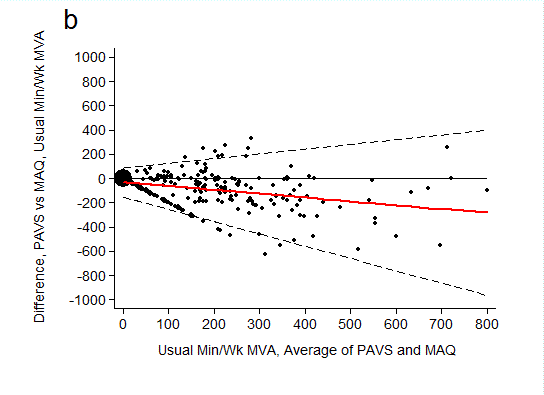
The red line shows how questionnaire differences change across the average-score range.
The vertical axis shows the gap between the two survey scores. The horizontal axis shows their average. The red line slopes down, and the dashed limits span a broad range. The plot makes the score gaps visible even when scores are related.
Figure 2B is from Ball and colleagues, Preventing Chronic Disease, 2016, reused under the journal's open-access permission. Read it with the paper's stated methods and results.
If your goal is to use one score in place of the other, find the agreement results and the basis for an acceptable gap. The Bland–Altman paper explains that method question. This article does not set a threshold for your test.
Build a same-time criterion evidence note
Suppose a fictional paper compares a short reading form with a longer test in the same session. The text you checked states that the scores are related. It does not show an agreement result.
Use the table to keep the claim narrow. The study details are invented for teaching. No coefficient or real finding is implied. Replace each entry with cited text from your own source.
| Field | Fictional working entry | Check before keeping it |
|---|---|---|
| Target measure | Short reading-session form | Exact version and scoring rules |
| Criterion | Longer reading test | Authors' reason for this reference |
| Timing | Same session; exact gap unclear | Methods or supplement |
| Reported result | Authors state a link between scores | Method name and actual result |
| Missing evidence | Agreement not found in checked text | Whether it is given elsewhere |
| Bounded inference | Same-session score link | Group, use and remaining limits |
Table 1: A colleague writes: “The short form is valid and can replace the longer test.” That leaves the intended use unstated and adds a claim that the scores can be exchanged. A same-session link does not by itself justify replacement.
A better note says: “The paper states a link between the short form and the chosen reading test in the same session. The text checked here does not show whether the scores can be used in place of each other.” Add the group and measure versions once you find them.
This does not show that the form is poor. It shows which claim has support and which still needs work. Keep “not found in the text I checked” distinct from “not assessed in the study.” The latter needs a check of the full paper and supplements.
For several papers, keep one entry per measure version and reference. Do not merge a child sample with an adult sample, or a translated test with its source version. The scale-development primer places validity work in the wider process of checking a scale for its use.
Trace the reported evidence in Atlas
Prepare the main paper, any useful supplement and the measure's scoring description. Add only material you have permission to use. Include methods and limits, rather than just the abstract.
Create an Atlas project, select the relevant sources and ask:
Find the target measure, reference criterion, time gap and stated method in these sources. Cite each field. Keep association distinct from agreement. Mark missing details unknown. Do not infer that scores can replace each other or predict later outcomes.
Check the returned fields
Treat the answer as a draft extraction and check it against the sources:
- Open each citation and read the text behind the field.
- Check whether a date refers to when the test was taken or the period it asks about.
- If the answer says same day but the source says only baseline, keep the source's wording.
- If it calls a survey a gold standard, check what that reference actually measures.
- Save the corrected note with links and a separate field for your judgment.
A reviewer should be able to open the source behind a field without searching the chat. If an answer claims the scores are interchangeable, find the source support or narrow the claim.
Atlas helps you read and compare supplied sources. It does not compute a correlation, judge an acceptable score gap or certify validity. Keep those choices with the researcher and the appropriate methods review.
Write a conclusion the study can support
Name the measure, reference, group, time gap and stated result. Then say what remains open for your use. A clear limit makes the note easier to revise when a new paper or reviewer comment adds evidence.
For the fictional reading case, replacing the longer test needs agreement evidence. Forecasting later reading scores needs later-outcome evidence. If the next question concerns how the task matches daily life, use ecological-validity appraisal. Stronger wording cannot supply any of those results.
Before using the note in a review, check that each factual field has a source. Keep missing fields unknown and label your own judgment. A narrow cited claim is more useful than a broad claim that a test is valid.
Check the evidence behind your criterion claim
Compare the measure, criterion and timing passages.