
Ecological validity, in this guide's task-and-setting sense, asks how a study relates to a specified activity in daily life. Name that activity, then compare what people see, do and face in the study with what the target task requires.
The term has several uses, so check the author's meaning first. A scene can look like daily life while leaving transfer untested. This guide turns the comparison into a cited note. Its alert-response case is fictional.

Check the task behind the realism claim
Compare study conditions with the specified everyday activity.
What ecological validity means here
This guide focuses on task and setting correspondence: which features match a named daily activity, which differ and which remain unknown. That is a reading lens, rather than a universal definition of the term.
Schmuckler's expert entry distinguishes historical cue-based usage from representative design and newer discussions of settings, stimuli and responses.
Keep the author's meaning in the note. Two sources may use the same label for different questions. Read the entry before treating realism as a settled test of quality.
Whether an inference transfers to a target group, place or time belongs to external-validity appraisal. Task resemblance can inform that argument, but cannot settle it alone.
Specify the everyday activity before comparing
Real life is too broad to be a useful target. Planning tomorrow's appointments on a phone during a commute differs from planning next week's appointments at a quiet desk. Both are daily tasks, but their demands differ.
Name the person, task, setting and purpose. Find the source text that describes the target. If the authors leave it vague, mark it as vague. Do not turn your own proposed case into the authors' stated context.
Holleman and colleagues' critique challenges broad real-world-versus-laboratory labels. Concrete task features give the reader something to assess. Ask what is known, what must be done and what constrains the action.
Use five dimensions to organize the comparison:
- Task: the activity and goal people are asked to perform.
- Setting: the physical, digital and social conditions.
- Information: cues, materials, instructions and help people can use.
- Response: what people do and how it is recorded.
- Constraints: time pressure, interruptions, stakes and chances to recover.
This is an original reading rubric, not a validated scale. Do not turn a count of matches into a numerical validity grade. The importance of a difference depends on the claim.
A controlled task can help answer a narrow question about a process while leaving daily behavior open. The critique's discussion of context helps frame that limit without treating all lab tasks as poor research.
Separate a familiar scene from task correspondence
A virtual kitchen can look familiar while giving prompts and response rules that differ from cooking at home. Read what people must do, rather than judge the task by its appearance.
The original VR-EAL development report describes everyday-style scenes and the tasks within them. Its figure below gives concrete details to inspect in the methods.
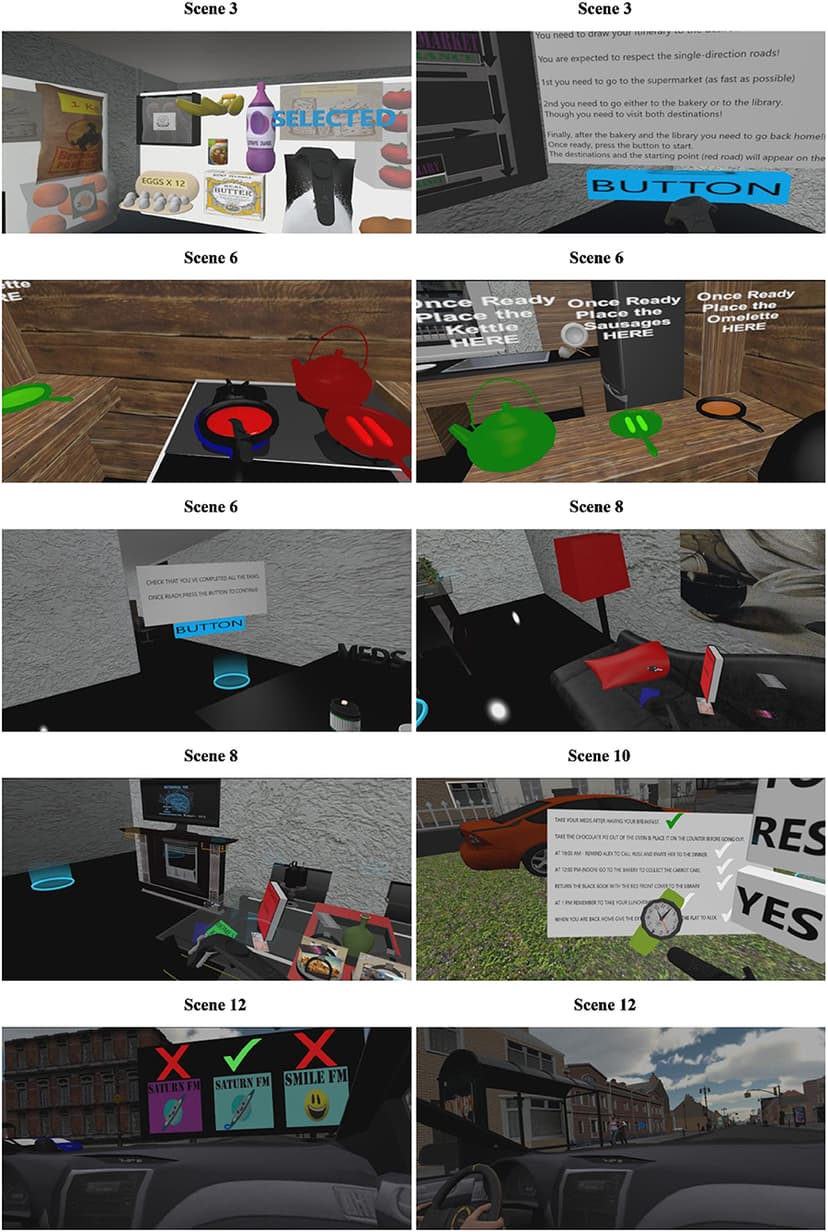
Familiar kitchen and shopping objects appear alongside prompts and task-specific response aids.
The screenshots show shopping, cooking and other task scenes. In kitchen panels, words and colored objects mark where items should go. Those aids are part of the study task. They do not show that daily cooking uses the same cues.
The figure points to what to check: objects, prompts and tasks. It does not prove transfer to daily life. Figure 3: Kourtesis and colleagues, Frontiers in Computer Science, 2020, reused unaltered under CC BY 4.0.
If your target involves recall without help, note a visible reminder. If it involves handling real objects, check how the simulated response differs. Use the VR-EAL methods to support the comparison rather than infer all task details from a screenshot.
The same care applies in a real store. Vogel and colleagues' supermarket study reports a real-store intervention and states that stores could not be randomized.
A familiar setting does not remove that design limit. Keep task resemblance distinct from the strength of a causal claim. The working-memory review by Fanuel and colleagues also weighs strengths and limits of more everyday-like tasks.
Build a task-setting correspondence note
Suppose a fictional study asks people to respond to appointment alerts on a desktop screen. They sit in a quiet room, see a fixed set of messages and acknowledge each by pressing one key.
The authors say it represents appointment planning during a daily commute. That target may involve a phone, other people, distractions and choices about moving an appointment. These details are invented for teaching; they are not findings from a real study.
This original table keeps the task description apart from the target question. Replace its entries with checked text. Leave target features unknown when the source does not describe them.
| Dimension | Fictional experimental task | Target correspondence question |
|---|---|---|
| Task | Acknowledge appointment alerts | Does noticing an alert represent planning? |
| Setting | Quiet room with desktop screen | Are mobile use and commute conditions described? |
| Information | Fixed messages and instructions | Does the target offer the same cues and help? |
| Response | One-key acknowledgement | Does planning need choices or rescheduling? |
| Constraints | Distractions and stakes unclear | Which target conditions are supported by evidence? |
Table 1: Do not conclude that the task has low validity just by counting gaps. Say which gaps matter to the claim. Seeing an alert and planning a schedule are distinct activities even when the message text is the same.
A bounded note says: “The task presents alerts and records a key press. The checked text does not establish how this represents planning choices, phone use or commute demands.” It names one match and several open questions.
That sentence does not call the study useless. If your question concerns detecting alerts in a quiet room, the task may be useful. If it concerns planning while traveling, more task and transfer evidence is needed.
Keep the authors' claims and your judgment in separate fields. A statement that a scene is realistic is itself a claim to assess. It does not fill every row in the table. The expert entry gives context for why a single realism label is too broad.
Check the correspondence passages in Atlas
Gather the task rules, setting, response steps and target activity. Add the stimuli as well. Use supplements for prompts or help missing from the main text, and add only sources you have permission to use.
Add the material to an Atlas project and wait for processing to finish. In chat, type @ and select the relevant sources. Choose Project only to prevent new web or literature retrieval. Earlier chat context remains available, so name the study and target-activity sources you intend to compare. Ask:
Compare the study task and setting with the authors' specified everyday activity. Find task goals, setting, cues, response and constraints. Cite each match or difference. Keep missing details unknown and separate the authors' claims from interpretation.
Inspect the cited conditions
Use the answer as a draft and make these source checks:
- Open each citation and compare the claim with the source text.
- Check what a scene shows and what the methods say people actually do.
- Keep assumed commute distractions out of the stated-study field.
- If a claim says the task proves transfer, find the support or narrow it to task resemblance.
- Select New, then Note, and save the corrected note with links, matches, gaps and unknowns. Wait for Saved before closing it.
A kitchen screenshot may show familiar objects while leaving the response rules open. A rating of realism is not the same as observed behavior outside the task. Keep these limits visible to the next reader.
Atlas helps read and compare supplied sources. It does not observe people, certify ecological validity or prove transfer beyond the study conditions. The researcher judges which task differences matter.
State what matches and what remains untested
Name the daily activity, the matching study features and the features the checked sources do not establish. This avoids turning a visual likeness into a blanket claim.
For the fictional case, the match is alert presentation and a key-press response. Planning choices and commute demands remain open. Those gaps guide the next sources to read.
Use the concurrent-validity guide if the next question concerns a same-time measurement criterion. Use predictive validity if it concerns a later measured outcome. Those are different evidence questions from whether the task resembles a daily activity.
Before finishing, check that each match has a cited basis, each gap has a defined target and every unknown remains visible. The note can be useful even when wider transfer is still untested.
Check the task behind the realism claim
Compare study conditions with the specified everyday activity.