

Correlational research measures how variables relate. Experimental research changes a factor and measures what follows. To compare the two, read what the researchers did, how conditions were assigned, and what the comparison can support.
A strong link between two measures does not itself show that one caused the other. An experiment can support a causal claim, but its label does not remove the need to inspect the design, missing data, and analysis.
This guide builds a method-to-claim note using two fictional reading-task descriptions. They are teaching material with no participant data or findings. Use the note to check a paper's claim against its actual methods.

Keep the study design beside the claim
Compare supplied methods and save checked claim boundaries.
The difference is what the researcher changes
In correlational research, the researcher measures variables without changing the exposure of interest. The BCcampus methods textbook defines the design this way. For example, a team might record how often people open source papers and compare that habit with a later reading-task score.
In an experiment, the team changes a factor and measures a response. NIST distinguishes observed links from causal relationships and explains why designed experiments help study the latter. The exact contrast, assignment, and test still matter.
Both approaches can provide useful evidence. Measuring a pattern can help describe a problem or build a prediction. Assigning a condition can help test an effect. The research question and actual design decide which claim is justified.
Do not identify the design from a graph, coefficient, or the word “significant.” The textbook's design distinction depends on how the work was done. Read the methods before turning the result into a statement about cause.
Compare measurement assignment and control
Three differences help you read past a paper's title. Keep them together in your note so the design label has an evidence basis. A result sentence alone may leave all three unclear.
Measured habits versus assigned tasks
A correlational description might say that people reported how often they checked citations. The team measures that habit; it does not assign people to have it. The habit may differ with experience, interest, time, or other features.
An experimental description might say that the team assigned people to read with source access or to read an answer alone.
That is a change introduced for the study. Read the actual tasks, not just the names given to the conditions.
The DePaul-hosted teaching comparison uses measured behavior and assigned exposure to show this distinction. Its examples also show why reverse direction and a third factor can be plausible accounts of an observed link.
For a first pass, draw two columns in your note: what the team changed and what it recorded. A score belongs in the second column even in an experiment. The methods chapter on measured variables helps you check which variable defines the design.
Sampling versus condition assignment
Random sampling concerns who enters the study. Random assignment concerns which condition an enrolled person or other unit receives. The experimental design textbook separates these procedures. A random sample does not turn measured habits into an experiment.
Find the assignment unit as well as the rule. A study might assign people, classes, teams, or the order of tasks.
“Random” needs an account of what was chosen by chance and when. Avoid assuming individual assignment from a broad label.
NIST's completely randomized design assigns factor levels to experimental units. Use it to understand that specific design. It is not a reason to treat all forms of randomization or all experimental units as interchangeable.
Try reading “random” with its next noun attached. A random sample of students says who was drawn from a group. A random task order says how tasks were sequenced. The assignment and order chapter explains why those details need their own place in your note.
The contrast created by a control
The control condition shows what the assigned task is compared with. It might be another active task rather than no activity.
The textbook describes several control conditions. Keep what each group actually did in the note.
For a reading study, compare the text, time, instructions, and tools available to each group. If one task adds both more source text and more time, the label “source access” does not isolate which part of that package produced a difference.
The experimental research design guide traces reported assignment and comparator details in real papers. Use it for that deeper reading job after you have identified the contrast your paper is trying to test.
Before you judge a control, state the exact question. “Does this whole task change the score?” differs from “Does one feature of the task change the score?” The NIST factors and responses account gives a useful frame for keeping what changed beside what was measured.
If the paper cannot answer the narrower question, retain the wider contrast it actually tested. That can still be useful. Your note should show why the stated result fits one question better than the other, instead of quietly changing the question.
Read the methods behind the causal wording
Start with the exposure or task the claim names. Locate the passage that says whether it was measured or assigned. A methods sentence about another study cited as background does not establish what the current authors did.
Next, find the criteria for forming groups and the time order. Who chose the condition? When was the outcome measured? Keep a source location beside each answer. If a procedure is unreported, mark it as open rather than supplying a familiar method.
Read the outcome itself. A score on one short source-reading task is not the same as long-term research skill. Write down the task, scoring rule, and test time before choosing language such as “better researchers” for your draft.
Then look for explanations the design leaves open. For a measured habit, ask whether skill could influence the habit or whether a third factor could affect both. NIST's correlation guidance keeps that third-factor possibility visible. The correlational research guide shows how to record the measures, estimate, and causal limit for an actual reported association.
For an assigned task, inspect the comparator, how the task was delivered, and who completed the outcome test. Assignment at the start does not mean all enrolled people provided usable scores. Read how missing results were handled before judging the estimate.
Use the source record to synthesize papers with their methods visible. A broad summary can make different designs sound alike. Keep the reported method, your interpretation, and unresolved checks as distinct parts of the note.
Worked design and claim comparison note
Consider two fictional descriptions about source reading. Both are invented for this guide. Neither is a report of completed work.
Description A: Volunteers report how often they check citations, then complete a task that asks them to check a claim.
Description B: A proposed study would place volunteers by chance in one of two reading groups before the same claim-checking task.
In the proposed experiment, one group reads an answer with access to its source text; the other reads the same answer alone. Both would receive the same task instructions and test time. These are invented teaching descriptions, not a validated study protocol.
| Reading field | Measured-habit description A | Proposed assigned-task description B |
|---|---|---|
| Exposure | Volunteers report their usual citation-checking frequency | The team would assign source access or answer-only reading |
| Group formation | The team would compare recorded habits without assigning them | Chance assignment would place each volunteer in a condition |
| Outcome | Volunteers would complete a claim-checking task; no scores are supplied | Both groups would complete the same claim-checking task; no scores are supplied |
| Sequence | A habit report would precede the task | Condition assignment would precede the task |
| Task controls | The short description does not specify matched instructions or test time | Instructions and test time would be the same across groups |
| Claim boundary | An observed link would not itself establish what caused a score difference | The planned contrast could test an effect, but no study or result exists yet |
Table 1: The map links a possible claim to the method that could support it. No scores, sample size, or effect estimate are supplied. You would need actual methods, results, and appropriate review before describing either design as completed evidence.
Correct the measured-habit claim
Suppose a draft makes this claim:
Opening citations caused higher claim-checking scores because frequent citation readers scored better.
Even if that pattern were found in description A, the claim about cause would reach beyond the stated design. The NIST distinction between a link and a cause is the key issue to check before keeping that wording. Better readers might already be more likely to check citations. Prior training could also influence both habits and scores. Those are questions to test, not findings about these fictional volunteers. The teaching page's alternative explanations show the reasoning behind this check. A bounded revision would say: “The study would examine whether reported citation-checking frequency is related to task scores.” Because this is a teaching description, keep the sentence in planned language. Do not convert an imagined pattern into a result.
Preserve the experiment's status
Description B changes a condition and proposes chance assignment. That makes its planned comparison different from measuring a habit. It does not show that source access improved a score, since no one has completed the proposed study. Keep the status beside the method: proposed, performed, reported, or unclear from the sources you read. A protocol can tell you what was intended. The final report is needed to check what happened and which results were analyzed.
For either design, retain the exact unit and outcome in your claim. A volunteer's score on this task would not by itself show what all researchers do, how they work months later, or whether a specific reading product improves research quality.
Keep design labels separate from certainty
The design name is a useful starting point. It is not a verdict on the paper. Measurement quality, missing data, analysis choices, and the scope of the sample can still affect the claim you use. Read those details before ranking evidence.
Assignment helps but has limits
Chance assignment aims to reduce group differences tied to who receives each condition. It does not guarantee perfectly balanced groups in every study. The textbook explicitly notes chance imbalance. Keep that distinction when describing the purpose of assignment.
A result also needs a clear target. A difference between source access and answer-only reading would concern that contrast under the tested conditions. It would not automatically identify which feature of source access mattered or prove that every learner benefits.
Some designs need a different comparison
A study that changes a task without chance assignment may use a quasi-experimental design. The methods chapter on this design explains why its control needs a closer check. Some reports need more than the two broad labels used in this guide.
The quasi-experimental design guide shows how to check that control and its assumptions. Use it when an existing group, a time rule, or a policy sets who gets a new task or service. Keep other reasons for a group difference open.
Being in a lab does not itself make a study experimental. Being in the field does not itself make it correlational. The correlational research chapter defines the distinction through what is measured or changed.
Neither design label tells you whether a claim holds elsewhere. Read who took part, where, and what was tested. When a causal claim rests on observed or nonrandom groups, ask an expert which assumptions and tests could support it. Keep the answer with the claim.
Compare cited study methods in Atlas
Add the papers, relevant protocols, and extra files that you are permitted to use to one Atlas project. Wait for processing to finish. Keep a proposed teaching note clearly labeled so it cannot be mistaken for the authors' reported methods.
-
Open a chat and type @ to select the sources you want to compare. Name each study and version so the question points to the correct method passages.
-
Ask: “Compare what was measured or changed, who received each condition, the assignment rule, comparator, and outcome. Cite each entry. Keep planned and completed work separate.”
-
Open the citations and read the surrounding source text. Use exact page or passage navigation when available. If it is unavailable, locate the named methods section yourself.
-
Check any answer that treats a random sample as random condition assignment. Find the passage about group formation and correct the note to preserve the actual procedure.
-
Inspect any causal sentence against the comparison. If it rests on measured habits alone, retain the observed association and the causal questions still open.
-
Select New, then Note. Save the method fields, source locations, corrected claim, status, and open checks. Wait for Saved before closing the note.
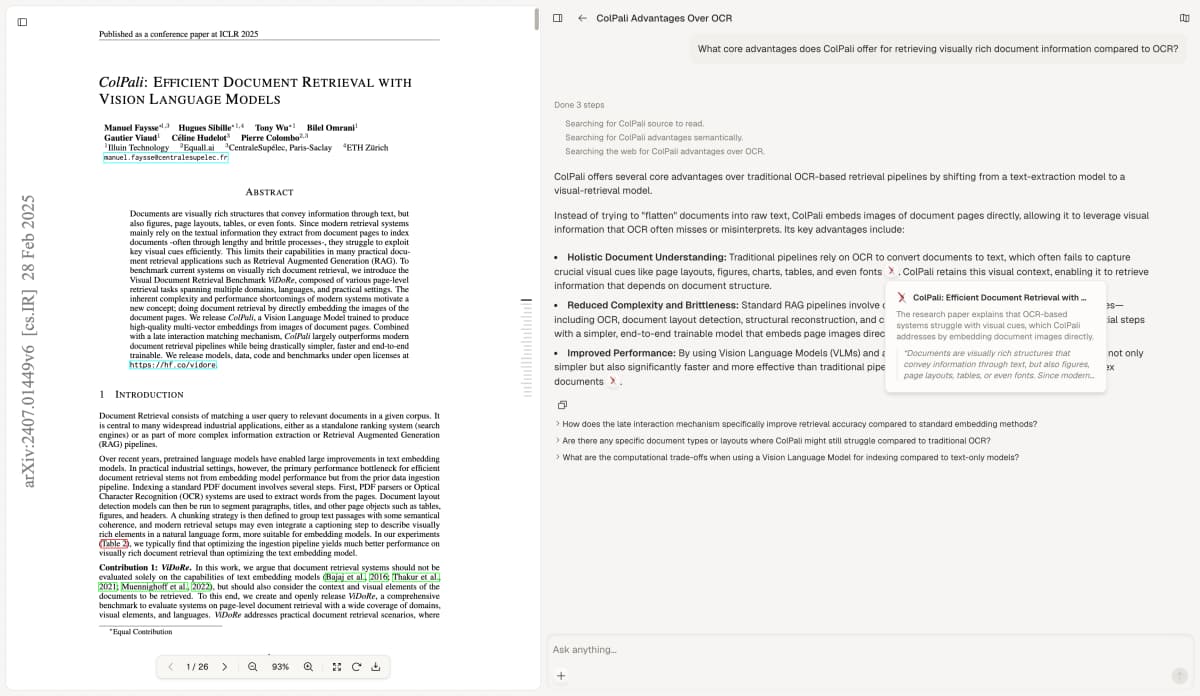
This Atlas capture shows ColPali, by Manuel Faysse and colleagues, under CC0. The unrelated paper illustrates source inspection. The image shows neither fictional study, a causal appraisal, nor a live test of the proposed reading comparison. Atlas captured the interface without editing the displayed paper.
Keep enough context for another reader to follow your correction. Source-based research notes can retain the study, method, version, and unresolved question together. A clean design label alone would lose that reasoning.
Choose the next check for your claim
If you need a measured link, start with what each measure means and how it was recorded. Find the actual result and how precise it is. Keep other reasons for the link open. A prediction about who scores well is a different claim from what makes them score well.
If you need an effect of an assigned task, first read how the groups were formed and what each did. The randomized design account shows the role of chance in that approach. Then check whether the task was delivered, who took the test, and how scores were used.
If a study changes a task without chance assignment, read its own methods and seek expert review. The quasi-experimental methods chapter gives background for that check. Write which rule or assumption is still open and which source might resolve it.
For a new study, take the question and planned contrast to the research team. Ethics, cost, size, tests, and the model need their own review. The teaching examples and questions can help frame the discussion; the reading note does not approve the plan.
Atlas helps compare supplied passages and retain checked notes. Researchers decide whether evidence supports the causal claim. Reopen the note when a protocol, correction, or final report changes what the methods can establish.
Keep the study design beside the claim
Compare supplied methods and save checked claim boundaries.