

A critical review explains the relevant argument of a text and judges how well it works. The judgment needs a clear criterion, a passage that supports it, and a reason the point matters. Calling a paper weak is not enough. Nor does a careful summary, on its own, make a review.
Before drafting, build a note that keeps the author's claim, source support, and your judgment apart.
This guide uses an invented pilot study of feedback on writing. The example shows what the paper adds while keeping its limits and unanswered questions clear.

Keep every review judgment tied to a passage
Compare the paper with your criteria and check the support for each criticism.
What a critical review needs
The UNSW guide combines summary with critical comment. Its stated learner goals include choosing suitable criteria and making a judgment based on them. Use your own assignment to set the scope: a course may ask for one paper, a comparison, or specific aspects of the method.
Critical does not mean that every point must be negative. A fair review can explain a strong feature, a limit, and a question that the paper leaves open. Your task is to make those judgments clear and show why they follow from the work. Avoid adding a fault merely to make the review sound more critical.
Laurier's article-review guide asks you to argue how well the paper achieves its goals. This gives the review a thesis of its own. The paper's thesis states the author's main claim. Your thesis states how you judge that claim and why.
For example, a reviewer might value a pilot's account of local change yet find it cannot support a broad causal claim. Both judgments can hold. The UW-Madison handbook also advises choosing a few key points rather than trying to discuss everything. Choose the points that drive your overall view.
Choose criteria that fit the paper
Begin with the task's criteria and the author's purpose. Does the paper aim to describe a process, explain an effect, defend a theory, or interpret a text? An account of what happened should not be judged as though it promised a trial.
A claim about cause, however, needs support suited to that claim.
The Southern Cross guide asks learners to form questions from their lecturer's criteria. Turn each one you need into a check you can answer from the paper. For instance, does the final claim stay within the people and setting studied?
Check the link between the claim and the support. Note what is measured or described, how the evidence was gathered, and what the author infers. If a method needs expert review, use the standard for that field. A writing checklist cannot settle all method questions.
CIPD's review guidance asks readers to examine the author's argument and source support.
Make that link concrete in the note. Record the claim, where it appears, what supports it, and the judgment you can defend. This gives the reader more to assess than a list of words such as strong or weak.
If other sources are allowed, check their publication type and choose them for a clear point of comparison. A later paper may ask a different question or study another setting. It may not directly contradict the paper you review. State what overlaps and what differs before using it to assess the claim.
The UNSW procedure includes value compared with other work as one test, while noting that each test may not suit each article.
Worked claim-evidence-limitation review note
The paper and all its study details below are invented for teaching. There is no real author, publication, dataset, or outcome. The labels identify sections of this fictional example. They have no counterpart in a published paper.
Suppose the assignment asks whether a writing-feedback pilot supports its conclusion.
The invented paper describes twenty-four volunteers in one writing workshop. Their drafts received rubric scores before and after a feedback session. The reported mean rose from 3 to 4 on a five-point scale. The discussion calls this a promising local pattern and proposes a controlled study. No comparison group is included.
| Invented source location | Paper statement or record | Review criterion | Supported judgment and limit |
|---|---|---|---|
| Introduction I1 | The aim is to explore a local feedback approach | Does the method fit the stated purpose? | A small pilot can inform a local exploratory question; it is not a population estimate |
| Methods M1 | Twenty-four volunteers attend one workshop; the same rubric is used before and after | Is the evidence clear enough to interpret the change? | The common scale aids comparison; rater blinding is not described and remains a check |
| Results R1 | The mean score changes from 3 to 4 | Does the result support the claimed effect? | It reports a change within this sample; without a comparison group, it does not isolate feedback's effect |
| Discussion D1 | The pattern is promising and a controlled study is proposed | Does the conclusion respect the design's scope? | The stated conclusion is cautious; claiming the paper proves effectiveness would misread it |
Table 1: The table gives the reviewer something to argue from. It shows the value of a local account, a causal limit, and a missing detail. The final claim also notes the need for further study. The note does not turn each limit into a failure or say that the author made the reviewer's stronger claim.
Turn the note into a paragraph
An original possible review paragraph would read: the pilot gives a clear account of score change in a small workshop sample. The same rubric gives both sets of scores a common frame.
The design cannot separate feedback from other things that may affect later drafts. Its main value is to explore a local pattern. The call for a controlled study fits that limit. Rater blinding is not described, so the scoring process needs further review.
This paragraph makes a judgment, explains its support, and states why it matters. It credits the stated conclusion. It does not accuse the paper of proving an effect it never claimed. It also gives the reader a clear open question without inventing a known scoring error.
Correct an unfair criticism
A weak review might say the study is worthless because it has only twenty-four people. That verdict skips the paper's purpose and the value of its local account. A better question is which claims the sample and design can support. The guide to limitations of the study helps keep that scope issue distinct from a sweeping verdict about worth.
Another weak sentence might say the raters knew the session order and biased their scores. The example only says blinding is not described. Ask how blinding was handled. The raters' knowledge and actions remain unresolved until the source supplies those details.
Make the judgment fair and bounded
Check that the criticism targets the author's actual claim. Read the abstract, discussion, and limitations together. If the author already narrows the conclusion, assess that narrow claim. You may still question it. The review should not quietly replace it with an easier claim to attack.
Keep a missing detail distinct from an observed flaw. A gap in the report can reduce what you can judge; explain how. It does not always show that the process was poorly done. State what is absent, why it matters, and what cannot be judged from the supplied report.
Avoid a fixed summary-to-critique ratio unless the assignment supplies one.
The UW-Madison guidance scales the introduction, overview, and chosen points to the task and page limit. Include enough summary to make your judgment understandable, then use the space to support the review's argument.
You can organize the review point by point, with the paper's claim and your judgment together, or use separate summary and evaluation sections. UNSW's guide allows these patterns. Choose the structure that makes your reasoning easiest to follow and fits the actual brief.
Your final judgment should follow from the points you examined. Southern Cross's procedure asks you to restate the overall view with its reasons.
Do not add a new charge at the end. Do not claim to have checked the whole paper when you reviewed only selected parts.
Build the review note in Atlas
Add the selected paper, review criteria, and other sources that you are allowed to process. Check that you have the paper's methods, results, discussion, and any needed supplement. Wait for processing to finish. Keep an unavailable section marked as a gap until you can check its text. Base review claims on the sections you can read.
Start a fresh chat if earlier outside sources would confuse the review. Choose Ask a question and mention the paper and criteria with @. Select Project only beside + to keep new retrieval within the project. Earlier outside chat context can remain; the control alone does not remove it.
Ask: “Compare this paper with the supplied review criteria. For each selected claim, record the source location, supporting evidence, criterion, strength, limitation, and unresolved question. Keep the author's wording distinct from my judgment. Do not infer a method defect from a missing report detail.” The prompt sets the scope of the reading task. Review each judgment against the supplied evidence.
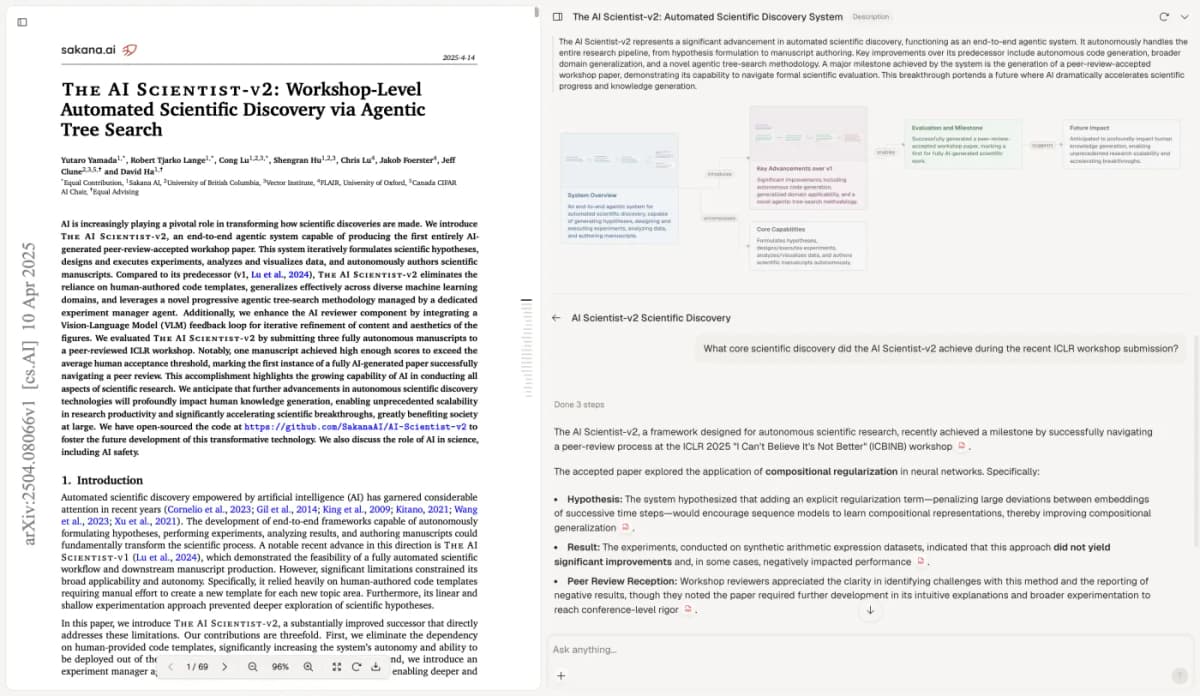
The real archive screenshot shows another paper and how a reader can check citations. It does not show the invented pilot or certify the quality of a review.
The displayed paper is The AI Scientist-v2, by Yamada and colleagues, under CC BY 4.0. The capture retains the original pixels.
Open each cited passage and read its context. Check whether the answer points to a result, the author's view, or a comparison source. If a nearby citation does not support the judgment, narrow or remove the claim.
The source-checking workflow makes this support check concrete.
For a permitted comparison source, check the overlap yourself. Name the intended source if the answer cites the wrong one and ask again. The process for synthesizing research papers can help preserve differences between sources rather than blend them into agreement.
Before you save the note, revise claims that go beyond the source. Correct claims that the pilot proves an effect or that missing blinding means known bias. Check that the answer does not strengthen the author's own conclusion.
To save the work, select New, then Note, add the title and corrected text, and wait for Saved.
Atlas helps compare supplied sources and organize notes. It does not run fieldwork or statistics, maintain a formal coding database, establish causality, certify appraisal, or replace your final judgment. Use the note to support your reading and writing, with the review's reasoning still your responsibility.
Draft from the checked note
Write an introduction that identifies the paper and your reviewer thesis. Select the few points that support that thesis. For each, give the relevant paper claim, the criterion, the source support, and your reasoned judgment.
Cite actual source locations in the form required by the assignment.
In the invented pilot, the thesis credits the local pattern and the cautious conclusion. Causal effects and the rater process remain open questions. The final review should preserve all parts of that judgment. Revisit the note if a supplement, corrected paper, or new test changes what you can fairly say.
Keep every review judgment tied to a passage
Compare the paper with your criteria and check the support for each criticism.