

Scholarly sources usually address people who study a field. Popular sources address general readers. The difference concerns who the work is for, what it aims to do, and how it is published. “Popular” does not mean widely read, and “scholarly” does not mean each claim is correct.
To compare scholarly vs popular sources, inspect the actual work and where it was published. Then decide what it can support in your research. Keep source type, peer review status, and fit for your task as separate judgments.
A table with reasons and open checks tells you more than a label on its own.

Keep reasons beside source classifications
Compare your sources with their publication and review details.
What scholarly and popular mean
A scholarly work adds to a field's research or debate. Its authors often explain their methods, engage with past work, and write for readers who know the field. A popular work may report news, explain an idea, argue a view, or entertain.
Purdue OWL's source guide suggests checking who writes the work, who reads it, its source list, and its review process.
There is also a trade category. NC State's library guide describes works aimed at people working in a field. An industry magazine may discuss practice and products in technical language. That audience does not by itself make each article a research study. Keep “trade” as an option rather than forcing all work-related texts into one of two boxes.
The label does not settle your choice. A well-reported news story may be useful for public context. A research article may be central to a claim about a study, but still require close reading of its method and limits. Start with the research question, then ask which kind of evidence it needs.
Check the work behind the label
Use several clues together. UC Davis's comparison guide contrasts who writes and reads the work, its language, source list, and review. These are good starting points. They do not prove the status of each text with an abstract and a long list of sources.
Inspect authorship and purpose
Look for the author, their expertise, who published the work, and its likely reader.
Ask what the work does: report a study, explain someone else's study, offer a view on practice, or describe a product. An expert can write for general readers. A profile can tell you who wrote the text. It does not prove that the claims in it are sound.
Read the evidence and article type
Find out how the text supports its claims. Look for methods, source citations, data, or a clear chain of reasoning. Then check the article type.
PLOS One's publication guide distinguishes research articles from study protocols and post-publication notices. A plan for future research does not report completed findings merely because it appears on a journal website.
Verify the relevant review process
Peer review means that experts assess a work through its stated review process. Check the policy that applies to the kind and version of work you have.
PLOS One's journal information sets out its own editorial and peer review steps. That tells you about that journal. It does not tell you which steps another journal uses.
Do not infer review from a database result, DOI, PDF layout, or the word “journal.” McMaster's library guide warns that not all articles in databases are peer reviewed and directs readers to publisher information. Keep the status as unverified when the policy or item details are missing. Unknown is a useful record of what remains to check.
Worked source classification table
The four profiles below are fictional teaching cases. They are not descriptions of actual publications, publisher checks, or research findings. Assume a reader is gathering sources about changes to library opening hours.
The point is to explain each classification and preserve what cannot yet be established.
| Fictional source profile | Proposed classification and reason | Review status | Possible research use |
|---|---|---|---|
| A report with named researchers, a described study, data, and references for a field audience. | Scholarly candidate because it reports research for specialist readers. | Unverified until the article type, version, and applicable policy are checked. | Examine the reported methods and findings for a claim about the study. |
| A newspaper story explaining the report to local readers and quoting the authors. | Popular because it communicates the research to a general audience. | Newsroom editing is a separate process from academic peer review. | Study how the newspaper framed the change; follow its link to the study for research claims. |
| A sector magazine article advising library managers about scheduling. | Trade because its purpose is professional practice for an industry audience. | Check the stated editorial process; do not infer peer review from technical terms. | Understand a professional debate or practice claim, with evidence checked separately. |
| A planned study document posted in a university repository, with no results yet. | Scholarly planning document; its function is a plan, not a completed result. | Unverified; repository hosting alone does not establish external review. | Understand the planned approach while avoiding claims that the work has been carried out. |
Table 1: The first row is cautious on purpose. The report looks scholarly, but the profile does not state that anyone checked its review rules. Writing “peer reviewed” would add a fact that is absent.
A sound note would keep the source type open to review and name the check still needed.
Revise a claim based on appearance
Suppose your first note says, “This is a reliable, peer-reviewed study because it has a DOI and references.” Replace that with a narrower account: “The text appears to report a study for readers in this field. We have not checked peer review. Check the exact version and the review rules for this kind of work.” You have kept the clues you observed and removed a claim you could not support.
After checking the relevant policy, add what it shows and where you found it. Even confirmed peer review would not prove that the study answers your question or that its findings support each claim.
For those questions, read the methods, results, and limits. Deciding the source type is one step in choosing a source, not the end of that work. The critical review guide shows how to connect a judgment to a criterion and a supporting passage.
Keep the version in the record
A title may have more than one version or form. Record the URL, date, article type, and version you actually read. Do not give one version's status to another without checking. If a citation leads to a different work, resolve that mismatch before using it as evidence. Ask a librarian when the source details remain unclear.
Match evidence to the research question
The primary or secondary role of a source is a separate distinction from scholarly or popular. Purdue's guide explains those roles through the source's relation to the subject. A news story can be direct evidence of that paper's coverage while also summarizing a study conducted by someone else.
Return to the fictional library example. For “What did the study find about attendance?”, examine the actual research report and its evidence. The newspaper story may point you there, but it is not a substitute for reading the study.
For “How did local news frame the opening-hours change?”, the newspaper story itself becomes material to analyze. Its publication category has not changed; the research task has.
Set the criteria for the claim you want to make. Check whether the source supplies the needed evidence, covers the right setting, and supports your wording. A local example may not support a broad claim about all libraries.
Keep uncertainty and counterevidence visible. If your assignment requires peer-reviewed research, confirm that requirement separately from your own judgment of usefulness.
Use a short decision note: what kind of work it is, how you know, what review evidence exists, which claim it supports, and what remains open. That record keeps a source from moving into your draft on the strength of its label alone. It also lets a reader see why two different source types may both have a clear role.
Compare sources and metadata in Atlas
Add permitted copies of the selected texts and the details you are using to check them. Wait for processing to finish. Name each source clearly, including its version when needed. If you have a paper, a news story, and a policy page, keep them distinct.
A multi-source comparison should retain which text supplies each reason.
Start a chat. In Ask a question, type @ and choose the named publications and policy sources. Select Project only beside + to prevent new web or literature searches. Earlier chat context can still contain outside material; use a fresh chat when that would blur the comparison. Ask for a table whose cells can be checked against supplied text.
Compare the named sources by intended audience, authorship, purpose, evidence, article type, and stated review process. Give a proposed classification with source-linked reasons. Mark missing publication details and review status as unknown. Keep source type separate from whether the work supports our research question. Do not certify quality from appearance.
Open the citation markers. Check whether the passage supports the actual classification reason. A source's methods section can support a statement about its method; it may not establish the publisher's review process.
Use a claim-to-source check to catch those mismatches. If the answer cites the wrong text, explicitly mention the intended source and ask again.
Correct the table before saving it. Replace “peer reviewed because it has references” with the review rules that support it or an open check.
If the proposed research use is too broad, compare it with the actual method and limits through close reading of the paper. The user still checks the source details and decides whether the work fits the claim.
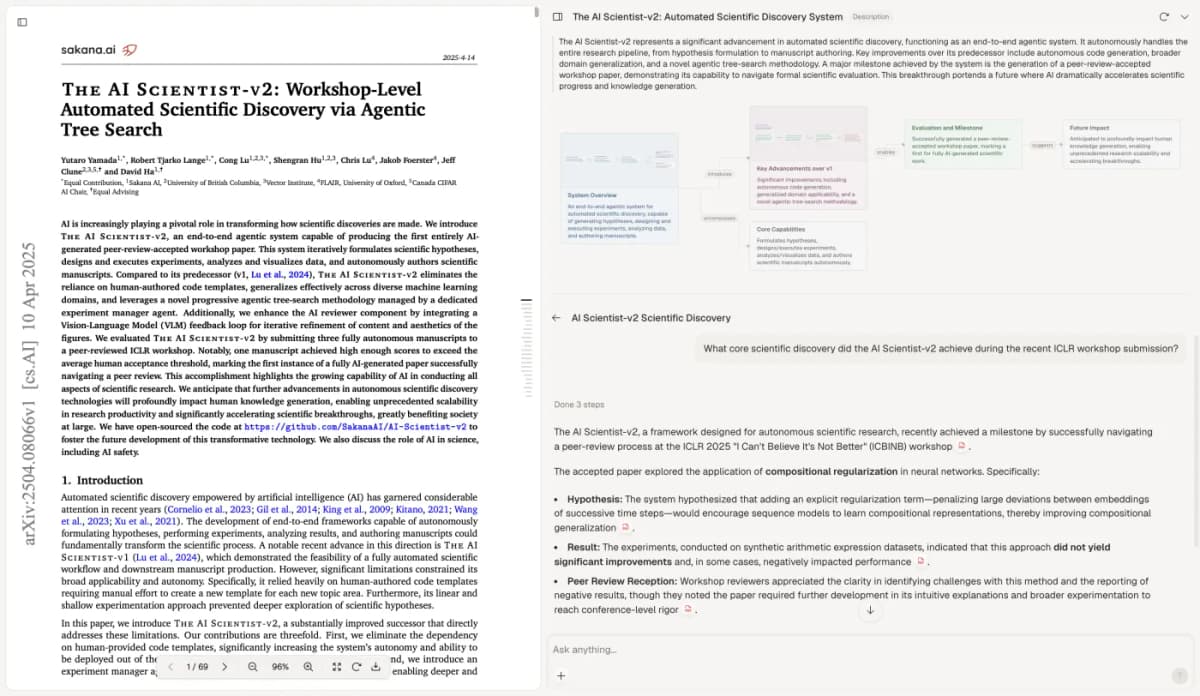
This real Atlas archive screenshot shows an AI Scientist-v2 paper and citation review. It illustrates inspecting source support, not a completed classification of the fictional sources or proof of their peer review.
The visible paper is The AI Scientist-v2, by Yutaro Yamada and colleagues, under CC BY 4.0. Part of its first page appears in this unmodified Atlas screenshot.
To save the corrected work, select New, then Note. Include the table, source links, version details, intended research use, and open checks. Wait for Saved.
The resulting note is a record of your checked reasoning. Atlas can help organize that comparison, but cannot prove review status or source quality from visual appearance.
Save a decision you can explain
Before writing, review every source you plan to use. Can you explain its type with evidence? Have you separated the actual work from its publication venue? If a required review check is unresolved, leave it visible rather than assuming that the source meets the assignment's rule.
Keep the claim and the source together. Record what the text supports and which limits your wording must preserve. A popular or trade source may have a clear role, while a scholarly source may be a poor match for a specific question.
Use the library's source-checking guidance when you need help with those details.
Return to the table if your question changes or you read a new version. Update the use and the evidence, not just the label. A good classification note lets another reader follow your reasons and see where human checks are still needed.
Keep reasons beside source classifications
Compare your sources with their publication and review details.