

A crossover study design gives each person more than one condition in a planned order. In a simple randomized AB/BA study, one group gets A then B. The other gets B then A.
The order matters when you read the paper. A later result may reflect the current condition, time passing or what happened to the person in the first stage.
Penn State's crossover design lesson explains the terms used for this order and timing. Use them to trace what happened before accepting the paper's comparison.
Keep the order, the times and the open questions in a note with links to the source. Another reader should be able to find the text behind each claim.

Check the sequence behind the study
Keep reported methods, source locations and remaining questions together.
Identify the sequence and study periods
The order in which someone gets the conditions is called a sequence. A period is the stage in which one condition is given and measured. AB and BA are two sequences, even though both include A and B.
A parallel-group study keeps people in their assigned groups. A crossover study moves the same people through conditions. Measuring one unchanged condition several times does not, on its own, make a study crossover.
The SAS AB/BA design reference labels responses by sequence and period. Those labels help you tell which result belongs to which stage of the study.
Note what A and B mean, who got each order and when the outcome was measured. The word crossover in a title tells you less than the plan set out in the methods.
Check the reason for crossing over
Why did the authors give the same people both conditions? Comparing each person with themselves can reduce the variation between people. The study also needs them to stay long enough to take part in the relevant stages.
Li and colleagues explain why the paired nature of the design matters. Someone who receives both conditions gives the study two related sets of data. That does not mean the authors used a method that accounts for the link.
Find how the authors chose the order. If everyone got A before B, a change over time is harder to separate from a difference between A and B. The phrase crossed over does not tell you whether the order was chosen at random.
The 2019 CONSORT crossover extension asks authors to explain the design and report the sequence. Use the details in the paper rather than filling a gap with what you expect a trial to do.
The diagram below shows randomization into A–B and B–A sequences across two periods. There is a washout period between them. This is a plan for the study, not proof that the pause removed the first condition's effects.
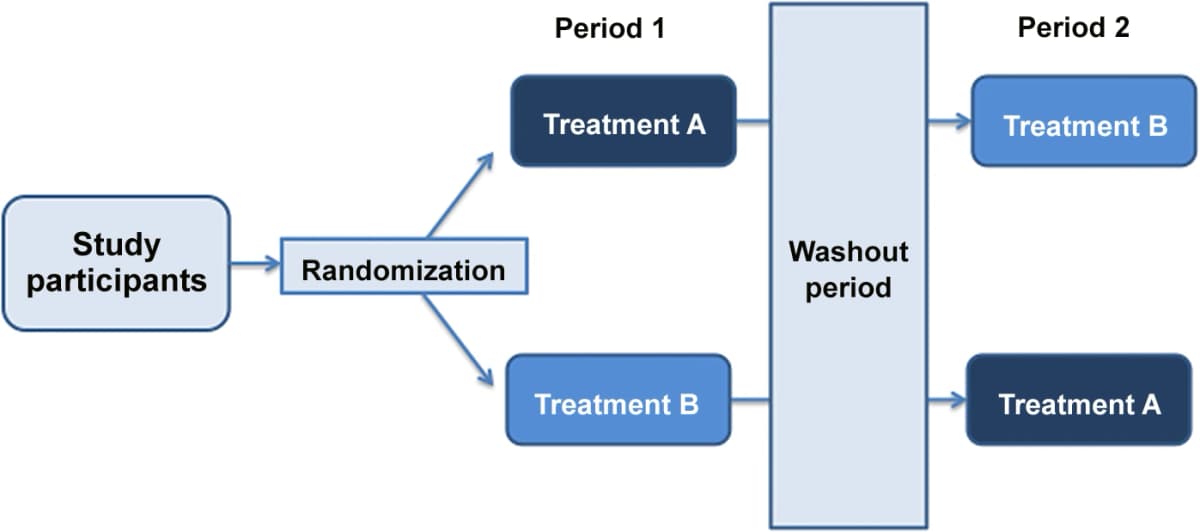
Li, Yu, Hawkins and Dickersin's original crossover diagram, PLOS ONE (2015), CC BY 4.0. Converted to WebP without changing the labels.
Some papers use more conditions or more stages. Follow the order that the authors used. You would lose key details if you forced a longer study into this two-period plan.
Separate period effects from carryover
A result can change because the second stage comes later. People may become used to the task. Their condition may change with time, or the staff may get better at taking a measurement. These are possible period effects.
Carryover means that an earlier condition still affects a later result. It could be a treatment that remains active or a skill learned in the first stage. To distinguish these explanations, look for evidence about what changed and why.
Penn State's methods lesson uses learning to show why a pause may not undo a lasting change. If a paper compares two teaching methods, ask what the first method taught people before they tried the second.
A washout interval puts time between conditions. Record how long it was and why the authors chose it. A stated length is not enough to show that it suited the treatment and outcome. The Cochrane Handbook's crossover guidance discusses when this design fits. A lasting treatment effect may make crossing over unsuitable. Adding a break does not turn a lasting change into a short-lived one.
The carryover-effect guide takes a closer look at residual influence from an earlier condition. Here, keep that question beside the full order, timing and outcome measures.
Build a sequence-period-carryover evidence table
Suppose you are reading a fictional study of two search interfaces. Forty people use interface A and interface B. All counts, times, file labels and pages in this example are invented.
Study Report R, page 2, says that 20 people were assigned at random to AB and 20 to BA. Page 3 describes two 15-minute tasks and a 20-minute break. It gives no reason why the break should remove learning.
Results Appendix S, page 1, says that 38 people finished the second task. It does not show missing data by sequence. A draft note claims that equal group sizes and the break ruled out carryover.
The four rows check that claim against the supplied text. Each one pairs a source passage with what it supports and a question that remains open.
| Check | Reported passage | What it establishes | Remaining check |
|---|---|---|---|
| Sequence | Report R, p. 2: 20 AB and 20 BA, described as randomly assigned | Two reported orders with equal initial allocation | Locate the sequence-generation and allocation details |
| Period | Report R, p. 3: two 15-minute tasks | Reported task duration in each period | Check outcome timing and whether tasks were comparable |
| Carryover | Report R, p. 3: 20-minute break | A reported interval between tasks | Find the rationale for lasting learning or residual effects |
| Missing outcomes | Appendix S, p. 1: 38 second-period completions | Some second-period outcomes are missing | Find counts and reasons by sequence and the analysis approach |
Table 1: This extract describes methods and open questions in a fictional report. It does not rate a real study or estimate an interface effect.
The corrected note says what the files show: two equally sized groups at the start and a break between tasks. The supplied text does not show that learning was removed.
The two missing outcomes also matter. Groups that started with equal numbers may have different numbers in the final analysis. The participant flow and methods used for missing data are needed to answer that question.
Read the analysis and participant flow
Find what the study measured and how the authors compared the results. The same person gives data under both conditions. Check whether the stated analysis accounts for this relationship, and save the source location.
The SAS crossover reference shows how AB/BA data relate to sequence and period. It is a worked method reference. It does not tell you to choose the same test for every type of outcome.
Look for the number of people who gave data at each stage. Two measurements from one person do not make two people. A total number of observations can exceed the number who took part.
Li and colleagues' reporting study explains how missing paired details limit the use of results. In your note, keep the effect estimate, its uncertainty and the authors' stated assumptions together.
Be cautious if a carryover test led the authors to discard the second period. Cochrane warns about this two-stage method. A non-significant test also does not prove that carryover was absent.
The CONSORT checklist guide helps you check the wider trial report, including participant flow and outcomes. The crossover extension adds details for this design. It does not replace the rest of the reporting guidance.
Compare the supplied study sources in Atlas
The source set should include the approved report, supplements and methods guidance. Keeping versions together in your research paper organizer helps you tell which file each note describes.
- Add the permitted files and wait for processing. Mention the report, supplement and guidance with @ in the chat.
- Ask: “Find the stated AB/BA order, task times and reason for the break in Report R. Compare them with Appendix S. Separate stated methods from missing details and cite each passage.”
- Open the citations and read the surrounding text. Check whether it describes the people assigned at the start, those who finished a stage or those included in the analysis.
- Correct claims that go beyond the source. Create a note with New and Note, and wait for Saved.
In this example, an answer might claim that the 20-minute break proved there was no carryover. The report gives the length, but no reason why that length would remove learning. The note needs to preserve that gap.
There is a second trap in the appendix. Its 38 second-task completions do not establish 38 complete pairs. You would need to know who finished both tasks and how the authors used those records.
Atlas helps compare supplied passages and keep a checked note. Researchers decide whether the design fits, choose the analysis and interpret any clinical result. Opening citations does not guarantee that you have found every relevant passage.
Keep the conclusion within the reported evidence
End the note with the order, task times, outcome measures and analysis stated in the paper. List the sources you read and the questions left open. Missing text does not prove that the authors never used a method.
The EQUATOR record lists the 2019 crossover extension and links the general guidance. The current general checklist is CONSORT 2025. Keep the extension's own date and scope when you use it.
A protocol, correction or fuller supplement may later fill a gap. If it does, revise the affected row and note which passage changed your reading of the study.
Before using the results in a review, seek the right methods expertise for unresolved questions about the design, paired data and earlier effects. The table helps you see what needs checking. It does not settle those questions on its own.
Check the sequence behind the study
Keep reported methods, source locations and remaining questions together.