

A data availability statement tells readers where the data behind a paper are held and how they can obtain them. It should name the location, identifier, access route, and any limits on use. The wording must match the data you actually have and the conditions readers will face.
A DOI can lead to a public record while the files remain restricted. A statement that calls those files “open” would be wrong even if the link works. Check the access claim, not just the presence of a link.

Check the access claims in your statement
Compare your manuscript wording with source descriptions and record the gaps.
What the statement needs to tell
Springer Nature's author guidance covers both data you generated and data you reused. Name where the supporting data can be found, include persistent identifiers when available, and explain limits on access or use.
A persistent identifier, such as a DOI or accession number, gives readers a stable way to locate a record. It does not by itself promise that the files are open. The record should explain what it contains and which version supports the paper.
Start with the results in the manuscript and list the data needed to understand them. Under PLOS policy, the minimal dataset includes what is needed to replicate reported findings, with relevant metadata and methods. Other journals may define the scope differently.
Do not choose “no data” just because you collected nothing new. Reused survey data, archived observations, or a text corpus may still support your results. Cambridge's access-statement guide frames the task around the research data supporting the publication.
If your statement relies on a plan for future deposit, check the data management plan separately. A plan says what you intend to do; the manuscript statement must accurately describe the relevant access state under the journal's submission rules.
Choose wording for actual access
For open data, name the dataset, where it is held, and a stable link to the right version. A draft might say, “The data used in this paper are held in the named archive at the dataset link.” Add the real name and link before use.
Open the record and check which files a reader can get. A draft link reserved for peer review may work for an editor but fail once the paper is public.
For restricted data, say why the files cannot be open and how a reader can ask to use them. Name who reviews requests and the rules that apply. Do not promise that all requests will be approved.
For third-party data, name who supplied the files and how others can apply for them. The right to use data in a study may not include the right to share copies. Ask your data steward to check the licence terms.
For mixed access, say which route applies to each part. Tables may be open while interview text needs review. Code may be held elsewhere. One broad claim can hide these differences.
Examples help with phrasing, but they do not decide what you may share. Springer Nature's collection shows several access states. Use checked facts from your own study instead of copying someone else's details.
PLOS guidance requires clear limits and a suitable request contact. The author cannot be the sole named contact under its rules. Check your journal before saying “available on reasonable request.”
A statement is an access claim
A real study by Federer and colleagues, published in 2018, grouped statements from PLOS ONE papers published during 2014–2016. Its figure separates data in papers and supplements, repositories, restricted access, requests, and combined routes.
The largest category in each year was data described as being in the paper and supplemental files. Repository and restricted-access statements were separate categories. These are historical statements about where data were said to be, not a current estimate or proof that every reader could obtain the files.
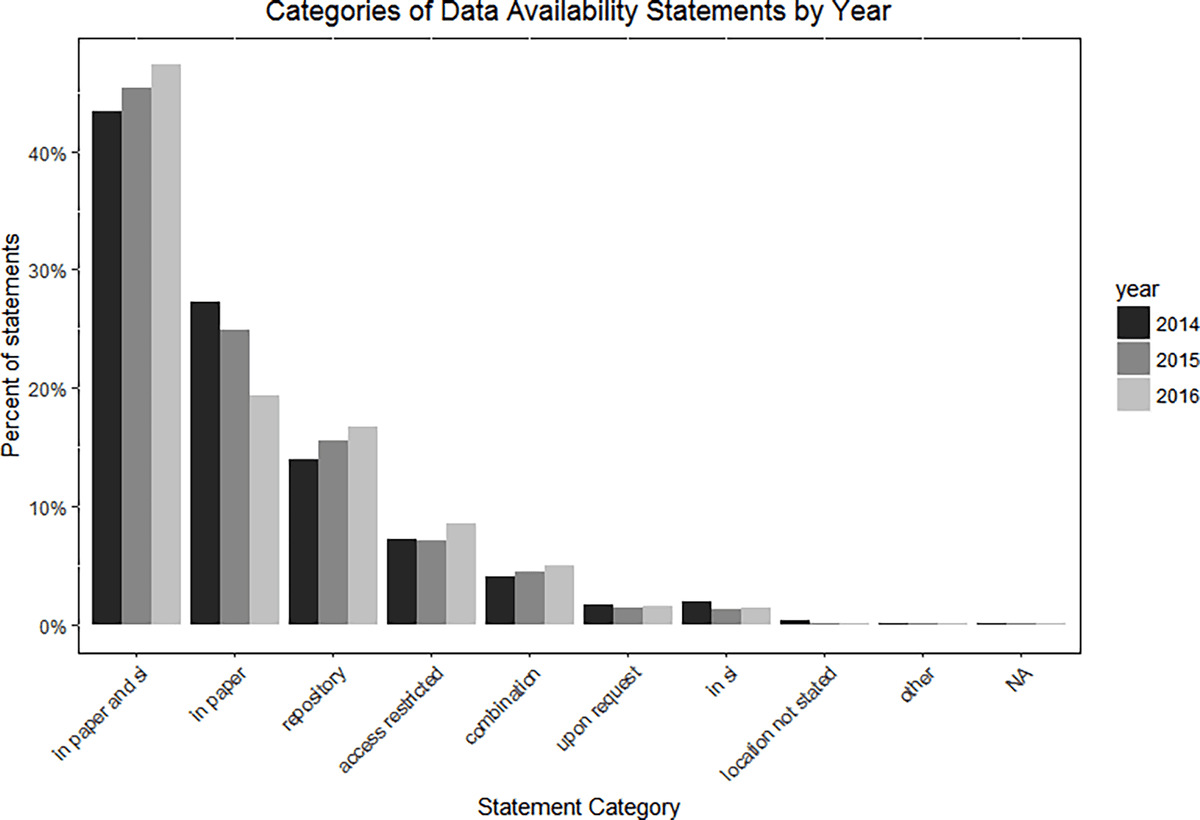
Federer and colleagues (2018), figure 3, CC0. The chart groups 2014–2016 statements by access route; it does not test whether files can be downloaded today.
For your manuscript, the practical lesson is to state which route applies to which data. The FAIR principles guide explains how documentation helps people find and reuse data. It does not turn a controlled dataset into an open one.
A worked mixed-access example
Consider a fictional interview study. Its record D1 describes an open codebook and counts of themes. Its access policy A1 requires review before anyone can read full interview text, which may reveal who took part.
The file list I1 names each part of the study's data. It also records which version was used for the paper. These are invented teaching sources, not a real dataset.
The draft says, “All data are openly available in the repository.” That claim goes beyond D1. The public record links to some open files and a request route for others. Readers cannot freely download the full interviews.
Use a claim check to connect each part of the statement with the actual documented access route.
| Draft claim | Documented condition | Needed correction |
|---|---|---|
| All data are open | D1 opens only codebook and counts | Name the open components |
| Transcripts can be downloaded | A1 requires committee review | Explain request and approval route |
| One record covers all files | I1 distinguishes versions | Name the supporting versions |
Table 1: The check narrows broad availability language to the conditions supported by the packet.
A revised teaching example could read, “The codebook and theme counts are held in the study's public data record. Full interview text is restricted because it could reveal who took part. The university's data access committee reviews requests under the stated rules.”
Before use, add the real link, version and request contact. Authors still need to check consent and sharing rules with the journal and data steward. Southampton's library guide warns that author-only requests may not meet funder rules.
Compare access descriptions in Atlas
Add only the files you may use in Atlas: the draft, record description, file list and access policy. You can check the wording without adding private raw data. Give each source a clear name.
Add the journal's current rules as a separate source. Those rules say what a statement needs; they do not prove that your files meet the rule.
In Ask a question, use @ to select those sources and then Send this comparison request:
Compare the data availability statement with the named record, inventory, access policy and journal instructions. For each availability claim, cite the dataset component, location, version and access condition. Flag claims of open access that describe only public metadata, missing request contacts, and conditions the draft omits.
Open each numbered citation and read the text around it. In the fictional packet, D1 shows that counts are open. A1 describes a review process for full interviews. If Atlas calls all files open, correct the claim.
Select New, then Note, and save the checked claim map with its sources. Wait for Saved. Keep the open questions beside the draft so a later edit does not turn them into firm claims.
This checks the descriptions you supplied. It does not test access to private files or grant the right to share them. Ask the authors and data steward to confirm the real route before using the text.
Check the reader route before submission
Open each public link as an outside reader would. Check the record, version and files you may download. For restricted files, ask the data steward to confirm the request steps and contact.
Ask your coauthors to compare the text with the paper's results. Open files may still lack the data needed to support a claim. If you used simple random sampling, the study notes should explain how the sample was drawn too.
Recheck the policy for the journal you chose. The PLOS rules apply to PLOS; another journal may ask for different details. Resolve missing links and access terms under that journal's process before the paper is published.
Check the access claims in your statement
Compare your manuscript wording with source descriptions and record the gaps.