

Deductive research starts from a theory or claim and checks what follows from it against data. Inductive research starts from observations and develops a broader account of the patterns. The key difference is the direction of reasoning, not whether the paper uses numbers or interviews.
When you compare studies, trace that direction through the source. A theory cited in the introduction may guide the work, but its presence alone does not show that the authors tested a prediction derived from it.
Scribbr's research approach guide gives the common theory-to-data and data-to-theory distinction. Use that starting point, then read the actual methods and timing.
Keep the starting claim, the work with data and the final claim together in your note. If the paper skips a step, name the gap so you can return to it when more sources are available.

Trace the claim back to the study
Compare the starting question, data and conclusion with their source passages.
Trace theory and data in the study
In deductive research, a theory gives the team a claim to test. They state what they expect to find and choose data that can test it. Even if the result fits, it does not prove the whole theory true.
In inductive research, the team looks at what they have seen and builds an account of the patterns. It may give them a new question to test later. What they can claim still depends on whom they studied, where and with what evidence.
Blackstone's sociology methods chapter explains both routes and how they can work together. The same project may develop an idea in one phase and test an implication in another.
Your note should state which step it describes. A team can start from theory, test a claim and then try to explain a result it did not expect. One label for the whole paper may hide those shifts.
Find the starting claim and its timing
For a possible deductive study, find the theory and the prediction drawn from it. How does the prediction relate to the question? Which outcome would challenge it? Keep the source location beside the claim.
The theoretical-framework guide helps when your task is to explain why an established theory fits the question. Here, the next check is how a selected paper used that theory with data.
For a possible inductive study, look for how the authors began examining the material. The paper should explain how patterns or ideas were developed, including what changed as they read more of the evidence.
The method named by the authors tells you what they planned. Their account of the work shows what they did. If those differ, keep both in the note and explain why you see a gap.
For a claimed test, find when the authors set out what they expected. Did it come before they saw the result, or after? A finished paper can tell a smooth story that leaves the order of those steps unclear.
Nosek and colleagues distinguish generating an explanation from known data and testing a prediction with new evidence. A protocol or dated plan can help you trace that distinction; it does not guarantee a good test.
Avoid matching reasoning to data type
Interviews can be read against concepts drawn from an existing theory. Numbers can reveal an unexpected pattern that prompts a new explanation. Do not infer the direction of reasoning solely from the form of the data.
Nina Baur's methods paper challenges the simple pairing of qualitative work with induction and quantitative work with deduction. Her discussion also describes shifts between forms of reasoning during a project.
The figure below uses arrows to show a path from data to theory and a path from theory to data, alongside abduction. Baur uses the existing/new theory labels for her own account. They do not give you a rule that fits every study.
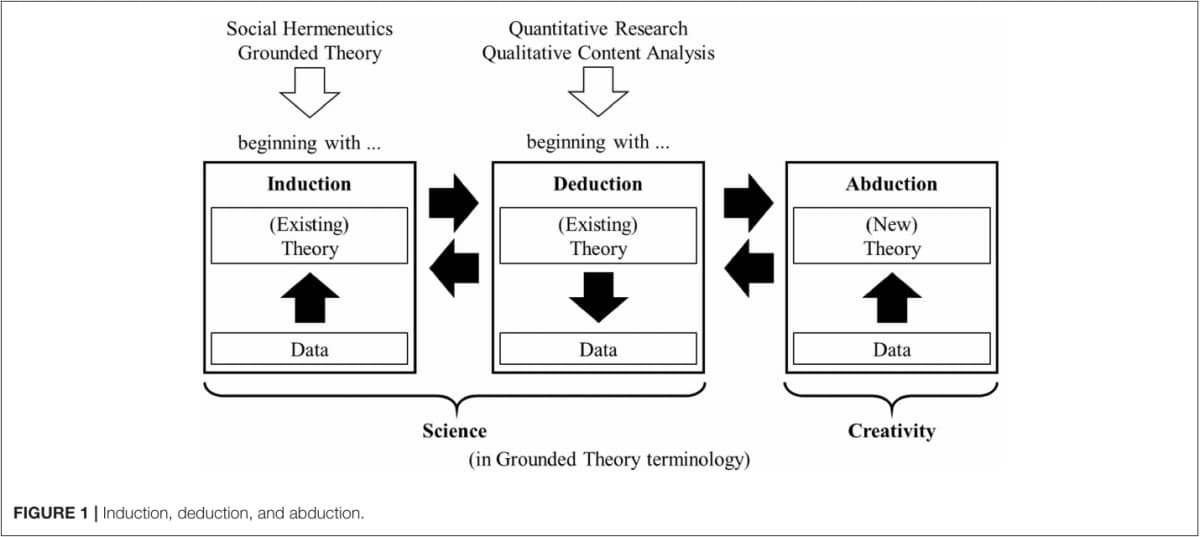
Nina Baur's original Figure 1, Frontiers in Education (2019), CC BY 4.0. Cropped from the source PDF with its full labels and caption retained.
Baur distinguishes fitting data to an existing theory from inventing a new explanation, which she calls abduction. Many introductory guides use induction more broadly for developing theory. Read a paper's own definitions before treating those labels as interchangeable.
The OpenStax account of inference also distinguishes a deductive argument's logical validity from the truth of its premises. In an empirical study, the quality of the measures and design still matters when testing an implication.
Build a theory-observation comparison note
Suppose you are reading two fictional campus studies about why students leave a study room. All paper labels, claims and pages below are invented. The table shows how to read the sources; it does not present real findings.
Paper A, page 2, draws on a prior model of access and predicts that later closing hours will be linked to more visits. Page 4 describes a planned survey measure. Page 7 reports that the expected pattern was weak.
Paper B, page 3, begins with open accounts of recent visits. Page 5 describes comparing passages about crowding and quiet. Page 8 proposes that control over the room may help explain why some students left.
A draft note calls A inductive because the result was unexpected and B deductive because its discussion cites a theory. Those claims skip the steps that the papers describe.
| Source check | Located statement | Reasoning direction | Limit to keep |
|---|---|---|---|
| A, p. 2 | A prior model leads to a prediction about hours and visits | Theory toward a claim to test | Confirm when the prediction and measure were set |
| A, pp. 4 and 7 | The survey examines the prediction and finds a weak pattern | A stated test does not become inductive just because it disappoints | Check measures, sample and the reported analysis |
| B, pp. 3 and 5 | Open visit accounts are compared for patterns | Observations toward a broader account | Inspect how the authors challenged their reading |
| B, p. 8 | Room control is proposed as an explanation and related to prior work | Developing an account, then relating it to theory | A discussion citation does not establish a prior test |
Table 1: This comparison keeps each study's stated starting point separate from its result and later discussion.
The corrected note keeps A's test and B's work toward an account distinct. If A then asks why the result did not fit, that is a further step. The new question does not change what the authors did in the earlier test.
B's idea comes from the accounts that the team read. It gives them something to explore next. To claim that all students leave for this reason, they would need evidence beyond those accounts.
Check what the conclusion can support
Deductive logic and a test with data do different work. A valid argument gives a true conclusion if its starting premises are true. A study also needs sound measures and evidence. You still have to check how the team gathered and used the data.
OpenStax explains that distinction. A logical chain can be soundly structured while a premise about the world needs further checking.
An inductive account goes beyond the observations used to form it. Scribbr notes that more observations do not make every future case certain. Keep the setting and exceptions visible when describing the reach of a claim.
Blackstone's chapter shows that the approaches can complement each other. Developing an idea and then testing it can deepen the work, provided the report makes clear which evidence served which purpose.
The qualitative-research-design guide helps with the wider choice of design, access and method. The reasoning-direction note has a narrower job: tracing how these selected papers moved between a claim and evidence.
Compare the study passages in Atlas
The files should include the approved papers and any plans that explain how the work began. A research paper organizer helps keep the versions together so you can tell which claim belongs to which file.
- Add the approved files and wait for processing. Mention Papers A and B with @ in the chat.
- Ask: “Locate each paper's starting theory or question, how it used observations and the conclusion it drew. Cite the passages. Distinguish a prediction set before the results from an explanation proposed afterward.”
- Open each citation and inspect the methods as well as the surrounding claim. Check whether the answer inferred timing that the source never states.
- Correct the comparison, create a note with New and Note, and wait for Saved.
In the fictional case, an answer might label B deductive just because it names a theory on page 8. The earlier passages instead describe comparing open accounts before proposing an explanation. The note should preserve that order.
The answer may also claim that A's prediction was preregistered. Unless a supplied plan or report establishes that fact, the correct entry is that the timing needs checking.
Atlas helps compare supplied passages and save a checked note. Researchers decide how to read the methods and what the claims can support. The citations give you text to inspect, but they do not guarantee that you can trace every step the team took.
Report the direction without overstating certainty
End with the starting point, the use of data and any later change in reasoning. Link those steps to the source. If you cannot tell when a claim was made or how it was tested, keep that question open.
Nosek and colleagues' methods paper explains why presenting a later explanation as an earlier prediction can overstate the evidence. Exploratory work remains useful when its role is described honestly.
A plan or fuller supplement may later change your reading. Revise the step it affects and show what the new text adds. The note should give another reader enough evidence to challenge the label you chose.
Trace the claim back to the study
Compare the starting question, data and conclusion with their source passages.