

Descriptive research aims to give a clear account of a defined phenomenon. Start with what you want to describe, who or what the study concerns, and which observations could answer the question. The word descriptive does not settle those choices for you.
A plan to describe students' source-finding habits needs more than a survey link. It needs a clear meaning for habits, a way to reach the intended students, and a limit on what their answers can show.
The example below is a fictional study plan, with no participants or results. It shows how to check those links before collection. Atlas can help compare supplied plans and background papers while you retain the decisions about the study.

Keep descriptive claims within the evidence
Compare a study plan with sources and save a checked scope note.
Define the descriptive aim
Descriptive research gives an account of what you study in a stated setting. You might ask how often an event takes place or which tools people use. The Scribbr guide sets out several ways to gather data for that aim.
The question should make the intended account clear. “Which sources do these students report using for their last assignment?” asks about reported use. “How skilled are these students at finding reliable evidence?” asks about ability, which the same answers may not measure.
You can use counts, written accounts, or both, if they fit the question. The EBSCO entry covers these approaches. Counts might show which tools people name. Their written answers might tell you how they chose those tools.
Qualitative description still requires you to make sense of the words. Sandelowski's paper sets out an approach close to how people speak about their lives. You must decide how to group the answers and explain those choices.
Connect the question to the observations
Use the following sequence to expose gaps in a proposed study. Each step should leave a decision that a reader can inspect. A broad method label cannot supply the missing detail about whom you reach or what you observe.
-
Name the question. State the characteristic, experience, or pattern you want to describe. Keep it narrow enough that you can identify the evidence needed. If two questions require different observations, give them separate treatment in the plan.
-
Define the intended population. Say who or what belongs, where, and during which period. Statistics Canada's sampling guide distinguishes the population of interest from the population available to a survey. Record any gap between those groups.
-
Specify the phenomenon. Explain what a key term means here. Finding a paper could mean searching for a title, choosing a source, getting full text, or checking a claim. Decide which action your question covers before asking people about it.
-
Choose evidence that fits. A questionnaire, observed task, or existing record can provide different views. The Scribbr overview describes several collection options. State why your chosen material answers this question, rather than listing every available method.
-
Fix the unit and period. Identify what one record represents and when its content applies. The sampling guide distinguishes several units. A person answering questions, an assignment described, and a resource selected are different objects to count.
-
Bound the intended claim. Write a sentence you could support if collection went as planned. Then mark what remains uncertain. Review survey coverage and selection questions before promising that a reached group represents everyone you named.
Keep these decisions linked to the sources that informed them. A literature review process can help establish what earlier studies measured.
You still need to explain whether their definitions fit your setting and question.
Worked study-plan example
Imagine a study at the made-up Eastmere College. The plan is to ask first-year students who commute how they found papers for their last class task. They can choose to take part in a survey.
Check who the invitation can reach
The survey link would be on a QR poster in the library in the evening, in term weeks three to six. Think about who might see it. Students who never use the library could be missed before anyone answers a question.
The draft question is: “What ways of finding papers do students who answer say they used for their last class task?” It names an action and the evidence source. It does not measure skill or describe every first-year student who commutes.
The table is an original plan review. It contains no collected responses, tested questions, or estimates.
| Part of the plan | Proposed evidence | Boundary to resolve |
|---|---|---|
| People of interest | First-year commuter students invited through an evening library poster | The invitation may miss nonusers and students absent at those hours; coverage and self-selection remain open. |
| Source-finding habits | Answers about ways used for the last assignment | These are reports of use, not direct observations of skill or search activity. |
| Observations to summarize | One response record per student, with several resource choices allowed | State how duplicate records, skipped questions, the reference assignment, and multiple selections will be handled. |
Table 1: The map shows which parts of the proposed report depend on decisions the researcher has not resolved.
Repair the promised claim
Suppose the draft proposal promises: “This study will show that all commuter students lack reliable papers because library access is poor.” That sentence contains a population claim, a judgment about reliability, and a causal explanation. The proposed questions do not support that package.
A narrower planning sentence is: “The survey will describe what those who take part say about finding papers for their last class task in the stated term weeks.” This states the aim. No results exist yet, and the reach of any findings remains open.
If you ask why people chose a source, keep their answers as stated reasons. Sandelowski explains how to retain meaning. Someone might say a shared link was easy to use. That tells you about the choice they describe. It does not prove that poor access caused a pattern for all students. Keep the claim tied to who said it and what they meant by access.
The poster may still be useful for a bounded exploratory account. The problem arises when the report silently changes the reached group into the whole population. Survey guidance on frames and response helps locate that gap; it does not certify this fictional plan.
If the actual goal is to assess skill, revisit the question and evidence before fieldwork. A different task or measure may be needed. Adding the word descriptive to a proposal does not make a self-report measure the same thing as demonstrated ability.
Keep aim method and claim distinct
A descriptive aim allows different methods
A survey is a way to ask people questions. Descriptive names the aim of the account you plan to write. The methods guide also covers watching events and studying cases. Choose how to gather data through the question and what you can access.
In the example, asking about the last assignment can reveal remembered source use. Watching a search task could reveal what happens during that task.
Neither should be written as the other. Describe which view your material actually provides.
This distinction also matters when reading papers. Two studies may call themselves descriptive while using very different evidence. A source synthesis should keep those differences visible before grouping their findings together.
Timing does not settle the purpose
A study may collect material at one point or follow changes over time. That timing is a design choice. It does not, on its own, show whether the research aims to describe a pattern or test an explanation for it.
For the college plan, the invitation period and the assignment being recalled need separate definitions. Someone answering in week six may be describing work done earlier. Sampling guidance includes a reference period when specifying the population under study.
If a later round is added, record whether the same people answer again or a new group responds.
A difference between rounds could reflect a change in who responded. It should not automatically become a claim that each student's habits changed.
Description does not establish a causal effect
The example could describe sources named, problems people report, or reasons they give for a choice. A causal claim asks what made something happen. Seeing a pattern in these answers is not enough to show that one thing caused another.
Keep the source of each reason visible. “Respondents said access was difficult” identifies an account. “Poor access caused low research skill” adds both a measured outcome and a causal link that the fictional plan has not established.
Keep the meaning of people's accounts, too. Sandelowski explains this part of description. You can make sense of what people say and explain how you reached that reading. Their stories can be worth studying even when they do not prove a cause.
Plan what the data will mean
Write down how you will read and group the data before you gather it. In this plan, decide whether a database, a search engine, and a friend's shared link are separate choices. Check that the question asks about the action each group is meant to describe.
The survey guide covers how to word and test questions. Review a draft question even when its words seem clear to you. A student may read “find a paper” as getting full text, while you mean searching for a title.
Plan missing-answer treatment and state the base for each summary. The survey guide also addresses response. A skipped question is not a report of no use. If several resources can be selected, those selections are not the same count as the number of people who answered.
For written answers, keep the source words and explain how you grouped them. Sandelowski's approach stays close to meaning. Keep a less common view visible when it changes how a group should be read. A neat label can hide a real difference.
The method should leave a record of your choices and the evidence behind them. You cannot know every answer in advance, so keep changes made once you see the data and explain why you made them. Readers need to see the difference between what you planned and what you did.
Review a supplied descriptive plan in Atlas
Use Atlas to review material you are permitted to add. Suitable sources include the proposal, relevant background papers, and a draft scope note. The product review concerns those supplied texts; it does not perform the planned survey or approve the method.
-
Prepare the source set. Add the plan and relevant methods material, then wait for processing. Keep source names clear enough to distinguish the proposal from a published finding. A methods paper supplies guidance, not data from your proposed participants.
-
Select the sources with @. Choose the processed plan and guidance for a focused question. Ask which population, phenomenon, period, and observations the plan names. Request explicit separation of stated decisions from unresolved ones.
-
Ask about one claim. For this example, ask whether the proposed poster and questions support the promise about all commuter students. Request the relevant passages from the plan and guidance, with the remaining coverage and measurement questions kept open.
-
Inspect citations. Open a numbered citation and read the target passage with nearby text. If the view does not land on the exact passage, locate it in the source. Use an AI citation check to keep support review explicit.
-
Correct the note. Remove claims that the method has been validated, respondents represent everyone, or causes have been established. Preserve the proposed reference period and self-report boundary. Your correction should match the sources, rather than merely sound more cautious.
-
Save the checked decisions. Choose New, then Note, and wait for Saved. Keep the question, evidence type, unresolved design choices, and citation links together. Revisit that note when the plan changes or actual collection differs from what was intended.
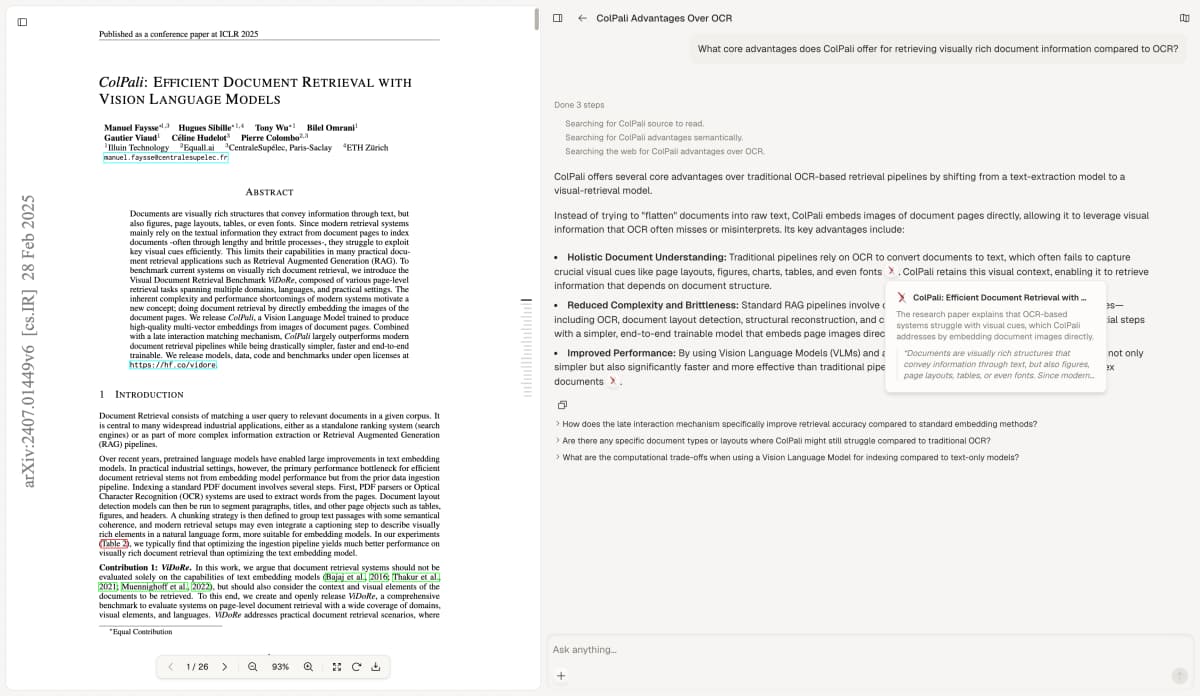
Atlas citation capture showing ColPali by Manuel Faysse and colleagues (2025), released under CC0 1.0. No paper content was edited. The image illustrates source inspection, not a product review or execution of the fictional student study.
Atlas can help compare the supplied passages and retain a corrected note. You remain responsible for research ethics, access, sampling, measures, analysis, and the claims made from the evidence.
A cited response does not settle those decisions for you.
Write the scope before the findings
Finish the plan with a short statement of what will be described, for whom, where, and during which period. Name the evidence source and its main boundary. The scope-of-the-study guide helps turn those decisions into a clear written account.
After collection, revise that statement around what actually happened. Keep the intended group separate from the reached and responding groups. The survey authority's coverage questions remain useful when reviewing how far a final claim can extend.
For this made-up plan, first decide who will see the link, what each question means, what you will count, and which class task people should recall. Do that before calling the study ready. A guessed figure cannot fill those gaps.
Keep the final descriptive account traceable to its observations. Readers should be able to see what was reported, what you inferred from it, and what remains unknown. That makes the description useful without asking it to carry claims the study has not supported.
Keep descriptive claims within the evidence
Compare a study plan with sources and save a checked scope note.