

A field experiment introduces a planned change in a real-world setting. To read one well, check what people did, where they did it, how the change was delivered, and how the outcome was recorded.
A hotel message tested during guests' stays differs from a hotel video shown in an online survey. Both can test a message, but they support different accounts of the task and outcome.
The worked note below compares published methods. Use Atlas to inspect cited context and save a checked note. Researchers still conduct fieldwork, analyze data, and judge what caused the findings.

Check field context in Atlas
Compare study settings and save a checked context-and-control note.
What makes a study a field experiment
A field experiment tests a planned change in a real-world setting. The change might be a message, task, rule, or service. Read who made the change and who received it before naming the study type.
Watching hotel guests' habits is a form of observation. Changing a message in their rooms gives researchers a contrast to test. The University of Chicago explainer describes this kind of planned change where people go about their daily lives.
Place is only part of the context. In their original field-experiment framework, Harrison and List name six factors: who takes part, what they already know, the good being studied, task rules, stakes, and the setting. A staged task outside a lab may still differ from daily life in what people stand to gain or lose.
Read the methods to find what was tested. A study can tell you about how people view a message while leaving open whether they act on it. Keep that limit with your account of the task.
Set context-and-control review criteria
Begin with a focused question: What changed in this setting, and what was it compared with? Your research objectives guide which details you need.
Find the exact study within each paper and read its methods. Check any linked plan and later corrections, too. The hotel paper has a publisher correction notice about restored chi and phi symbols. Use the corrected source in your review.
Use these criteria for the note:
- People and place: Who took part, and where did they do the task?
- Change: What was added, removed, or altered?
- Placement and timing: Who received each condition, and when?
- Comparison: What did the baseline or other group receive?
- Outcome: Did the team watch what people did or ask what they planned to do?
- Delivery: How did staff carry out the task and keep records?
- Open checks: What detail about the setting or tasks remains unclear?
Use your literature review process to keep your source choices and versions with the note. The table below uses two chosen papers to show how the review works.
A worked field-context-manipulation-control comparison note
Both papers test messages about towel reuse. Read their methods before assuming that the shared topic means they tested the same task.
Each row keeps the setting, change, and control together. The last column gives a limit to keep in view when you describe the study.
| Source and passage | Setting and change | Comparison or delivery | Checked note |
|---|---|---|---|
| Bohner and Schlüter, Study 1, Materials | Real hotel bathrooms received five towel-reuse messages | Standard environmental appeal compared with norm messages | An active message comparison, with towel placement recorded by housekeeping |
| Same study, Design | Messages changed by floor and week | Each message appeared on each floor for one week | Keep floor-week rotation visible. Do not rewrite it as individual random assignment |
| Same paper, Study 2, Design | Second hotel added a no-message week before intervention | Five message conditions followed the baseline week | Baseline preceded intervention. It was not a concurrent no-message group |
| Ekelund and Bergquist, Experiment 1, Materials and procedure | Online participants imagined a hotel stay and watched a message video | Random assignment to five appeals | Outcome was intention to reuse. Actual placement during a stay remained unobserved |
Table 1: The rows keep the task, its control, and the later outcome distinct so you can see what each study tested.
Use the note to compare methods. A full bias review or pooled result needs further work. Read each cited section before using a row in your own review.
Keep actual behavior and intentions distinct
Suppose a first note says, "The online study observed guests reusing towels." That claim changes both who took part and what was tested.
The online paper's procedure asks people to imagine the stay. Correct the note to say that it tested video appeals and asked whether people planned to reuse towels. The replies tell you about their intentions. They do not show what guests did during a stay.
The hotel paper used towel placement recorded during stays as its outcome. Keep that rule in the note. A broad claim about habits would lose the concrete detail of what staff saw and counted.
Both actions and plans can answer research questions. Give them distinct names so the reader can see what was tested. Before comparing studies, ask whether each outcome, task, and setting fits your question.
This helps you see what to do next. If you need to know how people act in a new setting, a study of their plans may help while leaving that field outcome untested.
Check timing, staff, and spillover
Keep the baseline's time visible
A second error would be to call the earlier no-message week a concurrent control. That means a control used at the same time, which the source does not describe.
The Study 2 design passage places the baseline before the message period. Keep that order in the table and ask what else might have changed over time. Leave it as a review question unless a source names an event and supports a claim about its effect.
Keep the standard message distinct from no message. One active appeal can be the control for another. Leaving it out of the note would change the question being tested.
Review who delivered and recorded it
Staff can affect how a task is delivered and counted. The hotel paper describes housekeeping records and says staff knew about the messages but were unaware of the hypotheses. Keep both facts in the note. They do not support a broad claim that all parts of the study were blinded.
The psychology methods textbook explains how staff can give different instructions or treat groups differently. Read the field study's instructions, routines, and records to check how the team kept these steps alike.
Spillover means a condition affects units beyond those assigned to it. Shared staff or contact between guests could create a route to check. Contamination can occur when a control group gets part of a task it was meant to avoid.
Keep possible routes as review questions:
- Could people see another group's message or discuss it together?
- Did shared staff carry a changed routine into other conditions?
- Could the same person enter more than one condition over time?
- Does the method describe how such exposure was handled?
Take these questions back to the protocol and study records. They do not show that contamination took place in these hotel studies. Where the source is silent, leave the gap open.
Bound what the setting can support
A field setting gives context to a finding. It does not show on its own that the result applies to every hotel, school, workplace, or date. Keep the people, task, local routines, and stakes with the outcome.
Harrison and List's context factors help you describe those details. John List's discussion of scale in the university explainer asks whether constraints change when a study grows.
Use the scope of the study guide to state how far your review reaches. Here, two chosen papers show method differences. They leave open which message would work best in your setting.
Check whether people knew they were taking part. Some field studies tell them, while others use different arrangements. The label alone does not settle consent, privacy, or whether the conduct was sound. Read the source account and leave ethics judgments with the relevant reviewers.
Review field context in Atlas
Add permitted papers and protocols to the project. Name the experiment sections you need so that rows do not mix methods from different studies.
- Start a chat in the project. In Ask a question, type @ and select the sources you want to compare.
- Choose Project only beside + to bound new retrieval to the project. Earlier chat context remains available, so state which sources the note should use.
- Ask: "Compare the setting, people, changed task, group placement, timing, control task, and outcome in these methods. Cite each row. Keep possible spillover and missing detail as open checks." Select Send.
- Open the citations for claims you need. Read the cited passage and surrounding text. PDF citations can open a precise passage when its location is known. Find the section by name if needed.
- Correct any row that turns intentions into observed behavior or a prior baseline into a concurrent control. Keep the source support with the revised claim.
- Select New, then Note. Save the checked comparison and remaining questions. Wait for Saved before closing it.
The first-party capture below shows an answer beside a PDF with a source preview. Its visible ColPali paper is unrelated to the hotel examples. It illustrates inspecting source context, without showing a field experiment or testing the accuracy of these methods rows.
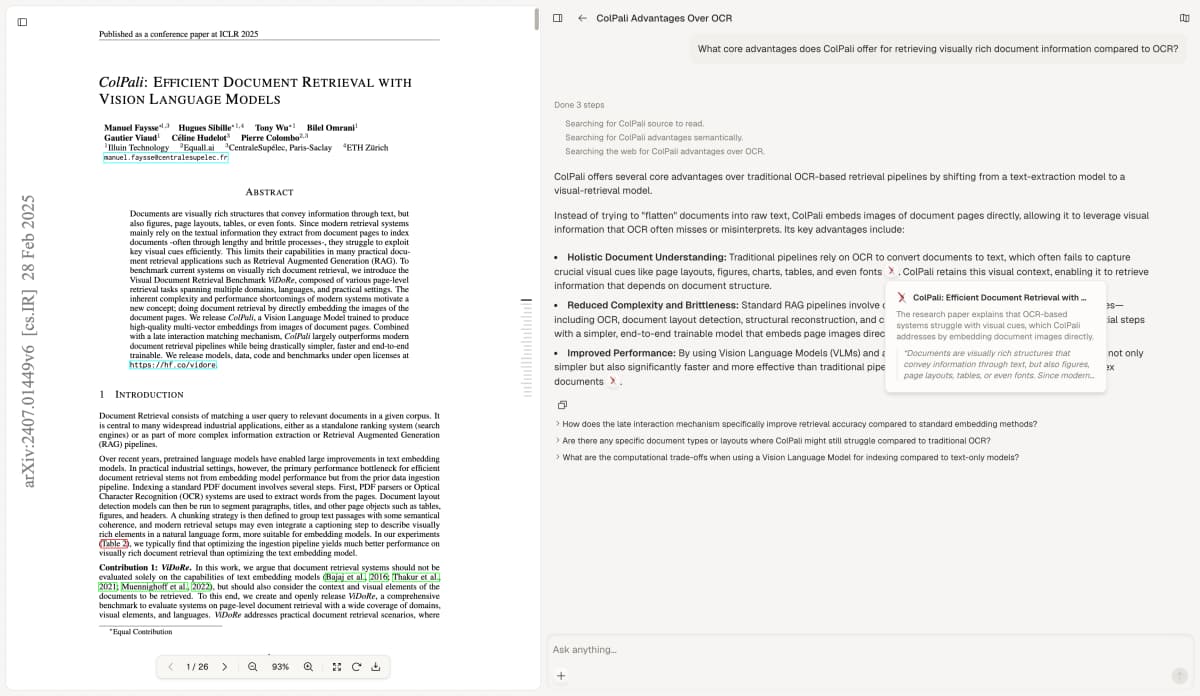
Inspect the cited source and surrounding text before accepting a row in the context-and-control note.
The visible paper is ColPali by Manuel Faysse and colleagues, 2025, released under CC0 1.0. The existing screenshot is reused without changes to its pixels.
Save the evidence and open checks
Keep source versions, study names, method sections, tasks, outcomes, dates, and revised claims in research notes you can revisit. State which details come from the paper and which are questions your review raises.
For example, keep the prior-week baseline as a fact and changes over time as an open check. Leave shared-staff exposure as a question unless a source records it. The next reader can then see what is known and what still needs work.
When a protocol or author response arrives, reopen the row and read the new support. Revise the note with the evidence that changed it. Researchers can use that checked account in further review to judge cause and effect and how far the finding might apply.
Check field context in Atlas
Compare study settings and save a checked context-and-control note.