

Hermeneutic phenomenology studies what lived experience means through careful interpretation. It asks how a person lives through an event in their own world. It also asks how the researcher's history and prior views affect the reading.
Begin with the experience you want to understand. Choose an approach that fits your question. Read each account in context. Keep the passage, your reading and its grounds together, alongside your prior assumptions.

Compare your reading with its source context
Keep the passage, proposed meaning and your reflexive revision together.
Understand the interpretive approach
A study of entering a place for the first time asks what that experience means. Counts of visits and lists of likes or dislikes cannot tell the whole story. You need to explore how the event is lived, including details a person may take for granted.
Phenomenology Online's account of the tradition highlights how people understand through language, prior views and tradition. Heidegger, Gadamer and Ricoeur are major figures, with different emphases. Name the stance your study takes and explain how it guides the work.
Laverty's comparison reviews Husserl's approach and those of Heidegger and Gadamer. These traditions change over time. Their labels cannot reduce the choice to describing facts on one side and freely inventing meanings on the other.
The working note below keeps one reading and its grounds together. You still need to engage with the philosophy that guides your study. If you have yet to choose an approach, use a qualitative research design to examine what fits the question. A process borrowed from another tradition may rest on different ideas.
Move between the passage and its context
A short passage gains meaning from the whole account. A small detail can also change your view of that account. The hermeneutic circle names this movement between parts and whole as you come to understand the text.
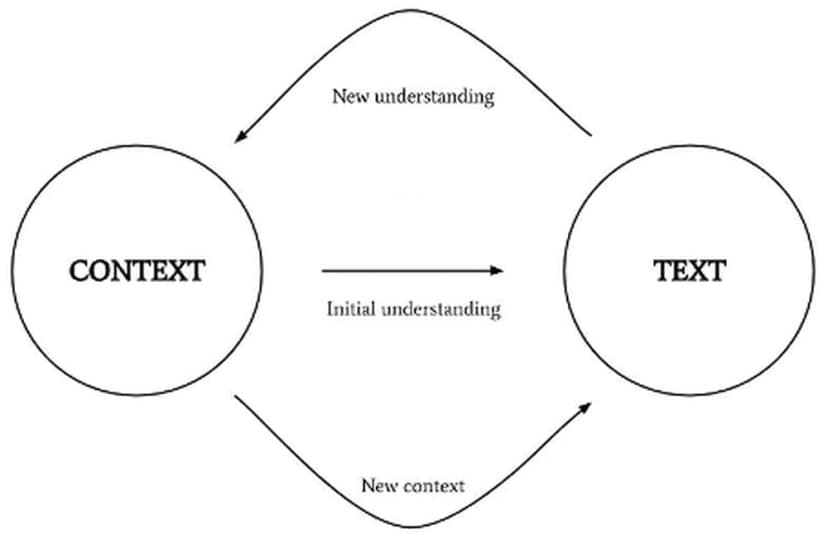
DukeLondon's Hermeneautic Circle diagram, with the whitespace crop by Chiswick Chap, CC BY-SA 4.0. Resized and converted to WebP. This simple illustration shows context and text informing one another.

The diagram connects Context and Text. A straight arrow gives the Initial understanding, while curved arrows show New understanding and New context.
For a transcript, context includes the nearby lines and the person's situation. Read a passage, return to that context and see whether your first reading changes. The picture helps you follow this exchange. You still need to learn the philosophy and use your judgment to conduct the study.
Alsaigh and Coyne's Gadamer-informed framework moves between the person's words, the researcher's reading and the whole text. It offers one route grounded in Gadamer's philosophy. If you use it, explain why it fits your study. Other approaches can take different routes.
Keep a record of changes in understanding. If a later part of an account challenges an early reading, retain both the first idea and the reason you changed it. A tidy final theme should not hide that work.
Examine what you bring to the reading
Your own history matters when you read an account. Your work, language, role and past can draw your eye to some details and away from others. Reflexivity means asking how these influences affect your reading as you conduct the study.
Phenomenology Online's discussion of hermeneutic reduction describes examining prior views through writing. In your note, name a view you brought to the passage. Explain why it matters here and how the text leads you to question it.
For example, a researcher who enjoys quiet reading rooms might initially see silence as welcoming. An account of the same room may connect silence with uncertainty about whom to ask for help. The researcher needs to question that first reading, without assuming that silence has one meaning for all visitors.
Ho and colleagues' discussion of reflexivity proposes a circle grounded in Heidegger's ideas of Being and time. The authors give it as one possible path, which still requires knowledge of the philosophy.
A diary of how you felt during the study leaves a further question: how did your prior views affect this reading?
Keep that reflection beside your reading. A background statement can explain your position. Then show how it affected a choice in the study. Describe what you first noticed, what you missed and which passage led you to change the claim.
Build an interpretation-context-reflexivity note
The following excerpt is fictional teaching material. It comes from no participant, interview or product test. Imagine a study asking what it is like to enter a university reading room for the first time.
I stopped by the door. Everyone seemed to know where to go, so I waited until someone looked up.
For this invented account, suppose the preceding lines describe a first visit and the next lines describe a staff member offering directions. Use those details when comparing possible readings. The line about waiting can support more than one initial idea, but the surrounding text helps you assess them.
| Note part | Entry for the fictional account | What to check |
|---|---|---|
| Passage and location | Account A, lines 12–14, about stopping at the door and waiting. | Keep the exact words and nearby lines available. |
| Context | First visit to the room, followed by an offer of directions. | Read the whole account for details about familiarity, welcome and finding one's way. |
| Interpretation | Waiting may reflect uncertainty about how to enter a shared space. | Explain how the doorway, other visitors and offer of help support this reading. |
| Reflexivity and revision | The researcher first assumed the quiet room felt welcoming. The account prompts a closer look at how the visitor finds a place within it. | Record why the first assumption changed and what other readings remain possible. |
Table 1: An early note might call the visitor unwilling to take part. That claim adds a motive the excerpt does not establish. Waiting could involve uncertainty, politeness or another concern.
The surrounding invented details favor a reading about finding one's way, but they do not prove an enduring personal trait.
A revised note can say that the doorway becomes a point at which entry depends on a sign from another person. Keep the words and context that support this reading beside it. Treat it as a reasoned interpretation of this fictional account, open to further challenge.
This short exercise leaves much of a real study's work still to do. Such a study would engage more deeply with its accounts and chosen philosophy.
Crowther and Thomson's interpretive guide links deeper readings with knowledge of the philosophy and repeated reflective work. Give that depth to a larger claim before naming it with an abstract label.
Develop meanings without forcing a theme
Read each account closely before looking for shared meanings. What matters in one account may have a different meaning in another. Preserve those differences as you return to the study's question.
Fuster's methodological discussion describes whole-text, selective and detailed readings. Each offers a way to ask what an account reveals about the experience. A phrase can draw your attention, but its frequency alone cannot decide its significance.
In the fictional example, the doorway could lead you to think about space, waiting and being among others. Before naming a theme, return to the account. Does your writing help the reader understand how entry is lived? Or have you replaced the event with a label broad enough to fit almost any visit?
Use the chosen philosophical concepts to deepen the reading. Crowther and Thomson caution against forcing ideas onto the account and describe an ongoing process of reading, thinking and rewriting.
Write down how a concept helps explain the passage, including the details that resist your first reading.
A disagreement between readers can be useful. Ask each person to show the passage and explain the grounds for their interpretation. You may revise a claim, retain two possibilities or identify a question the material leaves open. Agreement alone does not demonstrate that the reading is sound.
If a later account tells a different story, examine the difference. The same quiet room might feel restful to a regular visitor and hard to enter for a first-time visitor. Do not merge those readings merely because both accounts mention silence.
Compare approved accounts and notes in Atlas
Use accounts and notes only when the study's consent, ethics and data rules allow you to process them here. Leave out details that should not enter the workspace. A name is not the only way to identify someone, so check the context too.
Add the approved, processed accounts, your reflections and method guides to Atlas. Mention the files with @ and ask a focused question. You could ask it to compare two readings of a named passage, using the nearby lines and your stated assumptions. Ask what supports each reading and what remains unclear.
Open each cited passage and read the nearby lines. Check who speaks and whether the answer added a motive, mood or event that the account does not give. If the location is unclear, find it in the source before you keep the claim.
Correct claims that lack support, then choose New, create a Note and wait for Saved. Keep the passage location, context, proposed reading and reasons together. Add your reflexive comment and open question. Make it clear which words are the person's and which are yours.
The habits in how to synthesize research papers can help you keep files distinct. Your chosen approach still governs how you read lived accounts. Atlas can help compare selected text. The lived standpoint, reflexive work and judgment of meaning remain yours as the researcher.
Review the interpretation before reporting it
Trace each main claim back to the account and your reasoning. Check that the reader can tell which words came from a participant, which details provide context and which claim is your interpretation. Preserve the evidence that caused a revision.
Explain how the chosen philosophy informed the study. Alsaigh and Coyne illustrate one Gadamer-informed route, while Phenomenology Online describes a broader tradition.
A method name needs a clear account of its use in the actual inquiry.
Review the study's quality in a way that fits its commitments. Our guide to the CASP qualitative checklist offers questions for appraising an existing study. Such a checklist can prompt review, but it cannot replace the philosophical and interpretive work needed here.
End the note with the current reading and the next question it raises. Reopen the account when more context or a competing reading changes your understanding. The result should let another reader follow how you reached the claim and where its limits remain.
Compare your reading with its source context
Keep the passage, proposed meaning and your reflexive revision together.