

Homogeneous sampling selects cases that share traits relevant to a research question so one group can be studied in depth. The key is why those traits matter, rather than how alike the people seem in general.
For a paper you are reading, trace the question, the shared trait, and the stated reason for choosing it. A common job or experience does not mean that all members share a view. Your note should preserve that distinction.

Check the reason for the shared traits
Compare selection criteria with the study question and stated limits.
What homogeneous sampling selects
“Homogeneous” means alike on the chosen traits. A study might focus on new staff in one role, people who have used one service, or cases at one stage of a process. Other traits may still vary within that group.
Curtin University's sampling guide links shared traits to depth within a defined group. The choice is made on purpose to serve the question, rather than through a random draw from everyone who could be studied.
That makes it a form of purposive sampling. Laerd's methods guide explains why a group-specific question can call for similar cases. The report still needs to name the relevant similarity.
For example, “all were new staff” tells you less than “all had completed the same first-month training in the same role.” The second account gives a clearer shared experience to compare with the question.
Trace the question to shared traits
Use the study question and methods together to fill this table. A good fit needs a reason connecting the selected trait to what the authors want to learn.
| Link | Evidence to find | Limit to retain |
|---|---|---|
| Question | The experience or process being explored | A broad question may outrun a narrow group |
| Shared trait | The exact role, experience, or stage used for selection | Similarity on one trait leaves other differences open |
| Rationale | Why that trait helps answer the question in depth | A label alone does not explain the choice |
Table 1: Three links to inspect before treating a similar sample as a well-justified sample.
Scribbr's explanation frames the purpose as reducing variation to study a subgroup in depth. Apply that principle to the trait the report names, rather than treating every difference as a flaw.
If the study is about first-month training, later work history may be outside the intended focus. If it asks about career development over many years, a first-month sample needs a much narrower claim.
The worked qualitative evidence synthesis also describes homogeneous selection as a way to reduce variation. Its setting is choosing studies, so do not treat its table as a rule about a required number of people.
Worked example with different views
Imagine a fictional study asking how new library staff experience their first-month training. The authors select staff who entered the same role, completed the same course, and had no previous library job. These details and the report excerpts below are invented for teaching.
Those traits give the group a shared starting point. A note about the rationale could say that the study narrows the role and prior work history to focus on one training experience, consistent with the group-specific logic Laerd describes.
Now suppose one staff member found the course clear and another found it hard to follow. Both still meet the selection rules. Their disagreement is a finding to explain, rather than a reason to claim the sample failed to be homogeneous.
If a report says “the similar sample ensured a single shared view of training,” it goes beyond the selection facts. The shared-trait definition describes who is selected; it does not promise agreement in what they say.
A corrected note reads: “Staff share a role, course, and lack of prior library work. These traits fit the question about first-month training. Accounts can still differ within this group. The sample does not address experienced staff or other roles.”
The note gives the rationale its proper scope. It does not claim that the course caused the differences or that the group speaks for all library workers.
Keep the scope of similarity clear
Maximum variation sampling seeks a range on relevant traits, whereas homogeneous sampling narrows that range. Scribbr contrasts the two approaches as choices serving different questions.
Neither label makes one approach better for every study. For depth in one group's experience, common traits can help. For contrasts across roles or settings, that same narrow choice may leave the question partly unanswered.
Critical case sampling asks a different question: why would a finding in this case matter for a wider claim? Common traits alone do not supply that test argument, even if a study uses both kinds of reasoning.
Shared traits can also help focus group members discuss a common experience, as Curtin explains. This is a reason to consider the approach, not a guarantee that people will speak freely or agree.
A small group is not automatically adequate, and a larger one does not repair a poorly matched question. Inspect the paper's own account of depth and sample choice. Do not substitute a fixed number taken from a generic methods page.
When comparing papers, the research synthesis workflow helps keep differences in group boundaries visible. Two papers can both use homogeneous sampling while studying distinct roles or stages.
Compare the selection rationale in Atlas
Add the study question, methods, and relevant guidance to one project. Include only sources you can use and share. For this task, a methods account can be enough; named participant records are not required.
Use the paper analysis workflow if you need to connect the sample rationale with a paper's broader argument.
- Select the sources with @. Ask: “Which traits did the authors use to select the group? Why do they say those traits fit the question? Separate their stated reason from your inference.”
- Open each cited passage and read the nearby text. Check whether the trait was used to choose cases or was merely observed after recruitment.
- If an answer treats common traits as common views, correct it. Ask which passage supports agreement and keep any conflicting accounts visible.
- Create a note through New → Note. Save the question, traits, stated reason, disagreement, scope limit, and open issue with citations. Wait for Saved.
This existing first-party capture shows a cited answer beside an unrelated paper. It illustrates checking source context, rather than the fictional staff study or a test of sample similarity. Open the passage to see whether it states a selection rule or a finding.
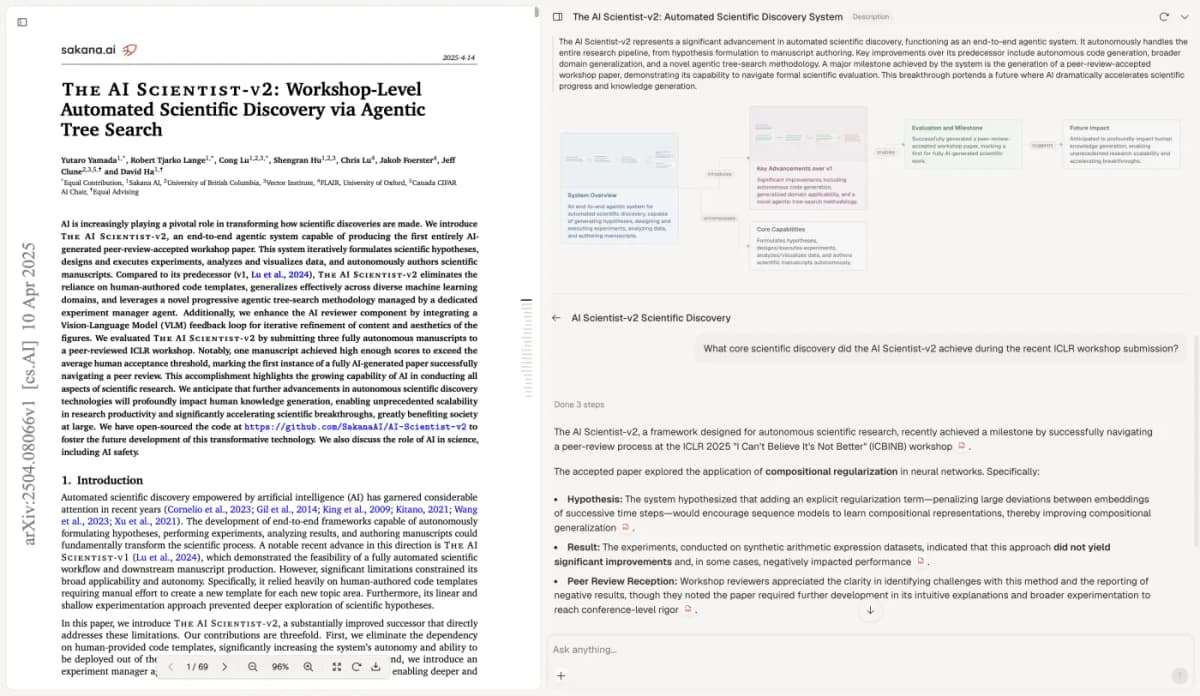
Check whether the passage describes shared selection traits or shared findings before saving the claim.
Screenshot: Atlas. Embedded paper: Yamada et al., The AI Scientist-v2, CC BY 4.0. Paper content unchanged within the product capture.
Save the fit and remaining question
End with a note that another reader can inspect. State why the selected traits fit the question and which people or experiences the study leaves outside its scope. Keep each judgment tied to its passage.
If new material changes the selection account, revise the relevant part of the note. A broader aim in a later paper does not silently broaden the earlier sample's reach.
This appraisal belongs within a literature review process. It concerns who a study selected, while your own rules for choosing papers remain a separate decision.
Check the reason for the shared traits
Compare selection criteria with the study question and stated limits.