

An N-of-1 trial tests treatments within one person across planned phases. In medicine, it often uses repeated crossover: the same person receives each treatment in turn. The team measures outcomes during those phases. CENT 2015 defines this scope and its reporting terms.
Reading the paper means tracing its claim back to those phases. You need the order, length, score timing, and level of analysis before you can judge what a reported gap means. Bring the report and protocol into Atlas to build a cited contrast, then open the passages and correct the claims yourself.

Check the source behind each trial claim
Compare your trial report with its protocol and methods guidance.
What an N-of-1 trial compares
The same person takes part in each phase, so the contrast is within that person over time. That differs from a group trial in which separate people receive two or more drugs. One person can contribute many scores, but those scores do not become many separate people. AHRQ's design chapter explains why time trends and linked scores matter.
A case report might describe symptoms before and after a drug. An N-of-1 trial plans repeat contrasts and scores in advance. The contrast might involve active drug and placebo, or different active drugs.
Read the source's own definition; the term does not describe every possible single-case experimental design. CENT draws that boundary explicitly.
A series of N-of-1 trials has several trials for single people. The authors may report findings for one person, a pooled estimate, or both. Keep those levels apart: a pooled result is not a statement that every person had the same response. The StatinWISE report describes feedback for each person and a pooled analysis.
Read the periods before the conclusion
Start with the methods and protocol, then read the results. A useful reading note answers what was tested, when scores were captured, and which data entered the analysis. For a broader source-reading process, see how to analyze a research paper.
Map treatment order and duration
Record each drug label and the planned sequence. A treatment period is the time assigned to one treatment. We call it a phase here. A block groups a set of periods that repeats.
Check whether order was randomized and whether the report explains how. CENT's terminology helps prevent confusion between a phase, a pair, and the full sequence.
Do not draw one fixed alternating sequence unless the source reports it. Randomized paired blocks can produce different full sequences. Keep planned length separate from actual exposure when a person stopped early. A table headed “planned phases” avoids silently turning a protocol into a record of treatment that took place.
Locate measurement and analysis details
Find the score, its scale, and its collection window. Then find whether the result tests one person's phases or combines several people's trials.
Check what the score is meant to measure. Face validity concerns whether a measure appears to fit that concept; apparent fit alone does not establish that its scores work as intended.
Mark missing scores and early withdrawals rather than filling them with assumed scores. AHRQ treats these as key issues for the analysis.
Read any handling of carryover: an earlier drug can affect a later phase. A washout is one possible design feature, not a universal fixed interval. Check the paper's rationale and analysis instead of deciding that the presence or absence of a washout settles the question.
Worked example from StatinWISE
StatinWISE tested a statin drug against a matching placebo. The people in the trial had reported muscle symptoms.
Here, we read its papers to learn what the study did. The original protocol and results report answer different parts of the reading task.
The table shows which details belong to the plan and which come from the results. It also marks the limits of each claim.
| Reading question | Published detail | Where to check | Limit on the note |
|---|---|---|---|
| What repeats within a person? | Six phases, with three statin and three placebo phases | Protocol: trial design and interventions | This is a plan, not proof every person completed six phases |
| How long is a planned phase? | Eight weeks in the protocol | Protocol: interventions | This trial-specific length is not a rule for other trials |
| How is order assigned? | Three randomized paired blocks of statin and placebo | Protocol: randomisation | Do not assign a named person a sequence without their data |
| Which scores enter the main contrast? | 151 people supplied at least one score under each drug | Report: abstract and pooled analysis | Recruitment count and analysis count differ |
| What does the main result describe? | The pooled contrast found no overall difference in muscle symptom scores | Report: results and statistical methods | The pooled estimate does not establish each person's response |
Table 1: This table reads the StatinWISE protocol and report. It does not recreate anyone’s trial data.
Separate individual and pooled findings
The report describes giving people summaries of their own data for discussion with their general practitioner. Its main reported analysis combines data across trials. A review note should state which level each sentence describes. Link back to the report's statistical methods when noting that split.
For example, write: “The pooled analysis found no clear gap in muscle symptom scores.” Do not write: “Every person had the same symptoms on both drugs.” The second sentence needs results for one person that the pooled statement does not supply.
Keep protocol and report differences visible
The protocol records the intended design. The report records what was analyzed and found.
If you only read the protocol, you cannot fill in completion, missing-data, or result rows. If you only read the abstract, you may miss how the sequence and scores were planned. The registered study summary gives another source for the planned phase and score collection rationale.
Add “not located in the supplied sources” when a detail is missing. That wording tells a future reader what you searched, while leaving room for an appendix or fuller report to answer the question later.
Repair claims that exceed the evidence
A claim can make a leap from a pooled result to one person. It can also treat no clear gap as exact equality, or extend a finding to people who were not studied. Keep the study’s scope alongside its finding. A source-grounded literature review can retain these limits when you compare papers.
For the worked example, repair “This proves the drug never causes symptoms” to “This series found no clear gap in the measured muscle symptom scores between its statin and placebo phases.” The revision retains the reported contrast and removes a claim about all people. It does not decide care for a different patient.
Flag uncertainty without inventing results
Keep the reported range of uncertainty beside a result when your note needs numbers. Copy the estimate and interval from the paper, checking direction and units. Do not create new calculations from an abstract or compare raw averages as though repeat scores were unrelated.
AHRQ's analytic guidance explains the design issues behind that caution.
CENT can help find missing reporting, such as an unexplained sequence. It is a reporting guide, not a certificate that a study has no bias or that a drug suits a reader. A missing detail creates a reading question; it does not prove the method was absent.
Check trial passages in Atlas
Add the trial report, protocol, and methods guide to the same project. Use sources you can access and have permission to upload. Give each source a clear label so the resulting note can distinguish the plan from the results. For concise review notes, the research-paper summary workflow gives a related starting point.
- Select the report and protocol with
@mentions in your question. - Ask for planned drug phases, order, score timing, level of analysis, and missing details. Request a source passage for each row.
- Open each citation and read the surrounding methods or results text. Check that the passage concerns the correct trial and paper.
- Correct any table row that treats a plan as a completed event or turns a pooled result into a result for one person.
- Add an open column for details not found in the supplied sources. Keep those gaps visible in your own note.
- Choose New → Note, paste the reviewed table and explanation, and confirm Saved before leaving it.
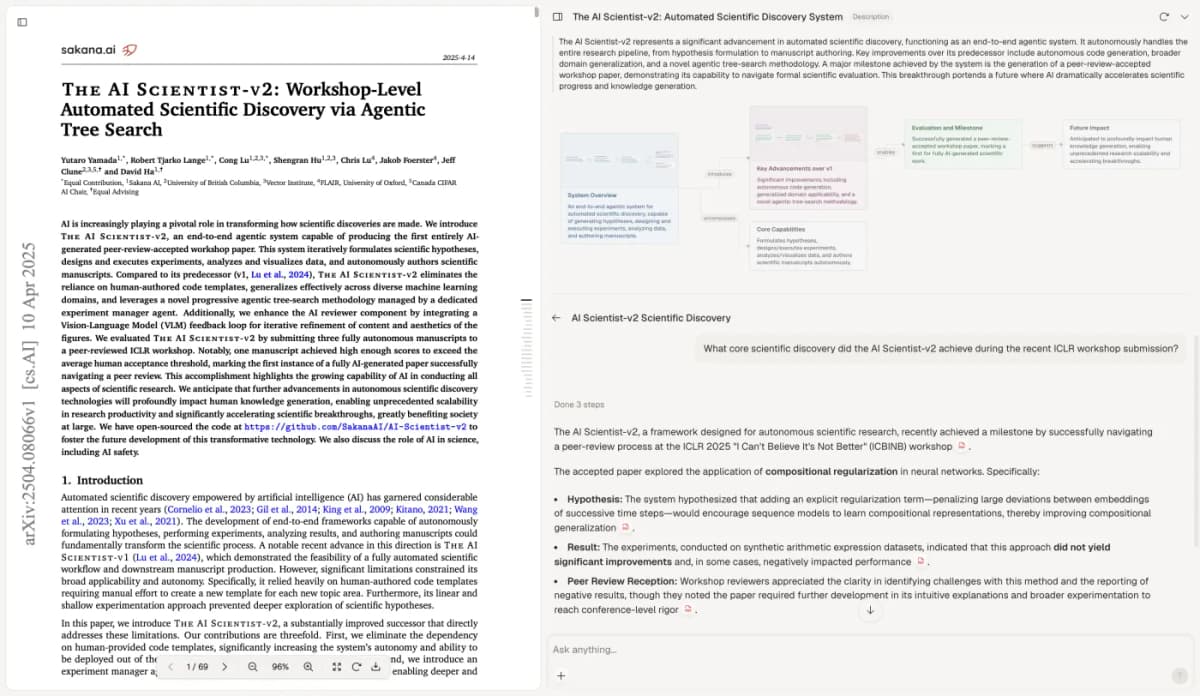
Actual Atlas citation-checking view using an AI Scientist paper. It illustrates opening source context; it does not show StatinWISE data or a clinical interpretation.
The visible paper is The AI Scientist-v2, by Yutaro Yamada and colleagues, under CC BY 4.0. Part of its first page appears in this unchanged Atlas capture.
Ask a bounded question: “Using these sources, compare the planned drug phases with the reported analysis. Separate individual and pooled claims, cite each row, and mark details you cannot locate.” This gives you a draft to inspect, not a verified trial appraisal.
If a citation only supports the number of phases, remove a claim about drug benefit from that row. Source access and source context matter more than the presence of a citation marker. Save the corrected version and the reason for the change.
Save the table with open questions
Save the paper title, protocol version, source page, and date with the table. List open details such as incomplete phases, carryover handling, or a result for one person you have not located. These notes help you revise the table when you find a new report or appendix.
Before citing the study in your own writing, check that every claim uses the right level of analysis and retains its uncertainty. A useful evidence note shows what the paper reports, what you corrected, and what still needs checking.
Check the source behind each trial claim
Compare your trial report with its protocol and methods guidance.