
Single case experimental design studies cases through repeated measures and controlled treatment changes across phases. To read a report, trace what changed, when it changed, and how the authors judged the outcome. A small sample or an A-B-A-B label alone cannot establish an effect.
This guide builds a phase-sequence and reported-change evidence note. The worked records are fictional, with no real participants or treatment results. Use the structure to check supplied reports while keeping the design, the data, and the claim about change distinct.

Trace study phases in Atlas
Check phase descriptions and the source support for a reported change claim.
What makes a single-case experiment
The case is the unit whose response is studied. It may be a person, but it can also be a clinic, class, or community. Epstein and Dallery's design overview explains this range and the role of repeated measures. Several cases can appear in one study, with each case's pattern kept visible.
A phase is a stretch of the study under a stated condition. A often names the baseline, while B names a treatment condition. Read the authors' definitions rather than assuming that A means no care or that B has the same content in every paper. The comparison depends on what was actually done. For planned repeat treatment comparisons within one person, read the N-of-1 trial guide and keep individual and pooled findings apart.
The WWC technical document describes repeated measurement and controlled changes in conditions. Its opened version is a 2010 pilot standards document, so it is useful here for design logic, not a claim about current formal ratings. A narrative about one person without those features is a different kind of source.
A case-study research design may explore a bounded case through several kinds of evidence. A single-case experiment needs a trace of treatment changes and repeated outcomes that supports its experimental reasoning. Neither becomes stronger just by borrowing the other's label; read the method that serves the actual question.
Trace cases, phases, and measures
Start with the study question and the unit of analysis. Then find the outcome and the rule for changing conditions.
This helps you tell a planned sequence from what took place, especially when the paper describes deviations or extends a phase after seeing an unstable pattern.
- Name the case. Record the unit receiving the treatment and the unit whose data are analyzed.
- Name the outcome. Find its definition, measure, timing, and direction of interest. A score rising may mean improvement or worsening.
- Name the phases. Copy the actual sequence and what each condition contains, with source locations.
- Find repeated measures. Locate the underlying observations or graph, including gaps and any changes to the measure.
- Find the change rule. Read when and why treatment was introduced, withdrawn, or altered, including any random process.
- Find the analysis. Locate how the authors evaluated the pattern and what limits they report.
The design-family overview describes reversal and multiple-baseline designs. A reversal returns to an earlier phase. Multiple baseline starts treatment at different times across cases, tasks, or settings. Keep that contrast clear when you read the study; these phase sequences test change in different ways.
If the report changes a phase midstream, keep that fact beside the reason. A reader needs to know whether the change followed the plan or responded to a problem.
An elegant phase list that omits the deviation can make the study look more controlled than the text supports.
Before a broad synthesis of research papers, keep one row per case or phase where needed. A mean across cases may hide a response that occurs in one case and not another. Preserve the case-level source trace before grouping findings.
Build a fictional phase evidence note
Imagine a fictional report about a visual cue intended to help a learner begin a routine task. The following phase labels, source records, and observations are invented for teaching. No study was conducted, and there are no actual effect estimates or participant outcomes behind the example.
The fictional plan calls the usual routine A and the added cue B. It reports an A1-B1-A2-B2 sequence, but the supplied excerpt gives only a short description of each phase.
The reading note records both that description and what you would still need to inspect before judging an effect.
| Phase | Fictional source record | Reported condition or change | Evidence still needed |
|---|---|---|---|
| A1 | M1, baseline description | Usual routine before the cue | Repeated measures, existing trend, and outcome definition |
| B1 | M2, first cue phase | Cue added; note says task starts became quicker | Underlying measures, timing of change, and cue-delivery record |
| A2 | M3, return phase | Cue removed; note says the learned routine persisted | Full pattern and a check of carryover rather than an assumed return to baseline |
| B2 | M4, second cue phase | Cue returned; note calls the routine improved | Measure consistency and reported analysis across all phases |
Table: Fictional phase-sequence reading note. Records and observations are invented; the table is not a real graph, experimental result, or proof that the cue works.
The A2 row is the main caution. Returning to the old condition does not guarantee that behavior returns to its old pattern.
If the learner retains a skill, withdrawing a cue may leave that skill in place. The phase label names the condition, not the response.
Teaching at Sydney's discussion notes that a learned skill may last. Use that point to ask about carryover in this made-up note. It does not set one rule for how many scores or people every study needs.
A source-reading table is a map to the evidence, not a substitute for it. Keep the graph, repeated measures, and analysis linked to the rows when they are supplied. If you have only these narrative excerpts, state that limit before using phrases such as experimental control or functional relation.
Correct a claim based on labels
Suppose the draft summary says: “The ABAB design proves the cue worked.” That jumps from a phase name to a causal conclusion.
The supplied fictional notes leave the measures, pattern, delivery checks, and full analysis open. They also describe possible carryover in the return phase.
Use the following criteria: can you trace the treatment changes, the repeated outcome pattern, and the reported basis for linking them? A source must support each part. The presence of four phase labels does not fill the missing fields or rule out a second change that occurred at the same time.
Revise the summary to: “The report names an A1-B1-A2-B2 sequence. The supplied excerpt does not establish the pattern across phases or the basis for an effect claim, and retained learning may affect the return phase.” This preserves what you found while narrowing what you can conclude.
The WWC account of replication explains why a pattern must be shown more than once. It does not let you rate this made-up excerpt as though the needed data were present. Use current rules on real data, with trained reviewers.
In a real report, the full data may resolve the concern, or the authors may explain why a different design was chosen. Read that explanation before rejecting or accepting the claim. “Not established in the supplied excerpt” leaves room for a source check; it is narrower than saying the treatment had no effect.
Check the reported basis for change
Look within each phase before comparing phases. What is the usual level, is the score rising or falling, and how much does it vary?
Then read how soon change appears when the phase changes and whether the pattern repeats. These questions help you read the authors' work; they do not amount to a tested method on their own.
Lane and Gast's review abstract calls for a planned check within and across phases. It also stresses reliability and fidelity: was the score measured in the same way, and was the task carried out as planned? A change in either can affect how you read the pattern.
Check overlap and consistency alongside the other features. A brief direction summary such as “improved during B” can hide wide swings or a trend that began before B.
Read the authors' reasoning and the underlying display rather than choosing only the feature that makes the result sound clearest.
Find any statistical method the paper uses, but keep its role clear. This reading workflow does not work out an effect or choose a test. A number in the results still needs the design, scores, and assumed facts that give it meaning.
SCRIBE's entry in EQUATOR links to guidance on how to report single-case studies. A clear report helps you find what took place; it does not prove that treatment caused the change. Check both what the report tells you and how well the study supports its claim.
Note carryover, other events, missing data, and changes in scoring. It may be wrong to remove support that a person needs. This guide does not tell you to stop treatment; trained staff must make study and care choices under the review that applies to their work.
Inspect phase sources in Atlas
Add the selected reports and permitted supplements to a project, then wait for processing to finish. Start a chat and type @ to choose the sources.
Clear file versions help distinguish a protocol, full report, and partial excerpt. Those sources answer different questions, even when they share the same study name.
The Project only option beside + stops new outside retrieval. Earlier chat context remains available, including outside material already present. A fresh chat helps when that earlier context could blur the report set you want to check.
Ask for a source-linked phase trace:
For each case in these sources, identify the outcome, actual phase sequence, condition in each phase, change rule, and reported analysis of change. Cite each field. Preserve deviations, missing measures, and carryover concerns. Do not infer an effect from the design label or a short narrative summary.
Open the citations and check the surrounding methods and results. The citation-tracking guide explains the value of a claim-to-source route. Verify that each passage refers to the case and phase under review, rather than a general description of how that design usually works.
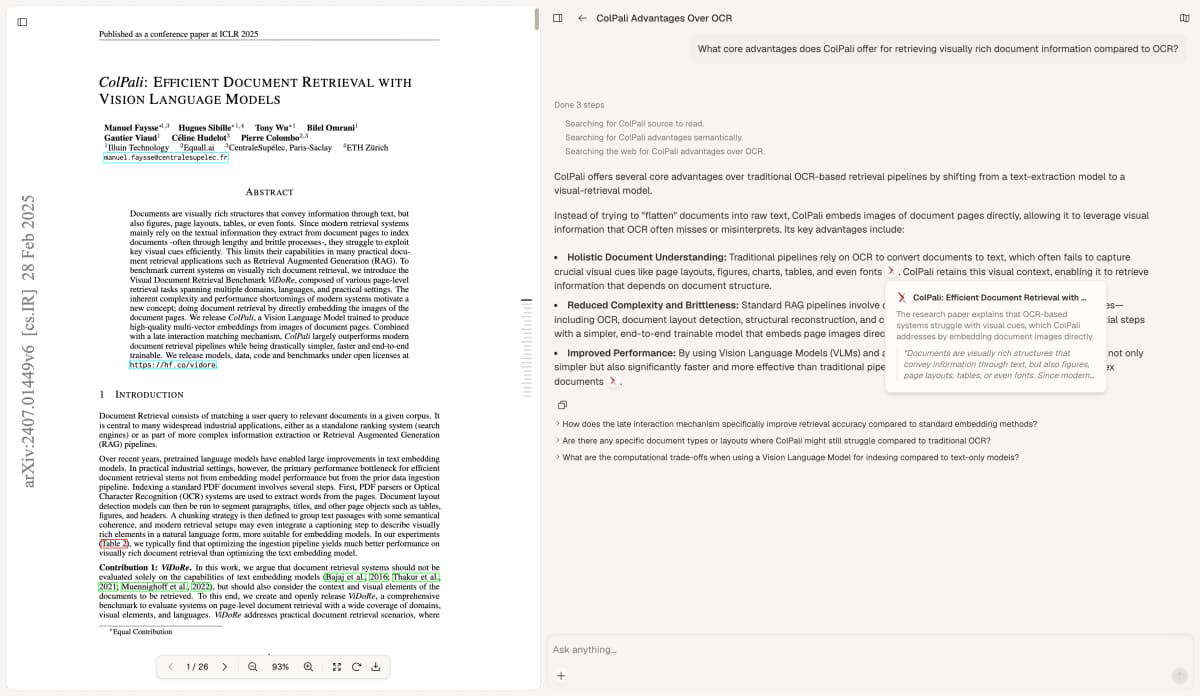
Existing Atlas screenshot displays ColPali by Manuel Faysse and colleagues, released under CC0 1.0. The capture was converted to lossless WebP without changing its content. It illustrates source inspection, not the fictional cue study, phase data, or an effect-analysis test.
Correct a row if Atlas turns an intended phase into an observed pattern or fills a missing measure from context. Ask for the exact passage, then retain the limit if it is not found.
A follow-up can help narrow the source question, but you still decide whether the new row is supported.
For difficult scans or layouts, the AI PDF reader guide can help you assess reading needs. Inspect the original page and graph yourself. Atlas helps read, compare, cite, and save notes; this workflow does not calculate effects, conduct a validated visual analysis, or certify causality.
Save the note with open questions
Before saving, choose one phase transition and trace it back to the condition, measures, and analysis. Check whether the claim concerns this case, several cases, or a broader population. Narrow the wording if the source cannot support that wider scope.
Create a note through New then Note, and wait for Saved before closing. Preserve source versions, phase locations, your corrected claim, and unresolved evidence. A reader should see why the ABAB label was retained but the claim of proof was removed.
Share the note with its open questions intact. When a full report or supplement arrives, inspect it before changing the row. A useful phase trace makes the next check clear without turning a missing record into an invented result.
Trace study phases in Atlas
Check phase descriptions and the source support for a reported change claim.