

An NIH project summary, formally the Project Summary/Abstract, is a short, stand-alone account of the work you propose to do. It covers the goals, aims, methods, and health relevance. The general limit is 30 lines of text. Build it from your checked proposal so that a reader can understand the project without opening the full application.
The NIH application instructions distinguish this attachment from the Project Narrative, which explains public health relevance in at most three sentences. Keep a separate outline for each.
An NSF application has a different structure. The Broader Impacts guide covers its societal-benefit criterion; do not carry NIH attachment rules into that section.

Trace your aims into a summary outline
Compare permitted proposal drafts and NIH instructions with source citations.
What the NIH project summary does
The summary tells a reader what question the project addresses, what the team will do, and why the work matters. It needs to stand on its own. A reference to “Aim 2 above” leaves a reader without the information they need.
The NIH advice on application sections treats the Summary/Abstract and Narrative as distinct public-facing texts. The Specific Aims attachment develops the project's goals; the Research Strategy explains the scientific case and approach in depth. Your summary draws from those parts without copying all their detail.
Write for readers who can follow science but may work outside your specialty. The funded summary also reaches public readers. Define an unfamiliar term when it is central to the project, and explain the question before naming a specialized technique.
An NIH summary statement is another document: it reports the outcome of peer review. NIH's explanation of summary statements describes reviewer critiques. That is feedback received after review, rather than the abstract you prepare for submission.
Check the rules for your application
Start with the funding call, formally the notice of funding opportunity or NOFO. Record its number, your grant's activity code, due date, and related NIH Guide notices. The NIH page-limit guidance sets the order: the call's rules override the general guide, and related NIH Guide notices override both.
Match the form and award type
The current How to Apply guide lists Version I for due dates on or after January 25, 2025. Use the form package tied to your funding call and the guide for your activity code. The due date matters more than the year in which a sample was written.
Read the extra rules for your award type. A career development summary also covers the career plan, goals, and setting; a fellowship summary includes the training plan and setting. Multi-project grants need summaries for their Overall and Other Components. An outline focused only on the study may leave those parts out.
Some search results lead to the non-research Project Abstract Summary help. Its first-five-lines guidance belongs to that form. Do not turn it into a universal opening rule for research grants.
Check the PDF rather than word count
The 30-line limit is a text-line limit, not a fixed word allowance. A font, margin, or wording change can alter where lines wrap. Count the lines in the final PDF after conversion.
Follow NIH's attachment format rules: text is at least 11 points, with no more than 15 characters per horizontal inch or six lines per vertical inch. Provide at least half-inch margins. Do not shrink text to force an overlong draft into the limit.
The Summary/Abstract and Narrative should contain text only unless the funding call says otherwise. URLs and links also need explicit permission in the rules. Keep source links in your working note while you check what belongs in the submitted file.
Keep the two attachment slots separate
The NIH eRA help illustration shows Project Summary/Abstract as item 7 and Project Narrative as item 8. They have separate attachment controls, so putting the narrative at the end of the abstract does not fill both slots.
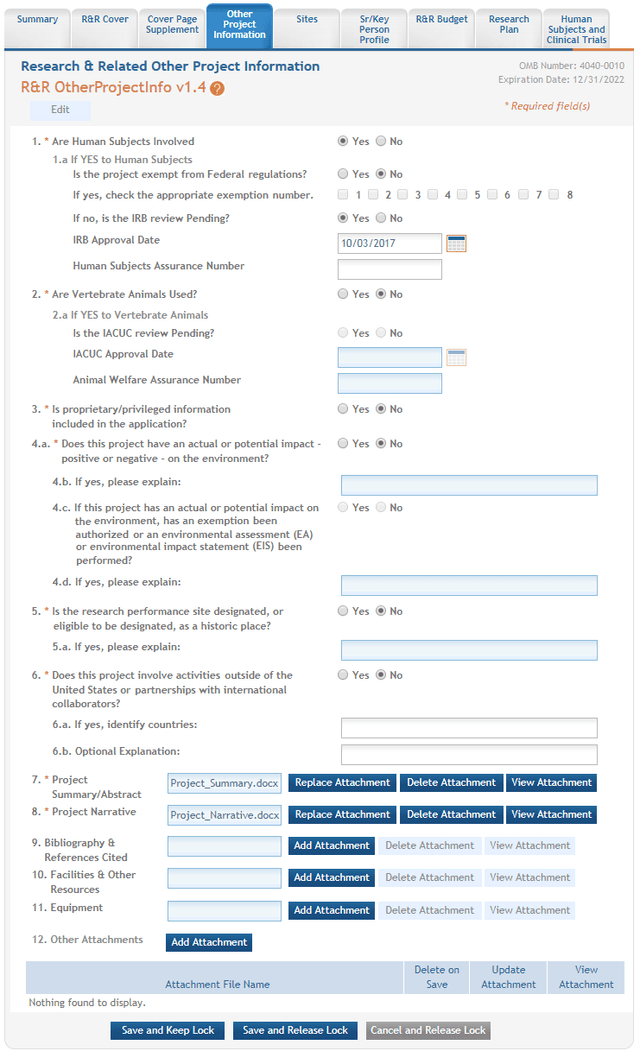
NIH eRA's published help image uses older sample filenames and dates. Use it to identify the separate rows; prepare current attachments as PDFs under the application instructions.
Before submission, preview the assembled application and check that each file is in its intended place. A correct filename in your local folder cannot show that the right attachment was uploaded.
Trace aims into a summary outline
Wait until the scientific plan is stable enough to summarize. NIU's sponsored-programs guidance recommends writing the abstract after the proposal so that it reflects the full project.
You can draft an outline earlier, then revise it when the aims or methods change.
A Specific Aims page is a separate proposal component; check its final claims before compressing them into the public summary.
Collect support before writing sentences
For each part of the outline, find the passage that supports it:
- Problem and gap: What is known, and what does the project still need to test?
- Goal and aims: What will the work try to establish or develop?
- Approach: How will the team address each aim?
- Contribution: What could the work add if completed?
Keep the source filename and page or heading beside each entry. Use the applicant's proposal as the source for planned work. A published paper can support the background, but it cannot confirm your team's sample size or chosen method.
When drafts differ, compare the aim and method passages before choosing wording. Ask the applicant which version is current. An older aim can sound polished while describing a study the team no longer plans to carry out.
Keep plans, findings, and flags distinct
Use future tense for planned tests and cautious wording for their possible contribution. A proposal to test an approach does not show that it works. An expected result should not become preliminary data during compression.
Beside the outline, retain two review flags: support not found and public-release review needed. The first sends a claim back to the applicant for evidence or removal. The second asks the applicant and institutional staff to decide what can be disclosed; a model cannot make that decision from text alone.
This is a useful point for an AI source check: open the cited passage and compare it with the outline entry. Check whether both refer to the same population, study model, method, and stage of work. Revise an entry that says more than its source.
Worked example from NIH's language guide
NIH's plain-language guide shows how it edits a heart-disease example. NIH says these examples are made up. Use them to learn about writing, rather than as funded projects or proof of health claims.
Map the scientific content to its passages
The following map uses Example 1's original and edited abstracts. Each row identifies a piece of content to preserve and a claim the writer should avoid adding.
| Outline element | Source locator in Example 1 | Content to retain | Limit to preserve |
|---|---|---|---|
| Research question | Before, hypothesis; After, second paragraph | How altered G-protein activity may relate to heart disease. | Keep the mechanism as a question to investigate. |
| Study model | Before, preliminary-data passage; After, first paragraph | The background includes work in animal models. | Do not turn it into evidence of benefit in patients. |
| Planned approach | Before, Specific Aims; After, third paragraph | Drug and gene-based approaches examine heart function and cell activity. | Explain how the work tests the question; preserve its planned status. |
| Expected contribution | After, final abstract paragraph | Better understanding could point to a target for future drug research. | A possible future target is not a proven treatment. |
Table 1: These rows are a reading aid for the official teaching example. For your application, replace them with checked passages from your own current aims and strategy.
Preserve the relationship while shortening
The edited example reduces the density of technical detail while keeping the question, methods, and possible contribution connected. It gives readers enough context to see why the proposed tests follow from the gap.
Apply that test to your own outline: can a reader connect each aim to an approach and the contribution? If the link is unclear, return to the proposal. A shorter sentence cannot repair an unresolved scientific choice.
Use NIH's sample-application directory to study other structures. Compare how a sample handles its task, rather than borrow its claims or assume its older instructions still apply. Funding does not isolate which sentence or structure led to the award.
Edit for clarity and public release
Ask a reader outside your narrow field to explain the project back to you. They should be able to name the problem, goal, approach, and possible contribution. If they cannot, find the term or missing connection that caused the confusion.
Define acronyms on first use and replace jargon where a plain term preserves the meaning. Keep the scientific detail needed to understand the work. Practitioner advice on the NIH abstract can help you consider project fit, but it does not create required headings or guarantee referral to a particular study section.
Review the draft for public release. NIH excludes proprietary, confidential information and trade secrets from the summary. Have the applicant and the right staff at their institution check private details before export. Keep open questions about what can be shared in the working note.
Follow NIH's originality policy, in force for the September 25, 2025 receipt date and beyond. It allows limited AI help but does not treat applications or sections substantially developed by AI as the applicant's original ideas. Checking sources or making light edits to generated prose does not show that this rule has been met.
Have the applicant write the summary from the checked outline. Compare each claim with its source evidence in the final aims and strategy. Then inspect the PDF, count the lines, and preview the full application. Review the science, what can be shared, and the file format as distinct tasks.
Keep a checked outline in Atlas
Atlas can help you locate support across permitted drafts and instructions. Use that comparison to prepare an outline the applicant can review and write from.
- Open one project and add only sources you are permitted to use. Confirm that the proposal drafts and current instructions have finished processing.
- In Ask a question, type @ and select the sources by name. Ask for passages supporting each outline element rather than a finished abstract.
- Open each numbered citation and read the surrounding text. If a precise location is unavailable, find the source by name and check the passage there.
- After you check the source synthesis, select New, then Note. Save the verified outline with its source locations and open applicant questions. Wait for Saved before closing it.
Try this focused question:
Locate the passages in these named drafts that support the project goal, each aim, the approach, and the expected contribution. Give the file and page or heading for each. Flag claims you cannot support, and keep planned work apart from findings. Do not write a final abstract or decide which details are confidential.
The applicant can use the note to resolve gaps, write the public summary, and check it against the final proposal and NIH instructions.
Trace your aims into a summary outline
Compare permitted proposal drafts and NIH instructions with source citations.