
A specific aims page explains the problem your research will address, why it matters, and what you plan to learn or build. Show how each aim helps answer the question. For an NIH-style grant, build the case from the evidence before you fit the plan into the required attachment.
Keep three things distinct as you write: what past studies found, what you think those findings mean, and what your project will test. A source can show why a question matters while leaving your hypothesis untested. Keep that distinction when you move from reading notes to the draft.

Check the evidence behind your aims
Compare papers, check cited passages, and save the evidence in a note.
What the aims page must explain
The page should let a reviewer follow the case for the work without rebuilding it from the full proposal. What remains unknown? Why would an answer matter? What will the project add, and how will the aims produce that knowledge?
NIH's Research Plan instructions ask for research goals and expected outcomes, including their impact. The Research Strategy holds the detailed significance, innovation, and approach. Use the Specific Aims requirements and the funding opportunity's rules to decide what your grant must include.
NIH's page-limit table lists one page for Specific Aims where the form includes that attachment. Check the opportunity and related notices for rules that supersede the table before you format the page.
A familiar outline has four parts: the problem and gap, the planned solution, the aims, and what the work could add. Use it as an aid, not a fixed script. A project that builds a tool may need a goal for that tool where another project tests a central hypothesis. NIH's examples of research objectives include both kinds of work. Let the logic fit the project.
Separate evidence from the proposed hypothesis
Before drafting, make an outline of the claims you expect to use. Keep the source, passage, and limit beside each claim.
“Supports significance” is hard to check later. Name who was studied, what the paper found, and the limit that changes how you can use it. The AI citation-checking guide explains how to check source support beyond the existence of a reference.
Use these four categories to keep evidence and proposed work distinct as you move findings from your reading notes into the draft.
| Entry | What to retain | What it can support |
|---|---|---|
| Published finding | Paper, passage, studied population, limitation | A bounded statement about what the study reported |
| Preliminary observation | Investigator-owned record, method, uncertainty | A description of existing team evidence |
| Interpretation | The reasoning connecting findings to the question | A rationale that remains open to challenge |
| Proposed hypothesis or aim | Investigator's question and planned test | What the project intends to evaluate |
Table 1: The outline makes the step from a result to a possible cause visible. Keep the reasoning beside the finding so a colleague can challenge that step.
Suppose a paper finds that patients who miss visits also report more transport barriers. This may give you a reason to study access. It does not by itself show that transport caused the missed visits or that a new transport service will help. Read the design and limits before you decide how strong a claim the finding can support.
Keep the gap's scope just as precise. “The papers read here did not study this group” states the limit of your source set. “Nobody has studied this group” needs a broader search. Use the research synthesis workflow to compare a larger set before making a claim about what is missing from the field.
Build the 4-part argument
Harvard Catalyst's worksheet links the broad problem to the remaining question, the planned work, and its impact. It allows for different project structures. Test that chain of reasoning before you polish the words.
Establish the problem and gap
Choose the findings that give a reason to ask your question. A list of all known facts can hide the problem the project will address. Keep the studies that show the problem, define what is unknown, or challenge a possible answer.
End the opening with a gap the work can address. “The disease remains a serious problem” leaves the question open. The significance of the study asks why an answer to that defined gap would matter. Keep the proposed contribution separate from a benefit the project has not yet demonstrated.
A claim about an unknown pathway under defined conditions begins to name what you could test, if the sources support that gap. Oregon's aims-page guide connects the known background to the remaining need.
State the proposed solution
Distinguish your long-term goal from this grant's objective. The goal may span several projects; the objective must fit this project's time, resources, and question. The research objectives guide shows how to connect a broad question to work you can complete.
If the project tests a hypothesis, explain its basis in the data you already have. If it builds a tool, explain what the tool will do and how you will test it.
The Harvard aims worksheet can help connect that objective to the gap you named.
Give each aim a purpose
An aim names what you want to learn or build. Explain the broad approach and what the result would help you decide. Put detailed methods in the proper later section, following the NIH Research Strategy instructions.
OHSU's guidance recommends linking each aim to the hypothesis, approach, and expected outcome. It also asks whether the work remains useful if a result is unexpected. Make those links visible so the aims read as a research plan, rather than a list of tests.
Connect outcomes to the original problem
The close explains what the work could make possible. A dataset or a tested measure may be its direct output.
A later benefit for care or policy may need more work. The Harvard proposal guide asks writers to consider the importance of the expected contribution.
If that benefit needs another trial or rollout, do not imply this project will complete it. Show how the actual output moves the research forward. Keep the NIH request for expected outcomes distinct from a promise that a later benefit will occur.
Work through an aims page example
Consider a fictional project about missed follow-up visits. It illustrates how to build the argument. The project is invented and has not been tested for feasibility; it is not a draft you could submit for funding.
The researcher has chosen papers on missed visits and access barriers. The outline keeps each finding beside its limits. The selected papers leave open which barriers matter most in the care setting this project will study.
The question could ask how specific access barriers relate to missed visits in that setting. This grant's objective would address that gap. “Solve missed appointments” would promise much more than the plan could deliver.
The research objectives workflow offers a way to check the match between a question and the work you plan.
Keep the hypothesis testable
A hypothesis might ask whether a defined transport barrier is linked to missed visits after accounting for other named reasons. The researcher must choose measures and a design that can test that question. Finding a link would not, on its own, establish a cause.
Keep three kinds of statement visible in the outline:
- Past papers report barriers and patterns of missed visits.
- This project will test a link in a defined setting.
- Whether a new service reduces missed visits is a later question with its own design and evidence needs.
Only the first statement describes existing findings. The other two name planned work, so they need the language of questions and predictions.
Make the aims answer different questions
One aim could examine the barriers and how to measure them. Another could test their link to missed visits using a separately planned analysis. These are outline questions. The research team must review whether the designs are sound before adopting them.
Ask what happens if the barrier is rare, the measure is flawed, or the expected link is absent. A rare barrier may leave too few cases for the planned test. A flawed measure may need a new approach.
A sound finding that fails to support the link may still help narrow the possible reasons for missed visits.
Check those possibilities before the page promises a particular answer. The OHSU aims guidance asks whether the project remains useful under an unexpected result.
Test dependencies and alternative outcomes
Connected aims can study different parts of one question. A problem arises when an early aim must yield a particular finding for all later work to begin. University of Oregon's guide uses this distinction to review the aims.
Suppose Aim 1 will find a new biomarker and Aim 2 will test only that new candidate. If none emerges, Aim 2 may have no target. The plan needs to explain whether an existing candidate, another approach, or a revised question could still produce useful knowledge.
Some projects must build something before they can test it. Describe what the later stage needs, when it can continue, and when it should stop or change course. An aim number names a stage; it does not remove a real dependency. The page needs to show what the later work relies on so reviewers can assess the risk.
For each aim, review the following questions with a colleague:
- What question does the aim answer?
- What must be in place to begin it?
- Which outcomes could you still interpret?
- What would fail if an earlier prediction lacked support?
- Which other approach is sound and feasible?
If every useful outcome needs the hypothesis to be confirmed, revisit the design. Explain what you could learn if the expected answer is unsupported. The Oregon guide's aim-dependency advice helps frame that review with your team.
Check selected paper passages in Atlas
Atlas can help compare the papers behind the case for your project. Keep the question focused on reading those sources. You develop the idea and write the grant.
For a larger set, organize the research papers so you can find the source behind each claim.
- Add the permitted papers to an Atlas project and wait for processing to finish.
- Open a chat, type @, and select the papers you want to compare.
- Ask: “For each selected paper, report who was studied, what it found about follow-up visits, its limits, and a supporting passage. Keep findings separate by paper. Do not propose aims or write grant text.”
- Open the numbered citation beside each key claim. Read the surrounding text and check whether the group, design, and limits match the answer.
- Fix overclaims in your note. If an answer treats a link as a cause, return to the paper and keep only what its design supports.
- Select New, then Note, and save the checked findings with source references you can recognize. Wait for Saved before closing the note.
The source reader and answer can be viewed together when you check a citation. The screenshot below shows an existing Atlas example using a paper about document retrieval. It is unrelated to the invented follow-up study or a grant.
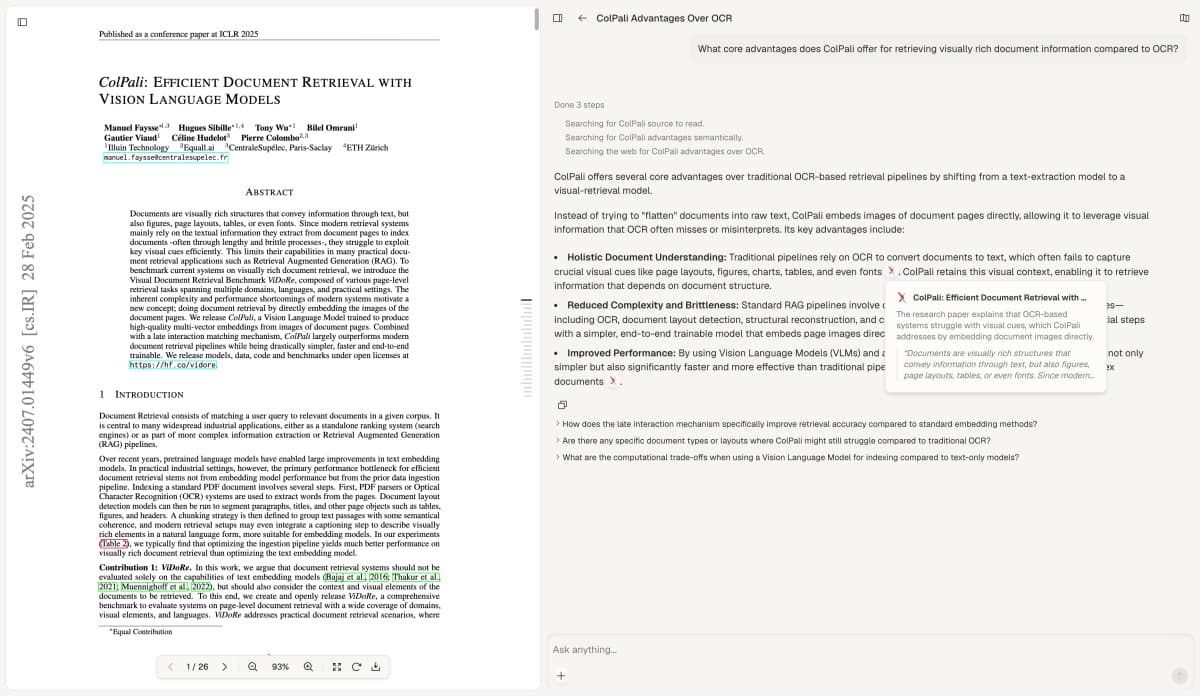
Open the source behind a claim and compare the answer with the paper before moving a finding into your evidence note.
An answer with a citation may omit a limit or say more than the source supports. If the citation is missing or unhelpful, name the paper and ask for the passage.
If the source does not answer your question, record that gap instead of asking for a more confident answer.
The note helps you read the papers. It cannot establish that you found every relevant study or that your plan is new and feasible. Choose AI research tools for the step you need help with, and have researchers review the move from source notes to study design.
Review the page before submission
Check the current opportunity, form, attachment format, and page limit. NIH's Specific Aims instructions restrict hyperlinks and URLs unless the opportunity permits them. Links help you trace sources in a working note. Do not assume that format is allowed in the submitted attachment.
Ask a subject expert and someone outside the field to review the page. Harvard Catalyst's proposal guidance emphasizes plain language and feedback from different readers. The expert can challenge the premise. The other reader can find where you have assumed knowledge that the page does not explain.
Give reviewers questions the page can answer. Is the gap supported? Does the objective address it? What would each aim teach us? Does the impact follow from the planned outputs? Keep objections to the science distinct from comments on wording.
Review AI use with your institution before relying on it to prepare a grant. NIH's originality policy applies from the September 25, 2025 receipt date onward. It states that applications or sections substantially developed by AI will not be treated as the applicant's original ideas. The notice allows limited assistance in some cases. It does not approve this source-checking procedure or give a numeric safe threshold. Editing generated grant prose yourself does not, by itself, resolve the policy question.
Before you send the draft for institutional review, return to the outline. Check the sources behind published findings. Keep the team's early data distinct from predicted results, and check that the page follows the rules for the intended opportunity.
Check the evidence behind your aims
Compare papers, check cited passages, and save the evidence in a note.