

An NSF mentoring plan describes how your project will support the growth of funded graduate students and postdoctoral scholars. Under general PAPPG 24-1 instructions, it is one project-wide attachment of no more than one page. A useful plan names what each trainee needs to learn, who will help, and how that help will happen.
Start from the work the trainees will do. A list of seminars and career services does not show how anyone will use those resources. The plan needs commitments that the project team can carry out and review.

Check the support behind your mentoring plan
Compare trainee roles and resource files, then review the cited commitments.
Check the current NSF requirements
Open the current NSF policy page and your solicitation before using an example. The live index lists PAPPG 24-1 alongside Supplements 1 and 2. Read effective policy changes with the base guide; do not use a draft replacement as the rule for submission.
Chapter II proposal instructions require a mentoring plan when a proposal requests support for covered postdocs or graduate students. The general limit is one page for the unified project, including linked collaborations and subrecipients.
The same plan can describe different activities for the two groups. A new graduate student may need close help learning a method; a postdoc may need chances to lead work and plan a career. Do not remove one group's support just because an older template mentions only postdocs.
The official PDF excerpt below shows the one-page rule and trainee coverage. It also says that the plan must not become extra space for the Project Description. Read this baseline alongside current supplements and programme-specific rules.
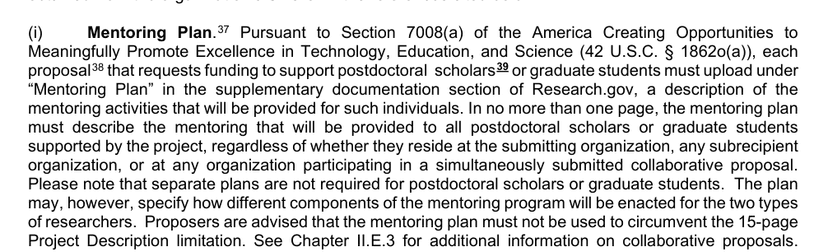
The plan covers supported trainees across the project, rather than only those based at the lead institution.
This is a direct crop from PAPPG 24-1, printed page II-32. Check proposal-type exceptions with your sponsored research office. A person's budget role can matter; the title “postdoc” alone does not resolve every case.
Mentoring is evaluated under the Broader Impacts criterion. The NSF broader impacts guide explains that wider criterion. Here, focus on the training commitments for people supported by this project.
Match trainees to concrete mentoring
For each trainee role, identify a skill needed to do the planned work. Then choose an activity that lets the trainee practise it with feedback. Link the activity to a mentor who has the time and expertise to help.
A weekly meeting is a schedule, not a learning goal. Explain what will happen there: review field notes, critique analysis choices, discuss a draft, or plan the next task. The level of support can change as the trainee gains skill.
Cornell's mentoring resources cover research skills, writing, sharing findings and career growth. Choose the areas that match your roles instead of copying all available categories into a one-page plan.
For every promised resource, check access, timing and ownership. A course may exist but run after the trainee needs the skill. A workshop may serve only one campus. A mentor may appear in a partner letter without agreeing to the schedule in your draft.
Use a working note to record those checks before you compress the prose. Your research objectives can help you see which skills the project actually requires. Training that is useful in general may still be poorly timed for this study.
A worked mentoring commitment map
Consider a fictional field-data project with one graduate student and one postdoc. The graduate student will clean observations and draft a methods section. The postdoc will lead quality checks and prepare a funding outline. These are teaching examples, not confirmed people or activities.
The working packet contains R1, the proposed roles; L1, a draft mentor agreement; and C1, a campus workshop listing. L1 confirms time for methods feedback. C1 lists a grant-writing workshop but does not confirm places for the project trainees.
This map helps the team distinguish a workable commitment from a resource it still needs to arrange.
| Trainee need | Proposed mentoring | Evidence or gap |
|---|---|---|
| Student data-cleaning skill | Weekly supervised review of one batch | R1 role; L1 mentor time |
| Student methods writing | Draft feedback at monthly meetings | L1 feedback commitment |
| Postdoc funding experience | Workshop plus mentor review of outline | C1 listing; access unconfirmed |
Table 1: The first two rows have proposed roles and mentor support; the last still needs an access check.
A draft passage could say: “The graduate student will review data-cleaning decisions with the methods mentor each week and bring a methods draft to monthly feedback meetings. The postdoc will prepare a funding outline with feedback from the project lead. Workshop participation will be included only after access and timing are confirmed.”
For the final submission, resolve the workshop gap rather than keeping an uncertain promise disguised as a commitment. If access is unavailable, the team could arrange another suitable activity and document its owner. It should not claim that an AI-generated plan books the resource.
Colorado State's policy-change guide explains the expansion to graduate students. That change makes role coverage a useful review step even when a lab has a familiar postdoc plan.
Keep the plan and IDPs distinct
The proposal plan describes support across the project. An Individual Development Plan, or IDP, sets out one person's learning and career goals. The two plans serve different needs even when one helps shape the other.
Under Chapter VII award rules, covered trainees with substantial support need an IDP reviewed each year. The base guide defines that support as one person month or more in the annual report period.
Check your award terms and ask your grants office how to record the support. A budget line may need review before you decide which duty applies.
Do not use the IDP threshold to decide whether your proposal needs a mentoring plan. One rule concerns support you request; the other concerns support under an award. Ask your grants office to check unusual roles or budget cases.
Keep private career goals in the right process for each person. The one-page plan can say how you will review goals without listing an IDP for every future trainee. Cornell's IDP guide explains the two tasks.
Find unsupported commitments in Atlas
Add the allowed proposal, role descriptions, mentor agreements and resource pages to an Atlas project. Include the current NSF instructions as a separately named source. In Ask a question, use @ to choose the files and then select Send.
Compare the mentoring draft with the named trainee roles, mentor agreements, resource descriptions and NSF instructions. For each activity, show the trainee skill, mentor, schedule, source support and unresolved gap. Cite the passages. Separate a listed resource from confirmed access and flag roles the plan misses.
Open each citation and read its context. For the fictional example, C1 supports the existence of a workshop, while L1 supports a mentor's planned feedback. Neither file proves that the postdoc has a workshop place.
Ask Atlas to separate the sources if it combines those two claims. Revise the plan yourself after the access check. Select New, then Note, keep the checked map, and wait for Saved. Retain the unresolved items until the responsible person confirms them.
The team still owns commitments, personal mentoring decisions and the final proposal review.
Review the one-page draft
Check that every covered role has meaningful support and that each activity has an owner. Confirm mentor time, partner arrangements, resource access and any costs before reducing the text to its final length.
The plan should show how support changes with trainee needs and how the team will review progress. Avoid promising publications, job placements or training outcomes that depend on factors beyond the plan.
Return to the current PAPPG index, supplements and funding notice for the final format check. Ask your grants team to review the plan and how it fits the budget. Leave time for that review before the deadline.
An NIH project narrative explains a different funder's public-health relevance. Reusing its short benefit statement would leave this plan's mentors, activities and trainee support unexplained.
Check the support behind your mentoring plan
Compare trainee roles and resource files, then review the cited commitments.