
A registered report receives peer review before the study's outcomes are known. A plan that passes review can receive in-principle acceptance. Publication still depends on the journal's stated checks for the completed study and report.
When reading one, gather the approved plan, the journal rules, and the later report. Ask what each file shows and what it leaves unclear. The worked note below separates a change to the task device that the editor allowed from a change to the score with no supplied decision.

Compare the approved plan and report
Check the plan, report, and recorded scope of each change.
Locate the reviewed plan and decision
The Center for Open Science format criteria call for review before the results are known and a decision subject to later checks. A study title or dated file alone does not show that these steps took place.
A preregistration is a dated plan for a study. A registered report also has peer review and a decision about whether the work can be published. Find the decision and the version of the plan it covers, rather than guessing them from the word registered in a file title.
The Kiyonaga and Scimeca review abstract describes this shift toward review before the team does the study. It explains the format, not whether a given team followed it. That requires the team's own records.
Start a note with the journal, study title, plan version, and stated stage. If the report links to several plan files, preserve their dates and roles. A later draft may not be the one the editor accepted. Match the decision to the named file.
Match the stages to the journal rules
Stage 1 reviews the plan for the study. Stage 2 reviews the report of what the team did and found. The COS workflow gives the broad sequence. Read the selected outlet's current guidance before applying rules about sending a plan or changing it.
For example, Nature Human Behaviour's procedure reviews the plan first and the full study later. It checks whether the team followed the plan and whether its claims fit the data. This is the journal's procedure, not a checklist for every outlet.
Build the comparison around files that can answer these questions:
- Stage: Does the file describe a plan, a decision, or work that is done? Keep a request apart from a decision that allowed it.
- Version: Which dated plan does the decision identify? A similar title does not show that two files contain the same accepted plan.
- Changes: What changed, when did it change, and what does each supplied decision allow? Keep the claim within what the editor said yes to.
- Tests: Which tests were planned, and which were added later? A new test may be useful while still needing a label that shows it was added later.
- Report: Where does the later article explain the plan, changes, results, and limits? Record exact locations so another reader can check your note.
The journal's reviewer criteria illustrate why a result the team hoped for cannot replace these checks. Under that procedure, the later decision does not turn on whether a finding seems new or striking.
The Chambers and Tzavella review abstract also cautions against treating the format as a fix for every problem with repeating a study. A format label does not prove that a measure, test, or claim is sound.
Worked plan-to-report alignment note
This is an invented reading-task study for teaching. The plan, editor, letters, people, and findings below are all made up. The four labels represent files a reader might be allowed to read; they are not real study citations.
In fictional P1, the team plans to compare two reading-task formats using a score taken just after the task. S1 names P1 as the plan it accepts in principle. C1 allows the team to use a new task device before they start gathering data.
Fictional R1 reports the main test, describes a different scoring cutoff, and adds an age-based test labeled exploratory. The supplied files show no decision about the score change. This gap must stay visible even though the new device has the editor's support.
Table: Fictional records for a stage-protocol-change alignment note.
| Record | What the supplied text says | What the note can support | What remains open |
|---|---|---|---|
| P1: plan version 1 | Two task formats; immediate score; stated score cutoff and main test | The planned outcome and test in this version | Whether later files match this exact version |
| S1: Stage 1 decision | Names P1 as accepted subject to later checks | P1 is the version named in the decision | Later checks still apply |
| C1: change record | Allows a new device before data gathering | Support for that device change | No decision stated for a score change |
| R1: completed report | Main test, changed cutoff, and age test marked exploratory | The later report distinguishes the added age test | No decision about the cutoff is supplied |
Table 1: A weak first note says, “All changes in R1 were approved, and all tests were registered.” It folds three distinct issues into one assurance. C1 names only the device, and P1 does not contain the age-based test.
A corrected note keeps each issue separate:
Fictional S1 names P1 as the accepted Stage 1 plan. C1 supports the new device only. R1 also reports a score change, but these files do not show that the editor allowed it. R1 labels the added age test as exploratory; it was not a test planned in P1. Ask the authors or editor about the score decision. The gap is not proof that the team did something wrong.
This note does not decide whether the score change was valid or whether the study passed Stage 2. It records what the supplied files show and where a needed record is missing. The researchers must take those questions through the journal's own process.
Keep missing approvals and new tests visible
Nature Human Behaviour's change guidance tells authors to ask editors about changes they did not foresee and state what each change covers. Do not assume the editor said yes just because a completed paper explains why a change occurred.
If a decision record names one change, keep the other changes outside that claim. The fictional C1 letter supports a new device. It cannot settle a different score cutoff just because both appear in the same report.
A missing decision may be absent from the files you were given. It is not proof that no decision exists. Ask which file or public statement resolves the gap, and keep the question if that evidence is unavailable to you.
For human follow-up, the response-to-reviewers guide helps explain a change and cite the text that supports it. A clear response still cannot replace the editor's decision about a change. Keep the response and the decision as distinct records.
The journal's exploratory-analysis rule allows added work under its rules if it is clearly marked. Do not relabel a new test as planned simply because it appears beside the planned tests in the final article.
Read the final claims with the same care. If a conclusion relies on the added test, state that basis in your note. Its status does not make it worthless, but it changes what a reader can say about what was planned before the work.
A methodology-section example helps with describing what was done. For a registered report, add the trail of plan versions: what the accepted plan said, what the team did, and which changes have explicit records.
Compare the supplied records in Atlas
Use Atlas for reading and comparison after choosing records you are allowed to upload. Journal rules and public plans may be available openly; editor letters or details about people may be private. Get permission and remove private details before adding such material.
Add the journal guidance, exact plan version, later report, and change record you may use to the project. Wait until processing finishes. Name each source so the question can refer to P1, S1, C1, and R1 without mixing up the files.
Start with Ask a question, select the intended sources with @, and choose Send. The broader research synthesis workflow helps compare files while keeping each source's claim clear.
A focused request could read:
Compare these supplied records by stage, plan version, planned outcome and tests, and later changes. Cite the source for each point. Separate a reason for a change from a decision that allowed it. Mark any missing record as unresolved, and keep new exploratory tests apart from tests in the accepted plan. Do not certify journal compliance.
Use Project only beside + to limit new web or literature retrieval. Earlier outside context can remain in a chat. If it could blur this comparison, start a fresh chat with the intended project files and repeat the source selection.
Open each citation and read the nearby text. The source-checking guide helps trace a claim back to its passage. Check whether the cited decision names the right plan version and the same change named in the answer.
If the answer says all changes were approved, inspect the records it uses. In the fictional packet, narrow that statement to the device change. Keep the score question open even if the answer sounds sure about it.
If the wrong version is cited, name the intended file and ask again. Atlas cannot know what an editor decided if no record says so, run the tests, or prove the study is sound. Authors and editors keep those duties. A cited answer helps you read their records; it does not take their place.
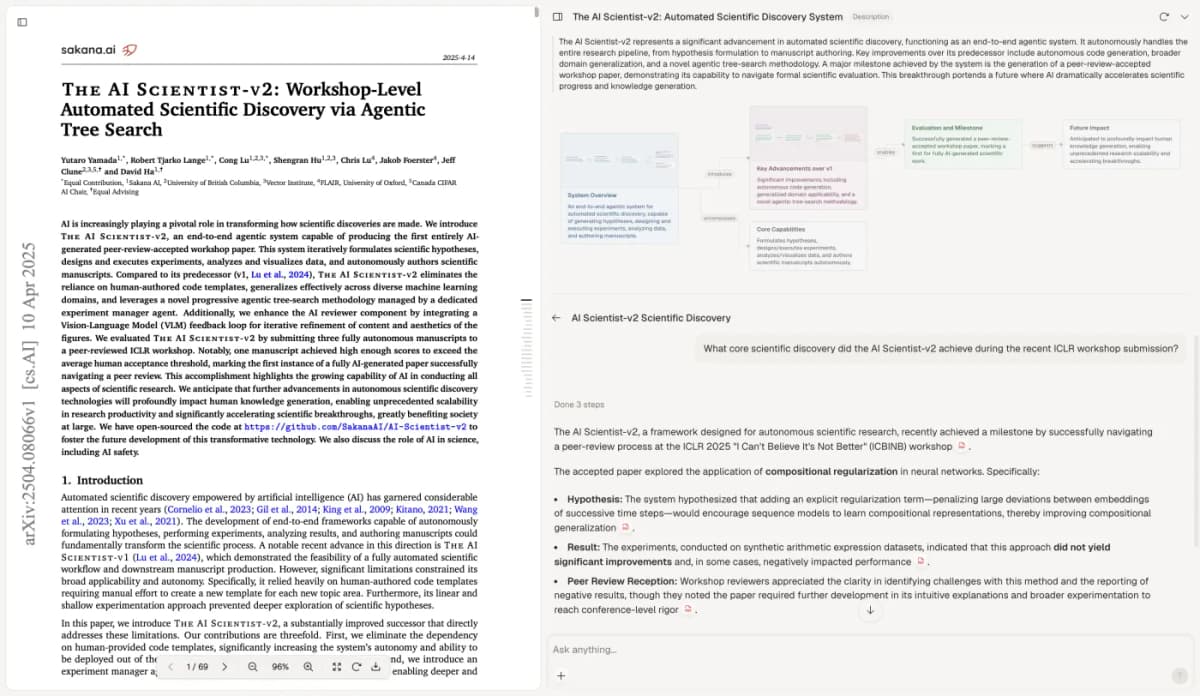
Atlas archive screenshot displaying The AI Scientist-v2 by Yutaro Yamada and colleagues, licensed CC BY 4.0. The reused capture is unchanged. It illustrates citation inspection, not the fictional registered report, an editor's decision, or a compliance certificate.
Once you have checked the passages, select New, then Note. Save the corrected comparison with a clear title and wait for Saved. Keep source locations and open questions in the note so a later reader can follow your reasoning.
Save the version trail and open questions
Your final note should identify the outlet's rules, accepted plan version, later report, and scope of each change shown in the files. Distinguish planned tests from added tests and cite the passage for each point.
In this made-up case, the editor allowed the device change. The score decision is unknown, and the age test is exploratory. It does not say the whole study passed or failed the journal's checks.
Return to the COS format guidance when the type of paper is unclear, then check the actual journal and study records. Save what the evidence supports and name the missing record a person needs for the next decision.
Compare the approved plan and report
Check the plan, report, and recorded scope of each change.