
A three minute thesis, often called 3MT, is a short research presentation for a non-specialist audience. The task is to explain what you investigated, how you approached it, what you found and why it matters within the event's three-minute limit. One static slide usually supports the speech. Check with your event team to learn which rules apply and who may enter.
Begin with the message you want someone outside your field to remember. Then work backward to the evidence needed to support that message. A memorable explanation still needs to preserve what your research actually shows.

Build your source-linked speech outline
Compare your thesis findings and event rules, then save checked speaking notes.
Start with the event rules
Confirm the constraints
Read your event's instructions before writing a script or making the slide. Save the rules beside your thesis abstract and key findings so you can check the same requirements during revision.
The UQ competition rules allow one still slide, shown from the start of the talk. You cannot add moving images, sound files or props. If you go over three minutes, you are out of the contest.
The talk must use spoken words. UQ excludes poems, raps and songs, so check the delivery style as well as the slide and timer.
Check with the event team when your timer starts. UQ's live rules include movement or speech, while Harvard's graduate event page describes starting through speech. Recorded events may have separate submission requirements. Ask your event team about any unclear rule before using a different school's page.
Choose the research contribution
Select a contribution that you can explain and support within the time available. Your thesis may have several studies. The audience needs a story that links the work you choose to share. Write one sentence stating the question and one stating what your work adds.
Use the UQ judging criteria to test the outline. They judge why you did the work, how you did it, what you found and why it matters. They also judge how well you keep the audience engaged. Your opening should lead into those details.
If your study is unfinished, check whether your event accepts your stage of work. Keep completed observations separate from the question you still plan to investigate. A desired outcome can explain motivation without becoming a claimed result.
A dissertation defense presentation serves a different audience. A committee can ask about methods in depth. A 3MT listener needs to grasp what you added on first hearing.
Build the research story from evidence
Keep 4 linked parts
Create a working outline with four parts: question, approach, finding and significance. Add a page, section or passage beside each research claim. These locators belong in your preparation notes even when the spoken script omits them.
For each part, ask what the audience must understand to follow the next one. Explain the problem before naming a method. Explain what you measured before giving the result. Explain what the result changes before describing broader hopes.
The example below turns a public report into speaking notes. It uses NASA's 2025 sea-ice work to show how to shorten a claim and keep its meaning. It is a teaching example, not a student's thesis or submitted script.
| Speech part | Evidence to retain | Possible speaking note |
|---|---|---|
| Question | Report's annual winter maximum | How much Arctic Ocean had sea ice at winter's peak? |
| Approach | Satellite observations and grid threshold | Scientists used satellite readings to estimate ice-covered extent. |
| Finding | March 22, 2025 measurement | That winter maximum was the lowest in the satellite record at the time. |
| Significance | Comparison with earlier winter coverage | Tracking the winter maximum helps describe how ice cover changes. |
Table 1: Each line retains a different job: pose the question, describe the measurement, report the finding or explain its relevance.
Check what the claim can support
Read the outcome and map
The NASA report explains how scientists count grid cells that are at least 15 percent ice-covered. That produces an estimate of extent, the area meeting that threshold. It does not measure ice thickness.
The map shows March 22, 2025 coverage against a yellow line marking the March median for 1981–2010. Median means the middle value of that historical series. Read the comparison as a difference in ice-covered extent; it does not show the depth of the ice.
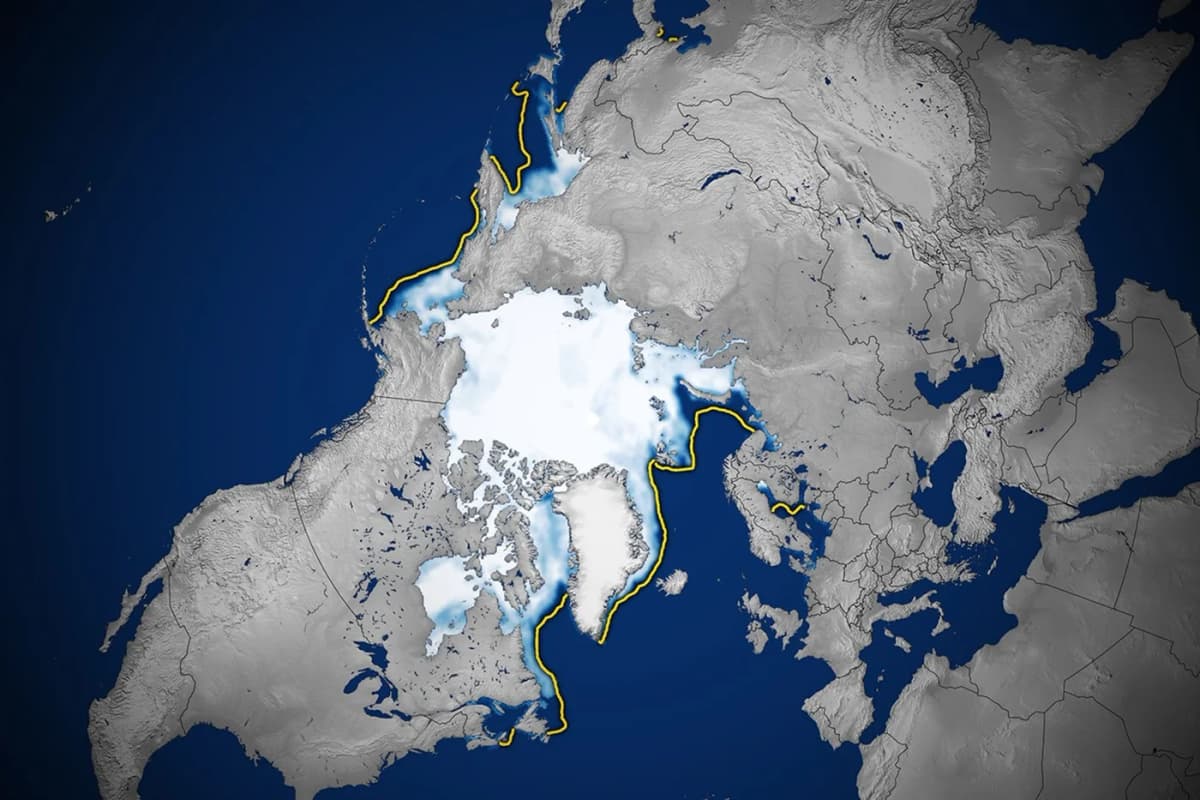
The yellow boundary helps the audience compare the observed winter coverage with the historical median without reading a table of annual measurements.
Image by Lauren Dauphin, NASA Earth Observatory, using NSIDC data. Original source; educational use under NASA media guidelines. Resized and converted to WebP.
Correct wording without changing meaning
A shortened line such as “Arctic ice was thinner than ever” would change the outcome being described. Replace it with the dated extent finding. NASA's 2026 account describes that later winter maximum as tied with the previous record, so the year matters too.
Apply the same check to your own abstract. Did “associated with” become “caused”? Did a laboratory test become a promise about use in the field? Did results from one group become a statement about everyone? Restore the condition before improving the sentence's rhythm.
Use another team's findings as background with attribution. The phrase “my research found” belongs only to the contribution you made. If the abstract and results section support different wording, inspect the fuller results and discuss the discrepancy with your supervisor.
Choose one slide and rehearse
Give the slide one purpose
Choose a visual that helps explain the central message while you speak. A photograph may establish context; a map may show a spatial comparison; a small plot may show the finding. Use material you are permitted to reuse and explain any labels the audience needs.
The Flinders preparation guidance warns that crowded text or complex diagrams can distract listeners. Test the slide at the size and distance where the audience will see it. If someone must study it to understand the next sentence, reduce the material or change the explanation.
For the sea-ice example, introduce the map's date and yellow historical boundary before discussing the comparison. Do not require listeners to infer the legend. A visual can support the measured finding while the speech supplies its meaning and limits.
Test timing and listener recall
Read the draft aloud with the actual slide and a timer. Include pauses and planned movement. A written word count is a planning aid; it cannot show how long your delivery takes.
Record a practice run and listen for the point where you rush. Cut a detail that does not support the main contribution before cutting the pause that lets the audience understand it. Keep enough time for the final significance statement.
Ask someone outside your field to tell you the research question and main finding afterward. Ask where they lost the thread. Those answers reveal a missing explanation more clearly than a general rating of the talk.
In his RIT preparation reflection, Sagar Lekhak describes using feedback and recording to refine pace, graphics and delivery. His experience supports an iterative approach; it does not establish one rehearsal schedule that works for every presenter.
Keep a short revision note after each run: misunderstood term, unsupported claim, confusing image or timing problem. Fix one source of confusion and repeat the full talk. Check that a shorter version still explains your approach and finding.
Use the source-checking guidance for closer reading. You still judge the claims and follow your school's AI rules. Build your slide and rehearse aloud in your chosen tools.
Keep a checked outline in Atlas
Compare the supplied material
Create a project and add the thesis abstract, key findings and event rules you may use. Wait for source processing to finish. Open a chat and use @ mentions to choose sources.
Ask: “Use these sources to outline a talk for people outside my field. Explain the question, approach, finding and why it matters. Cite each research claim. Keep findings apart from plans. Flag missing support or conflicts with the rules.”
For earlier work across studies, use the research synthesis workflow.
Inspect and save the outline
Open each numbered citation and read the passage in context. Check the outcome, who was studied, how sure the finding is and whose work it was. A related passage may not support a stronger claim.
If Atlas suggests “thinner ice,” change it to the dated extent finding. If your sources have no result yet, mark that gap. Select New, then Note, and save these checks with source locators. Confirm Saved. Keep the final script apart from these notes.
Build your source-linked speech outline
Compare your thesis findings and event rules, then save checked speaking notes.