

A dissertation defense presentation should make your argument easy to follow and test. Start with the problem, state what your work adds, and show the evidence for each main claim.
Keep the limits close to the results they qualify.
Build a claim-evidence-question outline before you build the slides. Use the completed dissertation, your committee's guidance, and the talk requirements as sources. The example below traces a released defense back to its dissertation; it adds no new experiments or scores.

Trace your defense claims to study evidence
Compare the dissertation and committee guidance, then save a cited talk outline.
What should a dissertation defense presentation explain?
Explain what problem you studied, why it matters, what you did, what you found, and what your work adds. Give the audience enough evidence to follow that argument.
The main talk should have a clear route through the work, rather than a shortened version of every chapter.
CMU's defense guide emphasizes your contribution and how projects join into one body of work. For each part, ask what the audience needs to know to understand the next claim. Remove detail that does not serve that route, or keep it ready for questions.
The argument will vary by field and study. A proof, an experiment, and a close reading have different evidence needs. Neil Rowe's engineering defense outline puts claims and their validation at the center. Use that principle with the methods and standards of your own discipline, rather than copying its slide counts.
Start with committee requirements and central claim
Keep the dissertation version and committee instructions together. Record how long you can speak, who will attend, which sections are required, and when questions will come. Check what you may share in public. Ask your chair to settle gaps before you finish the outline.
Confirm the local format and timing
There is no single defense length. Colorado Boulder mechanical engineering guidance specifies a 45–50-minute talk. Valdosta's guidelines specify a presentation no longer than 30 minutes. These are different local expectations, not numbers to average into a rule.
Use your actual requirements. Distinguish the talk from the full defense, which may include questions and private committee discussion. If two supplied documents conflict, note each source and date. A document comparison workflow can help locate the conflict; the chair or program settles it.
If you also need a three minute thesis, build a separate outline around that event's audience and rules.
Time your spoken outline during a rehearsal. A slide with one figure can take longer than several short transition slides. Cut or move material based on the work of explaining it, not a universal slides-per-minute formula.
Choose the contribution that unifies the talk
Write a sentence stating what your study contributes and within what scope. Link it to the dissertation's results and discussion.
“I studied this topic” names an activity. A useful claim says what the work found, explained, built, or demonstrated.
Separate your contribution from prior work. CMU's guidance on contribution and story asks speakers to keep the distinction clear and explain the big picture to listeners outside their immediate area. Define terms needed for the claim; do not assume the public audience has read the dissertation.
For several linked studies, name what connects them. The assertion-evidence defense tutorial describes how Jacob Snyder presented a slice of his work while showing its larger scope.
That is a useful choice to discuss with your advisor, rather than a rule that every defense must cover the same fraction.
Trace a dissertation into its defense story
Edouard Fouché's completed dissertation studies data with many attributes that arrive as a stream. The released July 15, 2020 defense groups the work around estimating dependency, monitoring, and knowledge discovery.
The talk links these questions and shows how the projects fit together.
Keep the claim, source, and question together
This documentary outline follows Chapter 8, Outcome, and Chapter 9, Future Work, in the dissertation. The questions are review prompts added here; they are not a transcript of what the committee asked. The algorithm names belong to this source example.
| Defense point | Dissertation evidence to inspect | Question to prepare |
|---|---|---|
| Estimate dependency with MCDE | Chapter 8 links the framework to Part II and its tests | Which requirements and test settings support the claim? |
| Monitor statistics with S-MAB | Chapter 8 links analysis and experiments to Part III | Which guarantees rely on a static setting? |
| Use the methods for knowledge discovery | Chapter 8 links SGMRD and text-outlier work to Part IV | Which task and evaluation does each claim concern? |
| Keep non-static theory as open work | Chapter 9 separates empirical support from further regret analysis | What is shown, and what remains to be proved? |
Table 1: For a real defense, expand each outline entry with the exact page, figure, method, and result needed to answer it. Here, Chapter 8 is printed pages 127–128, PDF pages 139–140; Chapter 9 begins on printed page 129, PDF page 141. Do not cite a conclusion paragraph as a substitute for reading the study evidence it points to.
Show how the research questions connect
The original slide shows three connected areas of work. Estimating dependency feeds monitoring; both feed knowledge discovery. Each area has a question about work on high-dimensional data streams. This map shows how the projects fit. The study evidence later in the talk supports their claims.
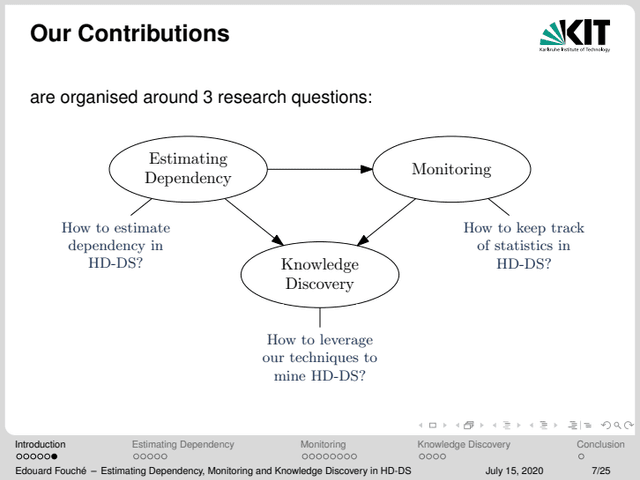
Original Edouard Fouché defense, slide 7/25, PDF page 25, July 15, 2020. Complete unchanged slide capture, CC BY-SA 4.0. Source institutional mark retained for attribution.
The PDF has a page for each overlay, so its page count differs from the displayed slide number. Keep both locators.
The dissertation's Future Work chapter leaves non-static regret analysis for future work. Keep that limit when you discuss monitoring. Tests that show strong performance do not prove a guarantee for all settings.
Prepare evidence and questions behind each claim
For each main claim, write the supporting dissertation passage, the evidence you will show, and the limit. Add one question that could test the link. Keep the question specific enough that you can point to the part of the study that answers it.
Prepare answers with source locators
Questions may concern why you chose a method, what a result means, or how your work differs from prior research. Colorado Boulder's defense guidance asks students to discuss committee interests in advance. Use those concerns alongside your own source review; do not predict that every committee will ask the same questions.
Where your method rests on a theory or model, connect that reason to the cited literature and the choices you made. The theoretical framework guide helps trace this relationship. Keep a method justification distinct from proof that a result is true.
Read the full passage behind an answer. A source-checking workflow can help detect when a sentence claims more than the dissertation supports. Keep backup figures or passages ready when they can help. Make them easy to find by slide or page number.
Rehearse the explanation and the evidence
Read the argument aloud with the figures you plan to show. Can a listener state the claim after your explanation? Can they see how the evidence bears on it? Explain key axes, groups, or assumptions rather than expecting a chart to speak for itself.
CMU's slide-design guide recommends descriptive titles and notes for what you plan to say. Use the title to orient the listener, and speak the reasoning that connects the visual to the claim. Keep the written dissertation available for detail.
Ask your advisor or peers to listen and flag links they cannot follow. Rowe's faculty guidance on rehearsal treats a practice run as a way to test both length and clarity. Record the feedback, revise the outline, then check that each changed claim still matches the source.
Check what the outline can support
Before using the outline, check each claim, source version, passage, key evidence, limit, and question. Make sure you can explain the connection yourself. A citation to a related chapter is not enough if it does not support your words.
Keep findings, your reading of them, and next work distinct. A research synthesis workflow can compare them across chapters without turning a plan into a completed result.
Preserve conflicts or gaps instead of filling them with a plausible answer.
If a question exceeds your evidence, say what you know and what would be needed to answer it. Colorado Boulder's advice on unknown answers encourages honest acknowledgment. A prepared outline helps you reason under questions; it cannot guarantee the committee's decision.
Check what you may share or process before you add the dissertation or review comments to any tool. A defense may include confidential data or unpublished work.
Follow the study and program's access requirements. Source checking cannot approve the methods, rerun the results, or replace practice for your talk.
Save a cited defense outline in Atlas
Atlas can compare the dissertation with committee guidance and help draft a working outline. Build the slide deck in your chosen presentation tool after checking the argument. Rehearse it yourself and make the final choices about claims and evidence.
- Add the completed dissertation, guidance, and requirements you may process to one project. Wait for processing to finish.
- In chat, type
@and select those sources. Choose Project only to prevent new web or literature retrieval. Earlier chat context remains available, so name the dissertation and requirements you intend to use. Ask for a claim-evidence-question outline that follows the supplied requirements. - Open each citation and check the passage. Correct overclaims, keep study limits, and mark missing evidence within these records.
- Select New, then Note. Save the checked outline with source locators and open questions. Confirm Saved before closing the note.
Try this request: “Using @selected sources, outline my defense around its main contribution. For each claim, cite the dissertation evidence, keep its limit, and suggest a question to prepare. Follow the supplied talk requirements. Distinguish prior work, my results, and future plans. Mark missing support; do not invent findings or promise a successful defense.”
Trace your defense claims to study evidence
Compare the dissertation and committee guidance, then save a cited talk outline.