

Yes, you can usually use AI for a dissertation, but mainly for the reading and sorting work, and only if you declare it. Most of the UK, Irish and Australian universities in this guide let you use AI to find, read and organise sources. Two of them ban AI-written text: Birmingham in taught master's dissertations unless the School permits it, and Bristol in research theses. The others let you use AI only if you acknowledge it, and none let you pass AI text off as your own. Your assessment brief, course handbook and supervisor have the final say. If you are writing a thesis at a US graduate school, the AI for thesis writing guide covers the same steps with US policies and a reference check.
A safe way to work:
- Read your brief and handbook for an AI rule. If they say nothing, look up your university's default.
- Ask your supervisor what is allowed for your dissertation, and keep the reply.
- Use AI to find, read and sort sources. Write the chapters yourself.
- Keep a log of each tool, what you used it for and when.
- Open every page and reference the AI points you to before you rely on it.
- Write the declaration your university asks for, in the place it asks for it.
On 7 November 2026 I ran step 3 for one chapter, a literature review, with six open-access papers in Atlas. The screenshots and the citation check further down come from that session.
Put one chapter's papers in a project
Ask for themes across your sources and open the cited page for each claim.
What UK, Irish and Australian universities allow
There is no single national rule. The Russell Group principles from July 2023 say "Universities will ensure academic rigour and integrity is upheld." They also commit universities to "provide students with clear guidance on how to use generative AI to support their learning, assignments, and research". The detail is left to each university, and often to each school or course. The table below shows what eight of them say, in their own words, from pages I opened on 7 November 2026.
| University | Default rule | What you must do |
|---|---|---|
| Glasgow (UK) | Dissertations count as unsupervised assessments, where "you can use GenAI, but you must acknowledge it." This applies when your course documents say nothing. | "Always acknowledge Gen AI use, no matter how light." |
| Leeds (UK) | "Students are permitted to use technologies to prepare work for assessment if restrictions are not specified within the assessment brief." Tools may play a supporting role, and your own learning and skills still have to show. | Reference your sources and "acknowledge use of assistance." |
| Edinburgh (UK) | AI can support your learning but should not "do the learning for you." Course guidance "may allow you to use AI in certain ways, or it may restrict it further." | Never hand in AI-generated text without acknowledgment. |
| Birmingham (UK, taught master's) | No AI-generated material "within any part of their PGT dissertation" unless the School has "specifically permitted" it. | If you use AI to proofread, tell your supervisor and add a statement in "a dedicated acknowledgments section." |
| Bristol (UK, research degrees) | Students are "not permitted to use generative AI tools to write any text that is used in your thesis." | Acknowledge any use for translation in the thesis. |
| Queen's University Belfast (UK) | Guidance for supervisors recommends allowing AI "unless it compromises the intended project learning outcomes." | Supervisors check that you have "signed a declaration" about your AI use. |
| Trinity College Dublin (Ireland) | AI "is permitted unless otherwise stated in course and module handbooks." | "You must (at a minimum) acknowledge its use." |
| Sydney (Australia) | "You can use AI in open (unsupervised) assessments," but generally not in secure ones without the unit coordinator's permission. | "If you use AI in your assessments, you're required to acknowledge it." |
Table 1: Default AI rules for dissertations and coursework at eight UK, Irish and Australian universities, quoted from their own pages on 7 November 2026.
Two patterns stand out:
- The starting point differs. Glasgow, Leeds and Trinity allow support by default. Birmingham's taught dissertations and Bristol's research theses start from a ban on AI-written content.
- Most ask you to declare it. Glasgow wants every use acknowledged, however light; Bristol asks only for translation and similar help to be acknowledged.
Check which rules cover your degree. Birmingham and Bristol publish separate pages for taught and research students. Sydney's page covers coursework, and the Queen's guidance is written for supervisors. A school or module rule can be stricter than the university default.
How to declare AI use
Most universities in the table ask you to declare AI use. The details they want, and where they want them, are much the same.
What to include
UCL's library guide lists four details:
- the name and version of the AI tool,
- the publisher,
- its web address,
- one sentence on how you used it.
UCL's example uses Microsoft Copilot: "I acknowledge the use of Microsoft Copilot (version GPT-4, Microsoft, https://m365.cloud.microsoft/chat) to summarise my initial notes and to proofread my final draft." Sydney's template follows the same pattern: "I acknowledge the use of [AI tool + version, publisher and URL] to generate [summary of what was generated]."
Where it goes
Where it goes depends on your university. UCL says the statement belongs in an "Appendix" or "Methods" section and "should not be included in the word count." Birmingham asks for proofreading use in an acknowledgments section. Queen's asks supervisors to collect a signed declaration and "any related evidence."
A template you can adapt
Here is a fill-in version built from those elements:
I acknowledge the use of [tool, version, publisher, web address] to [what you used it for] in [chapter or task]. I checked [what you checked, such as each cited page]. No AI-generated text appears in the submitted work.
If your rules allow some AI-edited text, replace the last sentence with what you kept and how you changed it.
Keep a log
Start a log on day one and add to it each time you use a tool. Note the date, the tool, the task, your question and what you did with the output. Glasgow asks you to acknowledge use "no matter how light," so small uses count too. A log also gives you something to show if anyone asks how you worked. In Atlas, each chat stays in the project with its question and cited answer, which makes this easier.
Where AI fits, chapter by chapter
Edinburgh's line is a good test for every chapter: is the tool supporting your learning, or doing it for you? In practice, AI is most useful where the work is reading and comparing many sources. It is least safe where the work is your own argument.
Literature review
This is where AI helps most. The job is to read many papers and show how they connect. A paper-by-paper list of summaries falls short of that.
Put the chapter's papers in one project. Ask for themes across them, with the page for each claim. Then open each cited page and read the passage yourself. Use the themes as a plan for your reading. Write the chapter from your own notes.
Edinburgh lists "Citing and referencing AI found sources without reading and verifying them" as misconduct. So a reference only goes in your chapter once you have read it.
For the method behind a themed review, see the guide to writing a literature review with AI. The next section shows one real session.
Methodology
Your methods chapter explains choices you made, so the reasoning must be yours. AI can help with the background. Ask which methods the papers in your field used, how big their samples were and what limits they reported, with page citations. Compare those pages, then explain in your own words why your design fits your question.
If you used AI in the research itself, for example to transcribe, translate or code data, say so here. UCL names the methods section as one place for the declaration. Check your ethics approval before you upload interview transcripts or other participant data to any AI tool.
Discussion
The discussion compares your findings with the literature. AI can find the pages to compare against. Ask something like "Which of these papers report results that differ from [your finding]? Cite the page." Then read those pages and write the comparison yourself. What your findings mean is the part your marker is grading.
Worked example: a literature review chapter
To test this on a real chapter, I set up an Atlas project called "MSc dissertation: literature review chapter" on 7 November 2026. The topic was generative AI and academic integrity in universities. I uploaded six open-access papers:
- Liang and colleagues (2023), on AI detectors and non-native English writers.
- Chan (2023), on an AI policy framework for universities.
- Weber-Wulff and colleagues (2023), on testing AI text detectors.
- Wang and colleagues (2024), on the AI policies of the top 100 US universities.
- Perkins and colleagues (2024), on the AI Assessment Scale.
- Walters and Wilder (2023), on fake citations from ChatGPT.
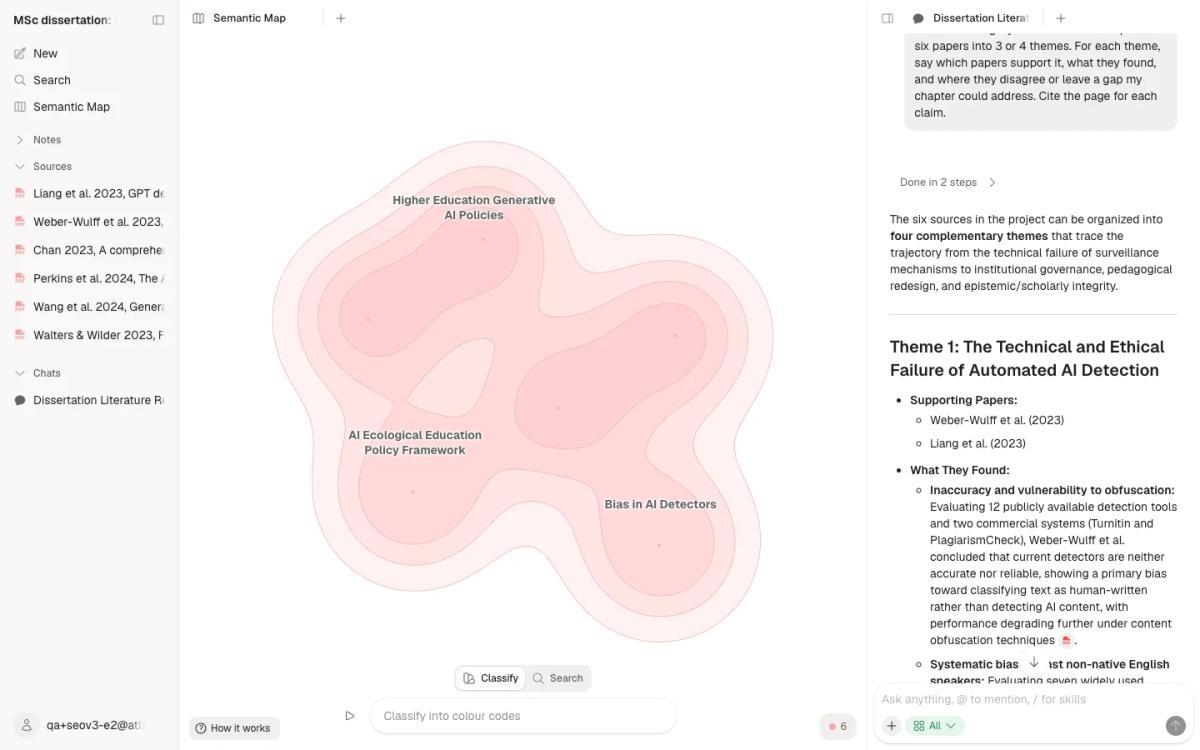
All six were ready to chat within two minutes of upload. I renamed each one to author and year so the citations would be easy to read. The project's Semantic Map grouped the papers under three labels, including "Higher Education Generative AI Policies" and "Bias in AI Detectors". The map shows which papers sit close in meaning. Use it to plan the chapter. You cannot cite it as evidence.
Then I asked one question:
I am writing the literature review chapter of my MSc dissertation on generative AI and academic integrity in universities. Group these six papers into 3 or 4 themes. For each theme, say which papers support it, what they found, and where they disagree or leave a gap my chapter could address. Cite the page for each claim.
The answer took about 87 seconds. It gave four themes: detection failure and bias, university policy, assessment redesign, and fake citations. It ended with a summary table. It had 20 citations, and each one named a paper and a page.
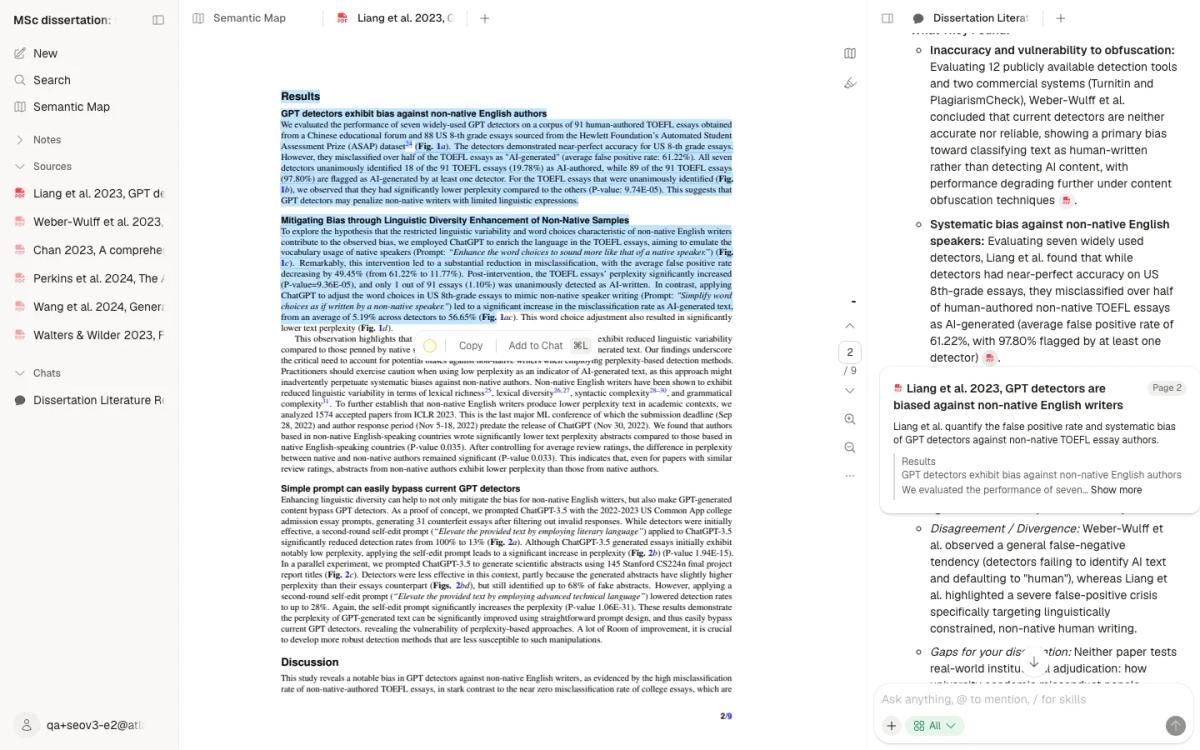
Selecting a citation opens the PDF at that page. The citation for the claim that detectors wrongly flagged essays by non-native English writers opened Liang and colleagues on page 2. The passage with the 61.22% average false positive rate was highlighted.
I then checked all 20 citations. For each one I pulled the text of the cited page and searched it for the figure or phrase in the claim. Here is what I found:
- 16 of 20 were supported. The figure or claim was on the cited page.
- 2 cited a second-hand report. Chan's page 2 says some Australian universities went back to pen-and-paper exams, but Chan is citing other writers (Cassidy 2023 and Cavendish 2023). In a dissertation, find and cite those originals.
- 2 pointed to weak pages. The claim about why chatbots invent references cited pages 1 and 2 of Walters and Wilder. Page 2 touches on it, but the full argument sits in the paper's Discussion on pages 6 and 7.
One word also stretched the source. The answer called Wang's documents "provost-level." Page 3 only says the study used official university sources and left out department and program pages.
The "gaps your chapter could address" were the most tempting part, and the least checked. They are the model's own suggestions. None of the six papers states them as findings. Treat each one as a lead to test against wider reading.
So the answer was a reading plan for the chapter. It told me which page of which paper to open for each theme. It was not text to paste.
The test had limits. It was one question on six papers on one day. I left the chat scope at its default. For dissertation work, choose Project only beside + so Atlas cannot run web or literature search, and start a new chat for each chapter, because earlier context in a chat can remain. Atlas page numbers count pages from the start of the PDF file, so check the printed page number before you cite it.
What to avoid
- Handing in AI-written text. Birmingham bans it in taught dissertations unless the School permits it, and Bristol bans it in research theses. Glasgow and Edinburgh require you to acknowledge any you include.
- Citing references you have not opened. Walters and Wilder found that 55% of the works GPT-3.5 cited were fabricated, against 18% for GPT-4. Among the real ones, 43% and 24% had substantive errors such as wrong authors or page numbers. The AI citation checker guide covers how to check a reference list.
- Running your own work through AI detectors. Leeds explains "why students should not use AI detector or plagiarism detector websites." Liang and colleagues found seven detectors misclassified over half of the TOEFL essays by non-native English writers as AI-generated. Sydney says "the AI detector score would not be the only evidence relied upon for an academic integrity case." Your log and drafts are better evidence of how you worked.
- Machine-translating your work into English. Edinburgh says this "is treated as false authorship and is not acceptable."
UK deadlines and when to start
Taught master's dissertations in the UK are often due in August or early September. Three confirmed examples:
- LSE Sociology (SO499): upload by 4pm on Thursday 12 August 2027.
- Edinburgh, School of Social and Political Science: Thursday 13 August 2026 for the 2025-26 taught MSc.
- Manchester, Alliance Manchester Business School: 2pm on Monday 7 September 2026 for the 2025/26 MSc.
Undergraduate deadlines are set by each department, so check your handbook. Research degrees have no shared date. At Manchester, for example, you submit by the end of your registration period or within a set submission-pending period after it. In Australia, Melbourne Law School gives anticipated due dates of 30 June or 31 December for its LLM minor thesis, depending on when you started.
We recommend you treat the date in your own handbook as the fixed point and plan back from it. Settle the AI rules with your supervisor before you draft your first chapter, so a late answer cannot force a rewrite.
What to do next
Sort out the rules early, before you start writing. This week, do three things:
- Email your supervisor to ask what AI use is allowed on your dissertation, and keep the reply.
- Start your log and decide where your declaration will go.
- Put the papers for your first chapter in one project and ask for themes with page citations.
Then you can spend the last month writing. To choose tools for each stage of a review, see AI for literature review. To turn themes into a written chapter, see how to synthesize research papers.
Put one chapter's papers in a project
Ask for themes across your sources and open the cited page for each claim.