

A UX research interview guide is a flexible plan for a conversation with someone who uses, or may use, a product or service. It connects what your study needs to learn with topics, open questions, and follow-up probes. Here, the interview is a user study, rather than a job interview for a UX role.
Suppose an event report records checks of tool availability without a later booking event. Asking why the price put them off assumes a cause the records never established. A better guide asks about the last time they considered borrowing a tool and leaves room for what happened next.
The worked example below connects five research gaps to prompts and probes. Atlas can help compare your study notes and draft that map. You still check the sources, review the wording, and pilot the guide with a person.

Draft your interview guide in Atlas
Check earlier research and save a reviewed discussion guide.
What belongs in the interview guide
A usable guide gives the interviewer enough structure to cover the study's topics while leaving room to follow the person's story. It usually contains an opening, a few core topics, optional probes, a closing, and notes about timing or activities. A probe is a follow-up that asks for detail or clarifies a response.
Keep the study's purpose at the top. Add the guide version, date, user group, planned length, and links to the agreed consent and recording plans. Those details help another interviewer see what this round is meant to learn.
The GOV.UK interview guide recommends starter questions and follow-ups for each topic. Use the guide to keep track as you listen, with freedom to pursue a relevant answer rather than reading every line.
The wider UX research plan covers the study decision, method choice, and recruitment needs. This article develops the question-and-probe part of that plan. If the team has not agreed what it needs to learn, settle that before polishing interview wording.
Start with evidence and open questions
Read the prior research with its limits
Gather the study questions, earlier research, and a short list of open issues. Keep each source's date, user group, method, and scope.
A support contact from an existing customer tells you about that contact. It may reveal little about someone who never joined.
For each useful passage, write what it supports and what remains unknown. An earlier interview may report that one person called to check a pickup time.
That account does not show that every borrower needs a call or that the booking page caused confusion.
The GOV.UK research-planning guidance starts with actionable objectives and beliefs to examine. If the objective is vague, use the research objectives guide to name the decision and what you must learn for it.
Separate findings from team beliefs
Mark your preparation notes as prior evidence, team assumption, or open question. Prior evidence has a source you can inspect. A team assumption is a belief that needs checking. An open question names what this study should explore.
For example, a product manager may believe that lower prices would lead to more loans. Keep that belief in your notes as an assumption. Do not open the session by telling people price is the main problem.
The User Interviews field guide warns that even asking about a person's biggest challenge can assume a negative experience.
A real GDS webchat study used what the team had seen and the users' roles to prepare guides. Make topics fit the evidence and people involved. That study's questions are not a ready-made guide for your product.
Turn study questions into open prompts
Translate the question into a lived event
A research question is written for the team. An interview prompt is spoken to a person. Translate the first into something that person can recall and describe. Asking how uncertainty affects conversion uses the team's terms and asks for an explanation they may not be able to give.
Instead, ask about a past event: think of the last time you considered borrowing a tool, and describe what happened. This leaves room for a booking, a different choice, or no action. NN/G's guide links prompts to study questions and uses events to draw out stories. Keep that question-to-prompt mapping in your method notes.
Ask one clear question at a time. A prompt that asks about finding a tool, paying, collecting it, and recommending the service can produce an answer to only one part. Start with the event, then follow the person's account. Keep technical product terms in your notes unless participants use them themselves.
Check the premise and prepare probes
Check each question's premise against the evidence for its topic. Why was collection inconvenient assumes it was inconvenient. How did you arrange collection leaves room for an easy process, a problem, or a different outcome. Neutral wording allows answers that challenge the team's beliefs.
Prepare probes that ask what happened next, who was involved, what they read or used, and what they mean by a term. Mark them as optional. If the person already covered a point, you need not ask it again. Yale's guide suggests core questions with follow-ups for different answers.
Use the person's words when you probe. If they say a date was unclear, ask what they saw and what they did next. Avoid replacing unclear with broken, frustrating, or deceptive. The GOV.UK method guidance stresses real examples, listening, and follow-ups that clarify what was said.
A worked UX interview question map
Keep the fictional inputs visible
The tool-loan service, preparation records, and proposed questions are fictional teaching examples that establish no real customer needs. No interviews, pilot sessions, participant quotes, or booking analysis were conducted.
The team wants to learn how people decide whether to borrow a tool and arrange collection. Its fictional inputs are:
- R1: an earlier interview summary.
- S1: selected support notes.
- E1: a limited event report.
- Q1: the new study questions.
E1 contains availability checks without a later booking event, but no reason for the missing event.
Read each row from the documented gap to the proposed prompt. The source explains why the team wants to explore that topic; it does not supply the next participant's answer.
| Prior evidence and gap | Study question | Open prompt | Optional probe |
|---|---|---|---|
| R1 mentions buying elsewhere; reasons are unclear. | How do people choose among options? | Think of the last time you needed a tool. How did you decide what to do? | What other options did you consider? |
| E1 has availability checks without later booking events; reasons are absent. | What happens between checking and choosing? | Tell me about the last time you considered borrowing a tool. What happened next? | What influenced what you did next? |
| S1 includes questions about pickup times; actual arrangements are unknown. | How do people arrange collection? | If you arranged collection, walk me through how you did it. | What information did you use? |
| R1 notes help from another person; their role is unclear. | Who takes part in the decision? | Who, if anyone, was involved in that occasion? | What part did they play? |
| Q1 asks about outcomes beyond booking; no prior account covers them. | What happens after the choice? | How did that occasion turn out? | Was there anything else you needed to do? |
Table 1: The map preserves five different gaps and makes each follow-up conditional on the person's account.
Correct an unsupported price assumption
An early draft might ask why the price stopped the person booking. E1 gives no reason for the missing event. It does not even show that a specific person abandoned a booking.
A missing event could also reflect a route not tracked, a later choice, or a change of plan. These are possible reasons to explore.
Replace that draft with the second row's event prompt. If the person brings up cost, ask how it fitted into their choice. If they describe timing or another option, follow that account.
Do not keep steering the conversation toward price because it appears in a stakeholder's note.
The User Interviews discussion-guide advice supports following useful responses. The correction keeps the topic while removing an unsupported answer from the question. It does not prove that the revised wording will work; the pilot still needs to check that.
If your target group includes people who only considered borrowing, add a branch for those who never collected a tool. Asking everyone about their pickup experience would assume an event that may not have happened. Make those branches visible beside the relevant question.
Arrange topics for a natural conversation
Open with purpose and easy context
Begin by explaining who you are, what the session is about, what will happen, and how to ask questions or skip a topic. Explain the actual plans for recording and data use.
Follow the approved consent process. Do not borrow a promise of anonymity from a template if it does not match your study.
Then use an easy, relevant opening. For the fictional study, ask what kinds of tasks the person recently needed tools for. It establishes context without assuming they used your service. The GOV.UK session guidance puts consent and an introduction before the main conversation.
Follow the event before asking for reflection
Arrange the main topics to follow the person's story from needing a tool through weighing options, choosing, any collection, and the outcome. Ask for their views once they have described the event.
Move between topics when that makes sense. Avoid breaking the story just to follow your document order.
Keep questions spoken aloud distinct from notes for the moderator. A reminder to explore other options is not necessarily a line to read verbatim. The distinction helps the interviewer listen without introducing every possible answer.
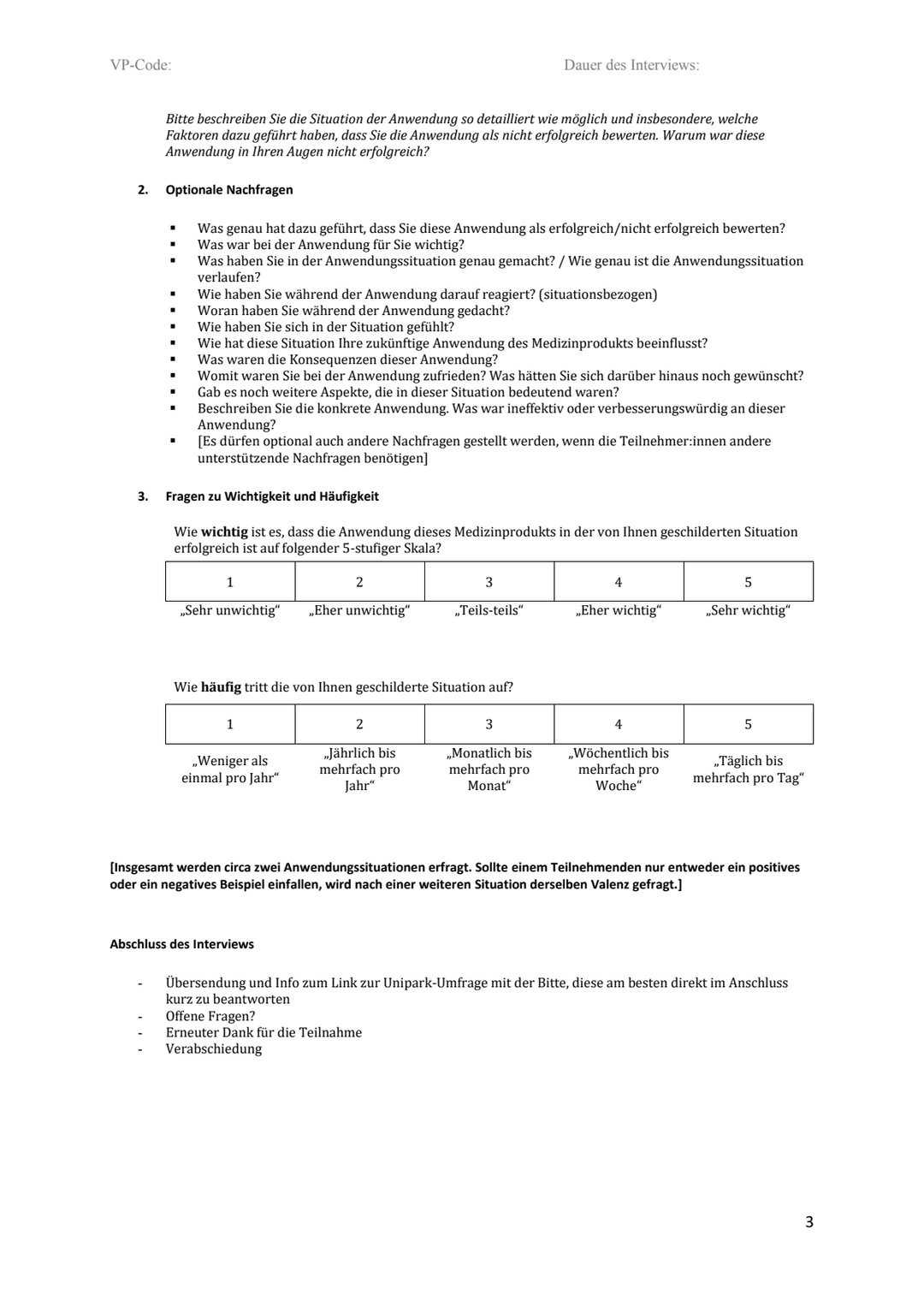
This original page from Freier and colleagues' 2022 medical-device UX interview guides separates optional probes, importance and frequency ratings, and the closing. It is reproduced unchanged under CC BY 4.0.
The German heading “Optionale Nachfragen” marks the optional probes; the bold closing heading marks the ending. The ratings and specialist questions belong to that study. They are not a universal UX template.
Make core prompts, optional notes, and the closing easy to tell apart in your guide. Finish by asking about anything missed, checking unclear points, and explaining the actual next steps.
The GOV.UK closing guidance includes those final checks. Leave time for that ending when you plan the session.
Pilot the guide and record changes
Try the whole guide aloud, including the opening and closing. A colleague can reveal awkward phrasing and poor flow. A pilot with a relevant user can also show whether the topic and examples fit their experience. NN/G's pilot advice covers wording, omitted questions, order, and time.
Notice whether a prompt needs repeated explanation, bundles several questions, or assumes something the person cannot describe. Check the branch for someone who never booked. If a story answers three planned questions, let it do so rather than making the person repeat it.
Treat section timings as a plan to test, with room for pauses and useful detail you did not expect. If time runs short, focus on the topics needed for this round's decision. There is no fixed question count for every interview.
After the pilot, record the old wording, the issue you saw, the new wording, and why it changed. Your record needs evidence from the pilot you run. The price-question correction above is only an editorial example.
Check access needs as part of preparation. Plain language, breaks, an interpreter, or a different session format may change the guide's pace and instructions. Agree those arrangements with the research team and participant rather than expecting one script to fit everyone.
Keep version dates when you revise the guide during the round. If a major topic or question changes, think about how that affects a comparison of earlier and later sessions.
The GOV.UK planning guidance includes practice sessions and access needs. Your change record helps others trace those decisions.
Keep interview claims within their evidence
An interview mainly gives you the person's account of events, thoughts, and experiences. Memory can have gaps, and people may leave out details or shape answers around what feels acceptable.
Neutral questions help, but they do not remove every source of bias.
If the team needs to know what happens on a booking page, choose a method to observe use or check records of behavior. NN/G's interview overview distinguishes reported experience from a usability test in which someone tries tasks.
A guide can support both parts of a combined session while keeping their purposes distinct.
Likewise, repeated comments do not by themselves tell you the share of all customers who hold a view. The GOV.UK qualitative interview guidance cautions that such studies describe a range of views without showing how common each is. The sample and measures need to fit a claim about that share.
Keep prior evidence and new interview material separate during analysis. A support note that prompted a question should not count as an answer to it. A researcher's suggested explanation should not become a participant quote. Record when the evidence does not settle the question.
For the approach to adapting questions while listening, see the semi-structured interview guide. Flexibility helps you explore an account; the study's purpose and claim boundaries still guide the work.
Draft and review the guide in Atlas
Add the prior research, gap list, and agreed study questions only when you may use that material. Keep source names, dates, and group limits clear. Choose what the draft should draw on before asking for questions.
Start a project chat. In Ask a question, type @ and select the relevant sources. If an item is absent, check that it belongs to the project and has finished processing.
For a draft limited to supplied material, select Project only beside +. Earlier chat context remains available, so start a fresh chat if it contains outside assumptions you want to avoid.
Ask for a bounded draft:
From these study questions, prior research, and gap notes, draft a UX user-interview guide. For each topic, separate the prior evidence from what remains unknown and cite the passage behind the topic reason. Add one open prompt and optional probes. Leave room for someone who considered the service but never used it. Do not infer why a missing booking event occurred or invent participant answers.
Inspect every topic reason in the answer. Open its numbered citation and read the surrounding passage. Check whose experience the source describes and whether the draft extends it to a different group. If a citation is absent or unhelpful, find the item by name and check it directly.
Then review the prompt itself. A citation can support exploring cost without justifying a question that assumes cost prevented a booking. Ask Atlas to separate the evidence from that assumption, and rewrite the prompt by hand.
Also inspect questions without prior findings. A documented gap may justify asking, but it must remain a gap.
Check the guide against all study questions, including the ones the answer may have missed. Reorder topics, remove repeated prompts, and mark the optional branches. Source selection and citations do not guarantee full coverage or good interview wording.
Select New, then Note, and save the reviewed guide with its source map, version, and open pilot checks. Wait for Saved before closing the note. The saved draft is preparation for fieldwork; it is not evidence that any user holds the views mentioned in the source notes.
Review before the first research session
Read the guide aloud once more. Each core topic should serve a study question, and each source-backed reason should match the cited material. Check that the prompts permit experiences the team did not expect and that the probes follow what the person says.
Confirm the opening, participant information, recording arrangements, access needs, and closing with the responsible researcher. Keep the current guide version beside the pilot revisions so the interviewer knows which wording to use.
Return to the fictional booking gap as a final check: does the guide invite a story about a choice, or supply price as the answer before the person speaks? Correct that premise, then use the actual pilot to judge whether the wording and sequence work.
Draft your interview guide in Atlas
Check earlier research and save a reviewed discussion guide.