

Conceptual analysis asks what a concept means, what counts as an instance, and where its boundaries lie. It helps you see whether authors who use the same word are discussing the same idea.
Three papers may use resilience to mean bouncing back, holding firm, or changing. A note that says “all authors mean bouncing back” would hide a difference that matters to the study.
This guide shows how to read the meanings in your sources before you choose one for your study. It uses real papers and test cases made up for teaching. In Atlas, you can compare chosen sources, check their claims, and save the note.

Compare concept definitions in Atlas
Keep each meaning and boundary case tied to a passage in your chosen sources.
What conceptual analysis clarifies
The central question is what makes something count under a concept. Frank Jackson's expert overview explains this task through proposed accounts, disputed cases, and the difference between existing and newly chosen concepts.
Start by setting the authors’ stated meanings side by side. Then look at how they use those meanings and whether a hard case shows a gap. Even a clear sentence can leave doubt about what counts.
There is more than one way to do this work. Beaney’s account explains the range of approaches. Kölbel’s methods paper links the kind of question to the grounds for an answer. The steps here help you compare sources; they are not a rule for all philosophy.
A conceptual framework explains how the concepts in a study connect. A clear meaning for resilience can help you build it. That meaning alone does not prove a link with stress, resources, or outcomes.
Decide which meaning you are investigating
State whose concept matters
Choose the owner and purpose of your question by asking whose meaning you need to understand. “How do these three papers define resilience?” limits the task to those sources. Asking what researchers mean would make a wider claim about a group that three papers cannot establish.
State the field, dates, language, and kinds of source you need. For a study of a service during an outage, a paper about health might offer a contrasting meaning. Explain why that contrast helps your question instead of assuming it fits.
Use your research objectives to explain why the distinction matters. Perhaps you need to decide whether uninterrupted minimum service and later recovery count as the same outcome in your review.
Separate description from proposal
An account may describe how people already use a concept or offer a new definition for a purpose. Kölbel discusses this distinction. Record which job the source is doing before comparing its terms with another paper.
You can choose a meaning for your study, but say why you chose it. “For this review, recovery means return to the stated service threshold” is your rule. It does not prove that all authors or service users share it.
Choose sources that reveal contrasting uses
Read the definition in its setting
Keep the passage, section or page, author, date, and version together. Read the text around the passage too. An abstract may leave out a rule or limit that the author explains in the body.
The Computing paper shows why nearby text matters. Its terms depend on which states of a system count as acceptable and on the kind of change. Calling this just “coping” would lose the rules that distinguish those terms.
Include meaningful contrasts
Choose sources for reasons you can state: they introduce an account, apply it to your setting, challenge a condition, or use the word differently. Do not pick only the passages that support the definition you already prefer.
The NIH account and Nisioti and colleagues’ proposal serve other goals. Read them alongside the first paper to see why “bouncing back” alone leaves parts of their meanings out.
Keep an exclusion note for sources you considered but did not use. A paper about an unrelated system may help define a contrast without supplying evidence for your setting. If you exclude it, record that reason rather than quietly narrow the field to supportive meanings.
State how you found and chose the sources beside the table. These three papers show a contrast. They do not form a systematic review of all meanings or show how often each meaning occurs.
Compare evidence for a proposed boundary
Ask what the condition requires
A necessary condition must be present for a case to qualify. A sufficient condition is enough to make it qualify. If your rule says resilience requires recovery after disruption, a system that resists disruption raises a question: does that rule wrongly exclude it?
Test these rules where they fit your question. Jackson explains why a full account in more basic terms can be hard to give. You may clarify a contrast while leaving an unclear case open.
Separate meaning from observation
For each source, note which cases fit, which do not, and which are unclear. Then ask what records would show that a real case fits. Knowing what recovery means does not show that a given system recovered.
A measure is distinct from what it aims to measure. An outage log might show that service returned to a threshold. That record alone cannot capture all the ways to resist, grow, or build capacity in the NIH account.
Keep a disputed case visible
When two sources disagree about a case, record why. Counting authors does not settle the dispute. They may set different thresholds, study other units, or choose different meanings. Keep a missing detail marked unknown until you find the passage that explains it.
For example, a paper may name recovery without saying whether the target is full performance or an acceptable minimum. Mark the target as unstated in that passage, then check the methods and discussion. Do not fill it from another author’s definition simply because both use the word recovery.
A worked comparison of resilience definitions
The following five rows are teaching paraphrases of three original academic papers. Their scope is the selected definitions. The last column states what a researcher would still need before applying the account to an observed case.
Five source accounts of resilience: where each draws its line and what a real case would need.
| Source and account | Boundary retained in the comparison | What still needs evidence |
|---|---|---|
| Computing: robustness, Section 3 | A change leaves the system within the same acceptable range | Which range applied and the states before and after change |
| Computing: graceful degradation, Section 3 | Performance may fall but remains within minimum acceptable bounds | Whether the minimum was met throughout the relevant change |
| Computing: recoverability, Section 3 | The system may enter an unacceptable but recoverable state and return | The unacceptable period and the basis for a return claim |
| Brown and colleagues: NIH working definition, Sections 3–4 | Capacity can concern resistance, adaptation, recovery, or growth after a challenge | The system, challenge, response, and measures suited to that capacity |
| Nisioti and colleagues: interdisciplinary proposal, Discussion and Conclusion | A minimum fitness level over time, with different permissions for structure and function to change | The fitness threshold, time window, and structure/function boundaries |
Table 1: The five rows are not five names for the same thing. The first three are parts of one system framework. The fourth serves NIH research. The fifth is a new proposal across fields, whose use still calls for choices about the setting.
Both panels show the system's possible states, with dead space, survival space, and acceptable ranges. On the left, change stays in the darkest acceptable range. On the right, it moves to a less preferred but still acceptable range. Neither arrow enters survival or dead space.
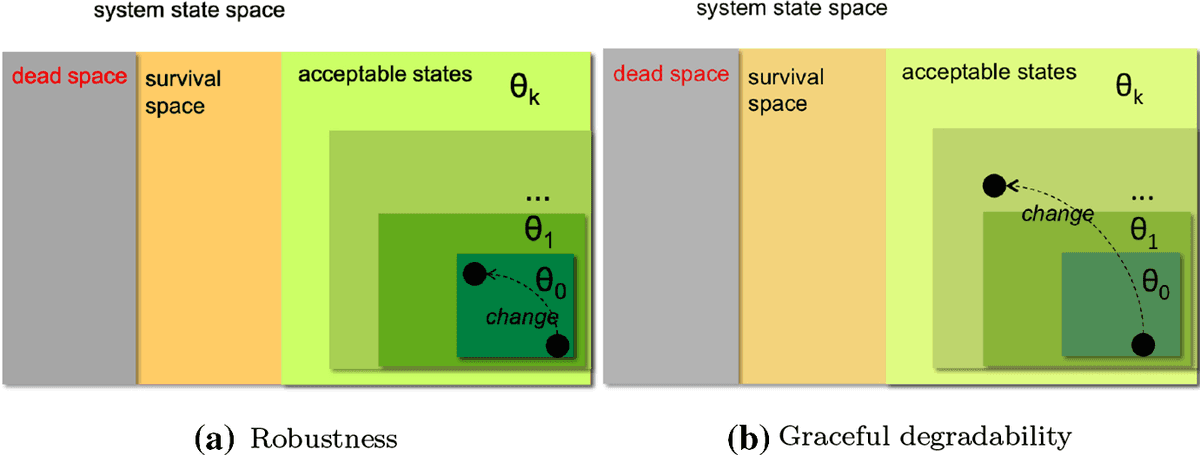
Original Figure 3 from Andersson, Grassi, Mirandola and Perez-Palacin, published online in 2020 and in Computing in 2021. Reproduced unchanged under CC BY 4.0.
In this diagram, worse performance need not mean failure if the system still meets the chosen threshold. The figure explains terms; it does not show a real service result. Its labels belong to this paper and do not settle the meanings in the other two.
The broader Computing paper also considers changed acceptance criteria. That raises a separate question for your comparison: did the system change, the rule for success change, or both?
Test the definition with boundary cases
Try a clear included case
The cases in this section are thought cases made up for teaching. The source authors did not report them as observations or examples. Imagine a booking service whose agreed minimum is the ability to submit a request during a power interruption.
Suppose people can still submit requests, but status updates slow down. The service would still meet the minimum in this made-up case. That illustrates a contrast in the Computing paper. To judge a real case, you would need its agreed rules and records.
Try a case your wording excludes
Now imagine a service that keeps every agreed function unchanged through the same interruption. A recovery-only definition would exclude it because nothing was lost and regained. The NIH account includes resistance, so that exclusion needs a reason if you intend to use the NIH meaning.
You could revise the definition to include maintained function, or retain a recovery-only concept because your question specifically concerns recovery. Either choice changes the task. Explain the choice rather than present it as a correction accepted by all authors.
Change one detail at a time
Suppose submissions stop, then resume later. That is a different case from slower status updates while submissions continue. Compare the same time window and minimum before deciding whether the label has changed.
Next, imagine the team changes its minimum to taking requests by phone. The service might meet the new rule but fail the old one. Keep that change in the rule in your note, so you do not claim that the old function returned when it did not.
The cross-field proposal asks you to state choices about structure, function, fitness, and time. A test case can show which choice matters. It cannot decide whose goals should set the service threshold.
Write a bounded working definition
Match the definition to the question
For this made-up outage review, you might write: “This review asks whether the service kept its agreed minimum or lost it and returned to it. We keep these two patterns apart and record changes in the rule for success.”
This is a teaching rule we have made for this task. It draws on a threshold distinction in the Computing paper. It does not cover that full framework or measure resilience in all settings.
Write a version and date beside the working definition. If a later source leads you to add uninterrupted service or change the recovery threshold, record the old wording and the reason for revision. Revisit any earlier classification that depended on the changed boundary.
Retain the alternatives
Keep a short account of the meanings you did not choose and why. The NIH capacity account is broader than the proposed service-log comparison. A broader concept can remain relevant without being fully measurable in those logs.
State what remains outside your definition: staff experience, future capacity, beneficial change, or effects on people using the service. Those gaps guide later evidence work; they should not disappear because the current comparison has a neat label.
Keep conceptual claims within their limits
Thought cases differ from field findings
An invented case tests how your rule classifies a described situation. It provides no evidence that a real booking service behaves that way, that users receive adequate help, or that one response causes another.
You need observed records and a suitable design for those claims. Keep the definition note beside the empirical work so readers can see which rule shaped the measurement and what the data can establish.
Familiar use is not everyone's use
Your own response to a case can help expose an unclear boundary, but it is not a survey of a research community. Kölbel's discussion of actual concepts shows why whose usage matters is part of the inquiry.
Likewise, finding a term often in papers does not prove those papers mean the same thing. Use the research synthesis workflow to keep claims attributed before grouping findings under one label.
Agreed meanings do not validate measures
Two authors may agree on meaning but use different measures. Others may use different words for much the same idea. Keep meaning, measures, and setting in separate parts of the note when deciding whether to group their results.
The cross-field paper explains why one metric, stripped of its setting, offers little practical help. Your note should state which units and goals you chose and the grounds for those choices.
Review the definition comparison in Atlas
Add the papers you are allowed to use and wait for processing. In Chat, use @ mentions to select the sources for this comparison. Project can include earlier chat context, so name the source set explicitly when you want to keep the current task bounded.
Request an attributed comparison
Ask: “Compare how these papers define resilience, giving each account's purpose, included cases, exclusions, section or page, and a cited passage. Keep author proposals distinct from reported usage, and mark missing detail instead of filling it in.”
The output is a draft comparison for review. Check that each row retains its own scope, and that the answer has not turned similar words into an unsupported consensus.
Inspect the claimed boundary
Open the citations and read the nearby passage. If the answer says all three sources require a return to the original state, check the NIH resistance and growth wording and the other papers' conditions. Correct that statement before using it in a note.
Ask a follow-up tied to the named source: “Show which passage requires the original state. Separate that claim from return to a minimum acceptable range.” If a citation lacks a precise location, use the available source view or locate the passage yourself.
Save the reviewed account
Copy the corrected comparison into a new note using New, then Note. Retain the source set, chosen meaning, boundary cases, disagreements, and unresolved measure questions. Check that Saved appears after editing.
If a passage is missing, name the source and ask again. Check the source yourself too. The note should record your checked reading; the answer cannot choose a meaning for all fields or prove that a scale works.
Turn the comparison into a research note
Finish with your question, the limits of your source set, the meaning you chose, and why it fits. Show a rival meaning that would put a case on the other side of the line. This lets a reader check your choice.
Keep the rule and the gap in the records together. For the made-up service review, a claim of “return to minimum service” needs a stated minimum and a record of return. It does not show future capacity or effects on users.
Give that next check a specific target. Instead of “read more about resilience,” write “check whether this paper defines recovery as full restoration or return to a minimum.” This keeps the follow-up connected to a disputed boundary and gives the reader a clear completion test.
The next task is to find the missing passage or measure evidence before making the wider claim. Once the definition is stable enough for your study, use the linked conceptual framework guide to explain relationships among concepts.
Compare concept definitions in Atlas
Keep each meaning and boundary case tied to a passage in your chosen sources.