

A conceptual framework explains the main concepts in a study and how you think they relate. It can take the form of text, a diagram, or both. It shows why the concepts belong together, what prior research supports, and what you still need to find out.
Start with the question and sources before drawing boxes. An arrow can show a hypothesis or an expected sequence. It does not prove that one concept causes another. Explain what each arrow means so readers can tell your proposal apart from a finding in an earlier paper.
The worked example prepares a framework for a hypothetical study of first-year commuter students. Two real papers help check the planned links. The new study remains a plan, with concepts and a design still to review.

Check your framework against its sources
Compare selected papers and inspect the support for each proposed relationship.
What a conceptual framework needs to explain
A framework connects your question, key concepts, and planned source material. Rocco and Plakhotnik's analysis of framework terms explains how theory and prior findings can ground a study. Your task is to show how those ideas inform this inquiry.
Concepts and relationships
A concept names something you want to understand, such as belonging or access to campus events. A link states how concepts might relate. For example, students who feel supported by peers may feel more included in campus life. Explain why you expect that link and where the source's support ends.
Fields differ in how they use these terms. Some expect a broad account of goals, context, and methods. Others expect a focused model of variables. Jordan Tegtmeyer's account of developing a dissertation shows how questions and design changed through review. Follow your course's terms and explain how you use them.
Narrative or diagram
In a survey, a diagram may show the links you expect between variables. In a qualitative study, text can guide the questions without assigning each concept a cause or outcome role. Scribbr's guide describes both forms. Use the literature review process to build the source basis, then explain how any chosen theory informs your model.
Fix the question and study boundaries
This hypothetical study asks how first-year commuter students describe peer support, campus belonging, and participation in optional campus activities. It will use interviews to explore how students connect these experiences. It will not estimate the effect of a campus programme.
Specify the phenomenon
Participation means taking part in optional campus activities during the first semester. Belonging means feeling accepted and included in campus life. Wanting to attend differs from attending. A student may want to join an event but leave for a work shift or the last bus.
Keep participation distinct from satisfaction, grades, and well-being. Adding those outcomes would change the question and the data you need. Write the group, setting, period, and focus above the first draft of the framework.
Record the limits
The proposed group is first-year students who commute to one institution. The inquiry covers optional campus activities in the first semester. It excludes students living on campus and required classwork. Adapt these choices to your own question and setting.
Explain how travel and work patterns affect whom you plan to interview. The methods must justify the sample and its scope.
If you need to choose an established theory first, use the theoretical framework guide. Explain how that theory informs this study's concepts and questions before adding it to your model.
Define concepts before drawing connections
Use each concept in the same way across the question, source table, and model. Dovetail's framework preparation guide connects this task to scope. For the commuter example, a working sheet could define:
- Perceived peer support: how students describe peers offering help or making them feel welcome. Support from the whole institution is a broader concept.
- Campus belonging: feeling accepted and part of campus life. Being on campus alone does not show belonging.
- Participation: accounts of attending optional activities, including examples of events attended or declined.
- Schedule access: whether event times fit travel, work, or care duties. This new contextual concept needs further source research.
A concept differs from the data used to study it. An account of feeling welcome may inform belonging, while an attendance record informs participation. Neither covers the whole concept. Check what each source can show before treating a useful record as a full measure.
For a survey, name the scale, what it measures, and the evidence for its use in your group. A scale's name alone does not show that it measures the concept you mean.
When papers use the same word in different ways, use conceptual analysis to compare their definitions and boundary cases. Keep those meanings beside the findings. Sociocultural engagement may cover more than attendance at optional events. Compare the meanings before treating two papers as support for the same link. The research synthesis workflow helps organize that reading.
Worked conceptual framework example
Build the source table before choosing the model's links. Give each planned link a row, with the prior finding and your new idea kept separate. This teaching example uses two real papers for a hypothetical study. It is not a complete literature review.
Kassab and colleagues' campus study examined student relationships, belonging, sociocultural engagement, and satisfaction. Its Results section reports no statistically significant direct belonging-to-sociocultural-engagement path.
Van Kessel and colleagues' review reports belonging associations with academic and well-being outcomes, while noting heterogeneity and risk of bias. Those outcomes differ from optional activity participation.
| Proposed connection | Source contribution and locator | Decision for this proposal |
|---|---|---|
| Peer support and belonging | Kassab et al., Study instruments and Direct effects: relationship quality was related to belonging. The source construct is broader than peer support. | Retain as a question, and explain the narrower peer focus. |
| Belonging and participation | Kassab et al., Direct effects: the belonging-to-sociocultural-engagement path was not statistically significant. | Keep provisional rather than labeling it established. |
| Belonging and other outcomes | Van Kessel et al., Abstract and Synthesis methods: associations concern academic and well-being outcomes. | Use as background without substituting those outcomes for participation. |
| Schedule access and participation | Neither selected source establishes this commuter-specific connection. | Mark an evidence gap and search relevant commuter-student literature. |
Table 1: The table records choices for a new plan. It does not copy either paper's model or claim that the sources prove these four links.
The second row changes the argument. You can ask whether belonging matters to participation here, but the link remains open. A nonsignificant result does not prove there is no link. Check the paper's definitions and limits before deciding what the result means for your question.
The fourth row calls for commuter-student research. The two papers do not show how schedule access matters here. Keep the gap as a question until you find relevant support.
Turn the table into an outline
Explain why the chosen concepts help answer the question. For this example, a draft paragraph might read:
This study will explore how first-year commuter students describe peer support, campus belonging, and participation in optional campus activities. Prior research gives a basis for asking about peer support and belonging. The link with participation remains open in this setting. The study will also ask whether schedule access helps explain when students take part. These concepts will guide the interviews and analysis, with room to change the model as the accounts are reviewed.
This text describes a plan for which no data have been collected. In your own text, cite the source-based reasoning and keep it distinct from your new questions.
A researcher-drawn model outline
Draw a box each for peer support, belonging, and participation. Add schedule access as context. Label each link with its meaning and source status. It may be a question to explore, a finding from another setting, or a gap needing more research.
For participation, a dotted line could mean proposed relationship to explore. Explain it in a legend and note the scope of one campus and one term. Check your course's drawing rules.
Keep the source table beside the diagram, with labels that match the text. For drawing choices, compare concept maps and mind maps by how they show links between ideas.
Use the source table to draw and review your final model, explaining how each connection supports your research argument.
Preserve revision decisions
Date each version and explain why you change a link. For example, record that a source check led you to change a causal arrow to an open question. Add a concept when it changes what you need to explain or collect.
Check framework sources in Atlas
Use Atlas to compare the papers and prepare a table you can check. Keep the full texts, with methods, results, and limits. Organizing the source set helps keep the versions used for each draft.
- Add the papers to one project and wait for processing to finish. Add a note with your question and definitions, labeled as your proposal.
- Start a new chat. In Ask a question, type @ and select the papers and proposal note. Choose Project only beside + to keep new retrieval in the project. A new chat avoids outside evidence retained in earlier conversation context.
- Ask for a comparison: "Compare these papers against my proposed framework. For each relationship, separate the authors' hypothesis, reported finding, and my new proposition. Include the source, section, supporting passage, qualification, and unanswered question. Do not replace participation with a different outcome."
- Open each citation and check the paper and passage. If a PDF citation opens only the source, find the results or methods section yourself.
- Check the nearby text for definitions and limits. If the answer says belonging causes participation, ask which passage supports that claim. Keep the link provisional unless the source supports stronger wording.
- Create New → Note and save the checked table and outline under Commuter framework evidence and open questions. Wait for Saved before closing it.
The existing Atlas capture below shows an open paper beside a cited answer. The paper concerns AI research. It illustrates source inspection and supplies no support for the commuter model.
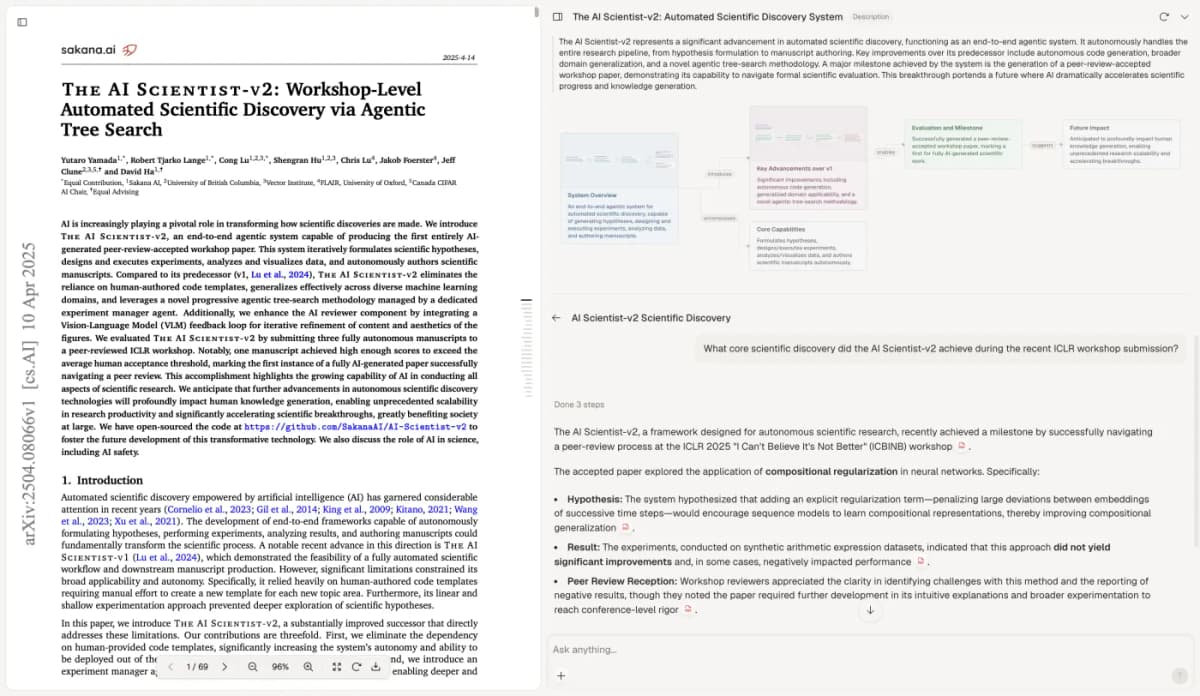
The AI Scientist-v2, by Yutaro Yamada and coauthors, appears unchanged in this Atlas capture under CC BY 4.0.
Open the cited source and compare its wording with the relationship proposed in your research note.
Ask for separate source contributions if a claim is hard to trace. Save the passage locator and your reading, with gaps labeled unresolved.
Review the model against your design
Before review, read the question, definitions, source table, text, and diagram together. A change in one may affect the others. Use the deductive vs inductive research guide to distinguish testing a prior claim from developing an explanation from observations. Check these points against the study you plan to conduct:
- Question fit: each concept serves the inquiry, with a reason to explore each link.
- Source fit: interview questions or records address the named concept. Attendance alone cannot answer a question about belonging.
- Claim strength: keep accounts, associations, hypotheses, and causal claims distinct. The design must support the claim you intend to make.
- Contrary accounts: allow someone who feels included yet cannot attend, or attends while feeling excluded, to challenge the model.
- Context: retain differences in group, setting, and outcome when you adapt a finding.
- Programme fit: follow local terms, citation style, and diagram rules.
Explain how you will check the order of events. One interview does not by itself show which event caused the next. Revise causal wording if the design cannot address it.
Bring the participation question and schedule-access gap to review. Decide whether to narrow the question, search further, or change the methods. Keep the source table with the revised framework.
Check your framework against its sources
Compare selected papers and inspect the support for each proposed relationship.