
Operationalization in Research: Compare Concepts and Measures
Operationalization turns a research concept into observable indicators and procedures. Use a checked matrix to compare how studies measure the same construct.
- Byline

Summary
Operationalization says how a study will observe or record an idea. It names the rule used to read the result.
Check each paper's definition, what it counts or codes, who was studied, and how it reads the result.
Two papers can use the same label for different measures. Read their methods before you compare the findings.
Operationalization turns a research idea into something a study can observe or record. Suppose you want to study student engagement. You still have to say what counts, what you will observe, and how you will read the result.
A count of study sessions and a student's report of focus could both bear that label. They capture different parts of the idea.
That difference matters when you read several papers. Atlas can compare selected papers and show citations for their stated measures, but the researcher must open the Methods passages and decide what the measures mean. A shared construct name is not proof that two results can be pooled or compared as the same thing.

Atlas

Compare research measures in Atlas
Compare selected papers and inspect citations behind each measure.
What operationalization means
A construct is the idea a study wants to examine, such as engagement, trust, or stress. A conceptual definition says what that idea means in the theory. An operational definition says what the researcher will observe and how the result will count as evidence. The open social-work methods text names the variable, measure, and reading rule.
The words serve different jobs. “Student engagement is sustained attention and active participation” defines the idea. “Count the share of planned study sessions completed over four weeks” names one possible way to observe it.
That count may reflect participation. It may say little about focus or what happened during each session.
OpenStax Psychology notes that an operational definition tells readers how a variable was measured. A clear procedure makes the study easier to inspect and repeat. It does not, by itself, show that the procedure captures the full idea the study names.
Move from concept to measure
Start with the research question. A count that suits “How often did students attend planned study sessions?” may fail a question about focus during those sessions.
Review past theory and measures before inventing a new one. The social-work methods chapter warns against choosing signs of a concept casually and points readers back to prior work.
Write the chain down
- Define the concept. Say what the construct includes for this question and what falls outside it.
- Name its parts. Engagement, for example, might include attendance, effort, and focused attention. Choose the parts your question needs.
- Choose an indicator. A completed session, a response to a question, or observed on-task behavior could each stand for one part.
- Specify the procedure. State who is observed, when, with what prompt or tool, and by whom. For a survey, include the exact item and response options. For a count, define the event and time window.
- State the reading rule. Say how a response is scored, coded, or compared, and what a higher value would mean. Record missing data and exceptions.
- Name the limits. Explain what the indicator may miss and what else could change its value.
The final two steps matter as much as the chosen sign. A paper that says it “measured engagement” without the question, rule, or score leaves the reader guessing.
Also state whether the conclusion concerns sessions, students, or groups. The unit of analysis guide explains why several observations from one student do not automatically support a claim about several independent students.
The open methods text treats the way a value is read as part of the operational definition.
Different designs need different records
A numeric study may count events or score responses. A qualitative study may use an observation guide or a code with stated rules for what it includes. Both need to show how observations became a claim.
For a program evaluation, the RE-AIM framework names five areas to assess. The evaluator still has to define each indicator and its source before making a claim.
In qualitative work, the concept may also change as the researcher reads the material. The social-work methods text separates numeric measurement from its later discussion of qualitative inquiry.
A worked operationalization example
The following example is hypothetical. It is a design exercise, not a tested scale or a claim about actual students. Let the conceptual definition be “sustained attention and active participation in planned study work.” The question is how engagement varied over a four-week course unit.
One team could use session completion. It counts planned sessions marked complete in a dated log, then divides by the number scheduled. The result is a clear share if the log rules are clear.
The count misses whether the student focused during a session. It may also reflect access to time, space, or a device.
Another team could use a short attention report after each session. It asks how much time the student spent on the planned task, using fixed choices. This asks more directly about focus.
It relies on memory and self-report. Two students may read “focused” in different ways. Neither approach covers the whole idea.
What the two values mean
Suppose both teams report a higher score for one group. The first score means a larger share of planned sessions was logged as complete. The second means students said they spent more of each session on task.
The claims may be related, but they do not describe the same act. Read the exact questions, log rules, samples, and setting before calling the results agreement.
The open methods chapter uses indicators to make abstract ideas observable. The hypothetical pair above shows why choosing an indicator also narrows what a result can mean.
Compare measures across studies
When two papers use the same construct name, read past the abstract. Find each paper's conceptual definition, Methods section, instrument or observation rule, score, sample, and stated limits. If an item or rule is missing, mark it as missing. Do not fill it in from a familiar scale name or from another paper.
The same label is a question
A 2024 article indexed by PubMed argues that results can depend on how a concept is measured. It calls for examining more than one way to measure it. The abstract supports that broad caution. It does not judge the two invented measures above.
A 2021 study's abstract also reports a telling result: researchers' reading of findings changed when the strength of the measure changed in the materials they judged.
The figure below comes from the 2024 article. Its left side treats one measure as if it captured the whole concept. Its right side asks readers to compare results from several measures before making a broad claim. It shows the author's design argument; it does not test the student example or set a required number of measures.
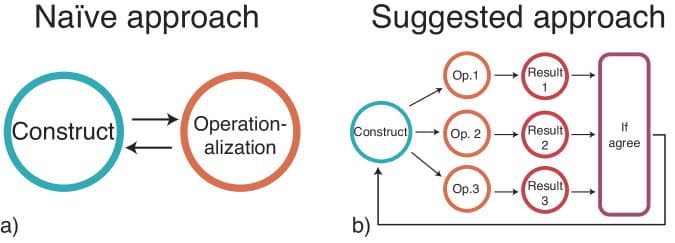
This is Figure 2 from Carpentras, Communications Psychology (2024), reproduced unchanged under CC BY 4.0. Choose a direct comparison only after reading the methods. If papers define different parts of an idea, use different items, or study different settings, keep the findings separate and explain why.
The OpenStax account of operational definitions and the 2024 method argument both support looking at the measure behind a label. Check the exact item, score, and setting before using the result as evidence for the broader idea.
Build a construct-indicator matrix
Use a matrix to keep the method check visible. The rows below continue the invented engagement example. “Study A,” “Study B,” and “Study C” are teaching labels. Their passage locations name imagined notes.
In a real review, replace each row with a paper you opened. Link the exact Methods passage that supports each cell.
| Study and definition | Indicator | Procedure | Reading rule | Context | Limit | Source check |
|---|---|---|---|---|---|---|
| A: engagement as participation in planned work | Completed sessions | Count dated log entries over four weeks | Completed ÷ planned sessions | One course unit; enrolled students | A checked box says little about focus | Hypothetical Methods §“Log”; no published citation |
| B: engagement as attention during planned work | Self-reported task focus | Ask one fixed question after each session | Share of sessions marked mostly on task | Same imagined course unit | Recall and response wording may shift the value | Hypothetical Methods §“Prompt”; no published citation |
| C: engagement as visible on-task activity | Coded behavior | Observer codes short samples using written rules | Share of sampled moments coded on task | Imagined group study room | Observation may change behavior; private thought is unseen | Hypothetical Methods §“Codebook”; no published citation |
Table 1: The last column states what can be checked here. These rows are invented, so there is no real source passage to open. With actual papers, put the page, table, or section beside each claim. Read the passage and any caveat around it.
The social-work methods chapter supports recording the measure and reading rule. It does not validate the rows in this example.
The open question is whether the three scores track enough of the same idea to support a joint claim. That needs a look at theory, method, sample, and evidence for validity. A shared heading in a sheet cannot answer it.
The research-paper synthesis guide covers the later task of relating findings once their measures have been checked.
Check paper evidence in Atlas
Add the papers you want to compare to one Atlas project. In chat, type @ and select them. Ask: “For each paper, cite its definition of engagement, sign used, collection rule, score, sample, and stated limit. Put ‘not found’ where the paper gives no answer.” Atlas can return cited passages for the first draft of the matrix. You still have to check them.
Open each citation beside a key cell. Check the Methods passage and the text around it. If an answer combines a scale name from one paper with a score from another, split the sources and fix the row.
Save the checked matrix and open questions in a project note. Atlas helps sort supplied text. It does not test scale validity or decide that measures are equivalent.
The image shows a real Atlas paper beside a cited answer. The visible paper is unrelated to the hypothetical engagement example. It shows where a reader can start the passage check before moving a claim into the matrix.
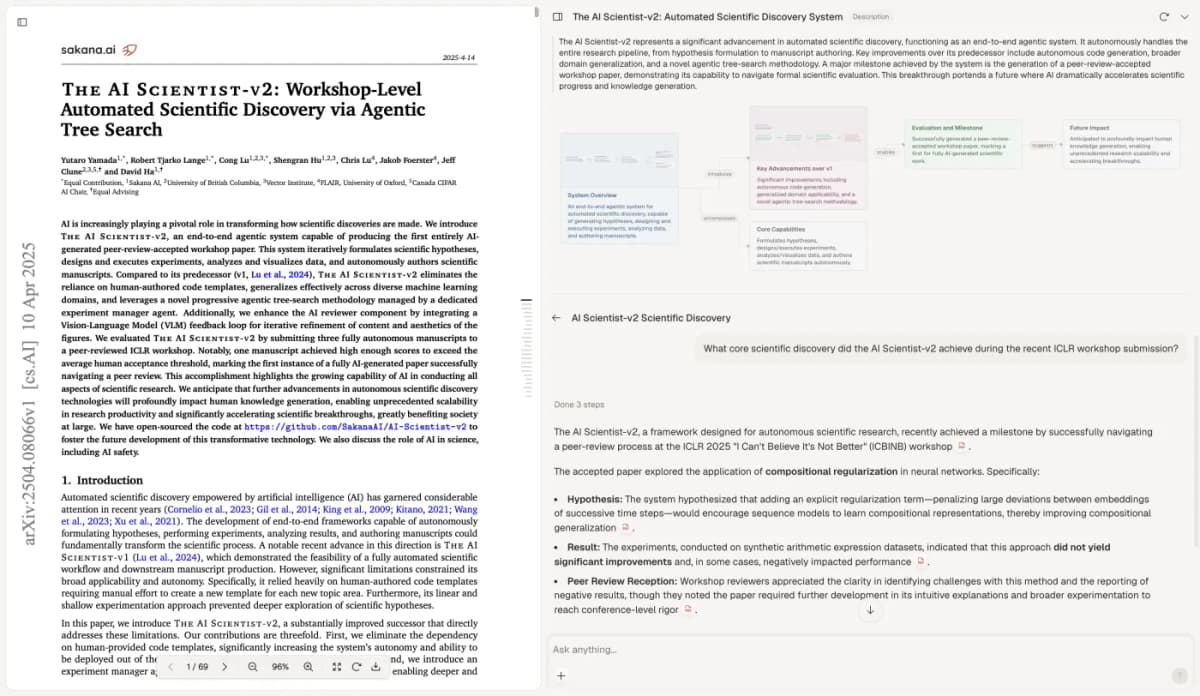
For help with broader paper reading, see the research paper analysis guide. The qualitative data analysis guide covers coding work that needs its own method choices. This page stays with the concept-to-measure chain.
Test what the measure misses
A clear procedure makes a study easier to read. It does not prove the measure captures the intended idea. Ask what was left out, such as focus in a session count. Ask what else could change the score, such as access to a quiet room.
OpenStax Psychology distinguishes a stated measure from the broader question of what findings mean.
Check whether the measure works the same way for the people and setting in the paper. A prompt written for one course, age group, or language may be read differently elsewhere.
The open methods text recommends grounding indicators in theory and past work. The researcher must still assess the evidence for each setting.
If measures disagree, report what each one captured and what remains open. Keep the source trail so another reader can check your judgment.
The 2024 paper treats such variation as a chance to learn more about the concept. A single pooled result may hide it.
Atlas
Compare research measures in Atlas
Compare selected papers and inspect citations behind each measure.
Frequently Asked Questions
It is the process of specifying how a construct will be observed, measured, manipulated, or interpreted in a study. The operational definition names the procedure and rule, not just the abstract concept.