
RE-AIM Framework: Five Dimensions and an Evidence Register
Apply RE-AIM to program evaluation. See what evidence fits each of its five dimensions, with a worked register that keeps source details and gaps visible.
- Byline

Summary
RE-AIM is a program planning and evaluation framework for Reach, Effectiveness, Adoption, Implementation, and Maintenance.
Define each measure, population, time window, and source before interpreting results.
A five-row evidence register can expose missing data; it cannot prove a program worked or met the framework.
RE-AIM is a framework for planning and evaluating programs across five areas: Reach, Effectiveness, Adoption, Implementation, and Maintenance. It asks who took part, what happened, which settings took up the program, how it ran, and whether effects or routines lasted. The official RE-AIM guide defines each area.
Suppose a report says “120 people joined” but gives no count of people eligible to join. That is useful Reach evidence, yet it cannot tell you the share reached. A good register keeps the reported count, source, and missing denominator side by side.
Atlas can help find and compare passages in the reports you select. The evaluator checks each passage and decides what it means for the local program.

Atlas

Build a cited evidence register in Atlas
Sort selected reports by dimension, open each citation, and flag gaps.
What RE-AIM asks evaluators to check
The framework broadens the question beyond whether an outcome changed. A program may help those who attend while reaching few of the people it was meant to serve. It may also work in one site but fail to become routine elsewhere. The original 1999 paper proposed five areas to make such issues visible in public health work.
The current acronym uses Effectiveness for the second area. The original paper used efficacy in its title and model language. Use the current official definitions when you set up a new review, and describe the terms used by any older study you cite.
RE-AIM can guide planning as well as a later review. The official application page offers routes for planning, delivery, evaluation, and sustainment. Teams still need to choose local measures, data sources, and time windows.
The five areas are a set of questions. Filling five boxes with quotes is only a first pass. A reported count needs a defined group, a source, and a period before a reader can judge what it shows.
Define the 5 dimensions
Reach concerns the people the program meant to serve and those who took part. Record the eligible group and who may have been missed. A count alone may say little about the share reached. The official definition also asks how well participants reflect the target group.
Effectiveness asks about outcomes for people, including possible harms and quality of life. Name the outcome, measure, timing, and study design. Do not read a before-and-after change as proof that the program caused it. Other events may have changed at the same time.
Adoption concerns the sites, teams, or staff who start the program. It uses a different base from Reach.
Ten clinics adopting a program is a setting count. It says nothing by itself about how many eligible people at those clinics joined. The official guide also asks whether adopting sites and staff reflect the intended settings.
Implementation asks how the program was delivered, including consistency, changes made, time, and cost. A site may adopt a program yet deliver only part of it. Record what the plan called for and what the report says happened, without calling every change a failure.
Maintenance concerns what lasts. At the setting level, ask whether the program becomes part of routine work. At the person level, ask whether effects persist at a stated follow-up time.
A launch announcement cannot answer either question. The official RE-AIM definitions separate these levels.
The systematic review of RE-AIM use found that reporting across dimensions has varied over time. That is a reason to show the source and gap for each area, rather than assuming that the framework name means every area was measured.
Set measures before collecting evidence
Begin with the local program question. Is the team judging access, outcomes, delivery, spread, or long-term use? Name the people and sites in scope. A short written plan helps keep the review from picking only the easiest figures after seeing the results.
For each dimension, write the indicator, its numerator and denominator if a rate is planned, the time window, and the source. Name the person who will check it.
If a document reports only a numerator, record that fact. Leave the rate blank until the base is known and the two counts refer to the same group and period.
The operationalization guide explains the link from a broad idea to a measure and reading rule.
For RE-AIM, “access” may call for a count of eligible people and a count of participants. “Routine use” may call for records months after launch. A single count cannot serve both jobs.
Check who wrote each source. A plan shows what was intended. A delivery log may show what ran. A final report may state results. Keep those roles separate even when the same team produced all three documents.
Build a five-row evidence register
This register uses a fictional community program and invented documents. P-01 is a made-up plan dated January 2026; L-02 is a made-up delivery log dated March 2026; R-03 is a made-up review note dated June 2026.
The labels and line numbers are teaching devices. No row is a real result.
| RE-AIM area | Fictional reported claim or measure | Source and passage | Gap the evaluator must check |
|---|---|---|---|
| Reach | “120 people joined the first cycle.” | R-03, June 2026, lines 12–14 | The eligible group and its size are absent; no reach share can be read. |
| Effectiveness | “Most attendees said the sessions helped.” | R-03, lines 28–30 | The question, response count, comparison, harms, and follow-up are absent. |
| Adoption | “Four sites opened the program.” | L-02, March 2026, lines 5–7 | The number and mix of eligible sites are missing. |
| Implementation | “Two sites shortened the sessions.” | L-02, lines 18–21 | The intended length, reason for the change, and delivery record need review. |
| Maintenance | “We plan to keep the program next year.” | P-01, January 2026, lines 33–34 | A plan is not later evidence of routine use or lasting effects. |
Table 1: The Reach row names a real type of gap: a count without its base. The Adoption row has the same issue at a different level.
The Effectiveness row is a reported view. The register cannot show who answered, what they were asked, or whether anything changed.
The Maintenance row is especially easy to overread. A plan dated before delivery may show intent. It cannot show what lasted after the program. The official framework guidance treats planning and later assessment as related stages with different evidence.
If the fictional log later gave the intended session length, the Implementation row could be updated. The evaluator would still need to ask whether the shorter session preserved core activities and why the change was made. A source line is a starting point for that review.
Read missing evidence as a gap
Turn each empty cell into a request. For Reach, ask for the rule used to count eligible people and the period covered. For Adoption, ask which sites were invited and how the four new sites compare with them. These two questions need different lists.
For Effectiveness, ask to see the exact item, the number who answered, the timing, and any account of harms. For Implementation, request the delivery guide and a change log.
For Maintenance, seek a later site record or follow-up measure. None of these requests assumes that the missing data exist.
The applied RE-AIM article describes use in real program planning and review. Its lesson for a document-based register is to keep context in view. The same dimension may call for a different measure across settings; a neat table does not make two programs alike.
A comparative analysis guide can help when you need to align measures from several program reports. Compare like periods and groups before placing figures in one column. If definitions differ, keep separate rows or notes rather than merging counts.
Check cited documents in Atlas
Add the permitted plan, logs, reports, and framework notes to one Atlas project. In chat, select the small source set with @.
Ask: “Find candidate passages for each RE-AIM area in these documents. Quote the reported measure, give the source and page or line, and mark where the denominator or follow-up is not stated.”
Open every citation. Check that a planned activity has not been presented as a delivered one, that a staff count has not been called a participant count, and that the dates match the claim. Save the checked register as a note with a reviewer name and open questions.
The Atlas multiple-source synthesis guide describes selected-source comparison with citations. An audit trail can preserve why the team accepted, moved, or rejected a candidate passage.
Atlas helps find supplied text; it does not score the program or fill missing figures.
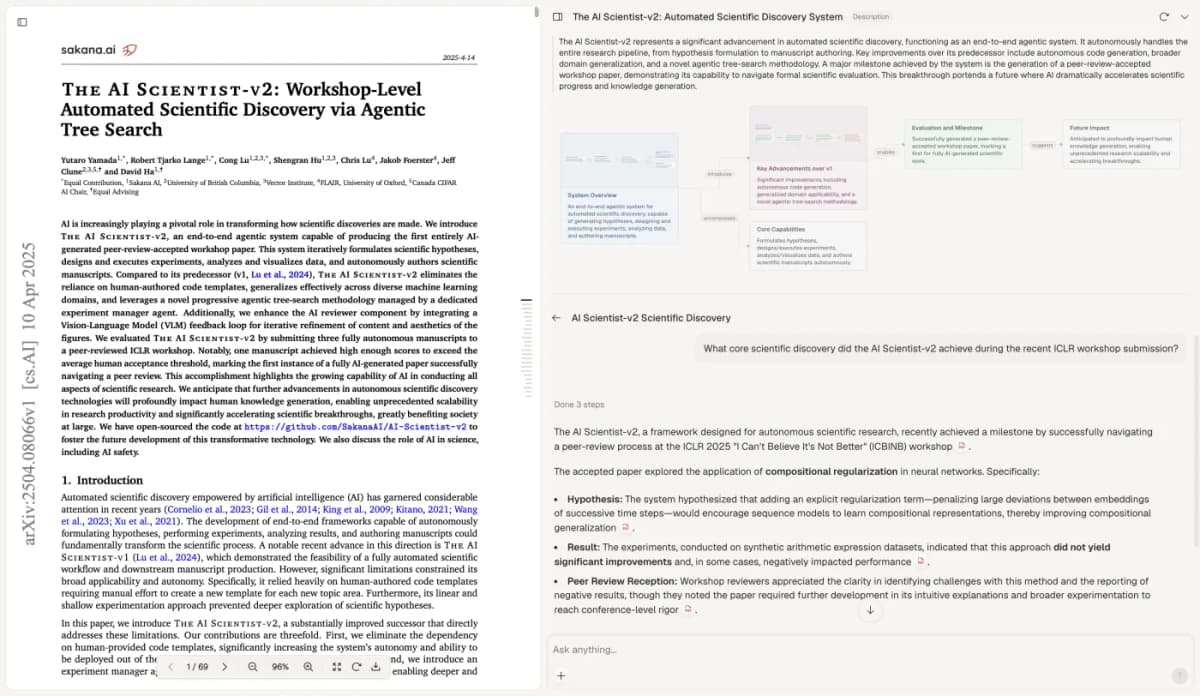
Atlas citation-inspection view. The pictured paper does not supply any claim in the fictional five-row register.
Keep interpretation with the evaluator
RE-AIM gives the team a shared set of questions. It does not determine which local indicator is sound or how much evidence is enough. The evaluator must review the data source, group, time, missing values, program context, and limits of the design.
Do not claim that an outcome was caused by the program because a report puts it in the Effectiveness row. A full register is not a certificate of fidelity, validity, or RE-AIM compliance.
A convergent mixed-methods guide covers a separate design choice when numeric and qualitative strands are brought together.
The official RE-AIM and PRISM hub also explains why context matters to use and sustainment. If staffing, funding, or local rules shifted during delivery, note that before comparing sites. A document set may hint at those changes yet leave crucial conditions unknown.
Turn the register into review questions
Take the five rows to the program team. Ask for the eligible people and sites, the outcome measure, the delivery record, and evidence from a later date. Assign a person to check each reply against its source.
If no reply exists, leave the gap visible. The register still helps: it shows what the available record can support, what remains open, and which claim needs a better source before it enters a report.
Atlas
Build a cited evidence register in Atlas
Sort selected reports by dimension, open each citation, and flag gaps.
Frequently Asked Questions
Reach, Effectiveness, Adoption, Implementation, and Maintenance.