
The CRAAP test helps you decide whether a source fits your research use. Its five criteria are Currency, Relevance, Authority, Accuracy, and Purpose. Librarians at California State University, Chico developed the framework. Their original criteria sheet says the importance of each part depends on your need.
Use the questions to check a source against the claim you want to make. Write down what you found, where you found it, and what still needs to be checked. Your final note should explain how you can use the source and where its support runs out.

Check your source evidence in Atlas
Compare the source with CRAAP criteria and inspect support for each judgment.
Start with your research question
The test helps you judge whether a source supports a specific use. A report may help you describe a debate while leaving its outcome unclear. A firm's page may show what it tells buyers without proving its claims about the whole market. Define your use first so you know what to check.
Suppose you want to know whether your campus needs more bike racks. A blog about cycling at another school may give background or ideas for questions. A local policy claim also needs facts about your campus, its users, and the issue that new racks would address.
Keep the source title, author, date, URL or file name, and the version you read. Add the claim you plan to support. These details let a second reader check the same source and see why you chose it.
Note any source rules in your assignment. You may need a peer-reviewed study even when a short article explains the topic well. For a wider project, the literature review workflow shows where finding and screening sources fit before you compare their findings.
Apply the 5 CRAAP criteria
Use the five criteria as questions to answer with support from the source and any outside checks you need. A word such as credible or current will not tell the next reader what you found. A page, date, method, or stated aim gives them something they can inspect.
A worksheet can help you keep the answers together. Southwestern's library resource offers a worksheet based on the Chico criteria. Follow your own rubric if one is assigned, and keep the reason behind each judgment visible.
Currency
Check when the page was posted or changed and when its data was gathered. A new post can rely on an old survey. A footer date may apply to the whole site. The Meriam currency questions ask whether that timing fits your topic.
- An old text may be right for a historical event or an early argument. Today's conditions may need new data. Record both dates and explain why they fit or fail to fit your use.
Relevance
Read enough to identify the topic, group, setting, and level of detail. A shared keyword does not prove a source answers your question. Leisure cycling may have little to say about a trip to campus. The Meriam relevance questions also ask about the audience and other sources you have read.
- Note what fits and what remains unclear. A source on theft might explain why some people avoid cycling while leaving rack space or road safety open. That tells you what to seek next.
Authority
Find who made the source and what they know about the claim. A cyclist may describe a parking issue they have seen. A transport researcher may explain how to study it. UNE Library's guidance recognizes expertise beyond academic circles.
- Match knowledge to the task and check the support behind the claim. A bike seller may know equipment well while lacking data to show that new racks will raise cycling rates. A job title or degree cannot fill that gap.
Accuracy
Pick the key claim and trace its source. Read the cited report, data, or quote in context, keeping its group, dates, limits, and degree of doubt. The Meriam accuracy questions ask what supports the claim and whether you can check it elsewhere.
-
References alone do not prove support. If a blog calls a survey campus-wide, check how people were recruited. If the methods are missing, withhold the judgment that needs them.
-
Seek a separate source where possible. Copies of one press release still lead to one account. The AI source-checking guide covers testing the link between a citation and claim.
Purpose
Look at what the source aims to do: inform, persuade, sell, entertain, or describe an experience. Check its author, sponsor, audience, and requested action. Saint Elizabeth University's source guide connects these questions to research use.
- A sales post may show a firm's pitch and a leaflet may show a campaign's position. Check their factual claims regardless of whether you share the view. Record disclosed ties as findings. Keep a suspected hidden motive as a question unless you have evidence for it.
CRAAP test example and worksheet
This source pack is fictional teaching material. The blog, survey, author, school, and findings are invented. The worksheet is not an observed Atlas result.
Imagine a post called Why Every Campus Needs More Bike Racks, published by Campus Cycle Desk in April 2025. It urges readers to buy racks from the firm that runs the site. The author's bio says they have sold bike equipment.
The post links to a 2018 survey at North Campus University. The summary says cyclists reported parking concerns. The survey extract gives the date and setting but leaves out how the sample was chosen. Your question concerns a different campus in 2026.
Use a row for each criterion. Keep the finding beside the source location and the check still needed.
| Criterion | Finding in the fictional source | Source location | Remaining check |
|---|---|---|---|
| Currency | Post dated 2025, survey dated 2018 | Post header and survey title page | Find recent evidence for your campus |
| Relevance | Cycling topic fits, campus setting differs | Survey setting paragraph | Check whether local users report the same problem |
| Authority | Author reports equipment-sales experience | Author biography | Verify relevant research expertise for the broader claim |
| Accuracy | Parking concerns reported, survey methods absent from extract | Linked survey summary | Obtain the methods before treating the result as representative |
| Purpose | Post promotes racks sold by its publisher | Recommendation and company link | Compare its recommendation with independent evidence |
Table 1: The table keeps the source's useful parts while showing why its local policy claim needs more support. You have a lead to an older survey and an example of a seller's pitch. You do not yet have a basis for buying racks at your own campus.
Correct the two mistaken judgments
Suppose a draft says the data is current because the blog was posted in 2025. Change that row to record both the 2025 post and the 2018 survey. The post has not made the old data new.
Suppose another row says the survey proves that more racks lead more people to cycle. The summary only reports parking concerns. It does not show the effect of adding racks. The missing methods also leave you unable to judge how well the sample represents the wider group.
Keep the post as background or a lead to further reading. For a claim about what your campus needs now, seek local data and read the survey methods before using its findings.
Check beyond the source itself
A neat page can look trustworthy. Bios, logos, and references may help you find out who is behind it, but important claims need checks beyond what the page says about itself.
Mike Caulfield's SIFT method gives actions for looking into a source, finding other coverage, and tracing claims to their first context. Use those actions to answer CRAAP questions when the source's own account is not enough.
CRAAP organizes the judgment by criteria; the SIFT guide shows how to leave the page and check its source and claims laterally. Use that process when a criterion needs support from beyond the source itself.
For the cycling example, check the author's background outside the seller's site. Find the survey through its publisher. Look for research about the issue your campus faces. Open each source before calling it a separate check on the claim. A search snippet can help you locate a source, but does not show all its limits.
Keep your research use in view. A background definition may need less work than a claim that will guide a policy. If a key gap remains, state the gap and narrow how you use the source. This keeps the review focused while leaving the missing support visible.
Build a checked worksheet in Atlas
Atlas can compare a source with supplied criteria and propose a cited worksheet. Add both files to a project and confirm that processing has finished. Start a chat, then type @ in Ask a question to select the source and criteria.
Choose Project only to keep new retrieval within the supplied project files. Enter the question and select Send. For the teaching example, you could ask:
Evaluate the mentioned cycling post for whether our campus needs more bike racks. Use Currency, Relevance, Authority, Accuracy, and Purpose as rows. Give a citation and open check for each finding. Keep the post date apart from the survey date. Mark missing methods and outside checks as unresolved.
Open the numbered citation for each judgment you plan to keep. Read the passage and its surrounding text. If the answer calls the survey current based on the blog date, ask for a correction based on the date of the survey.
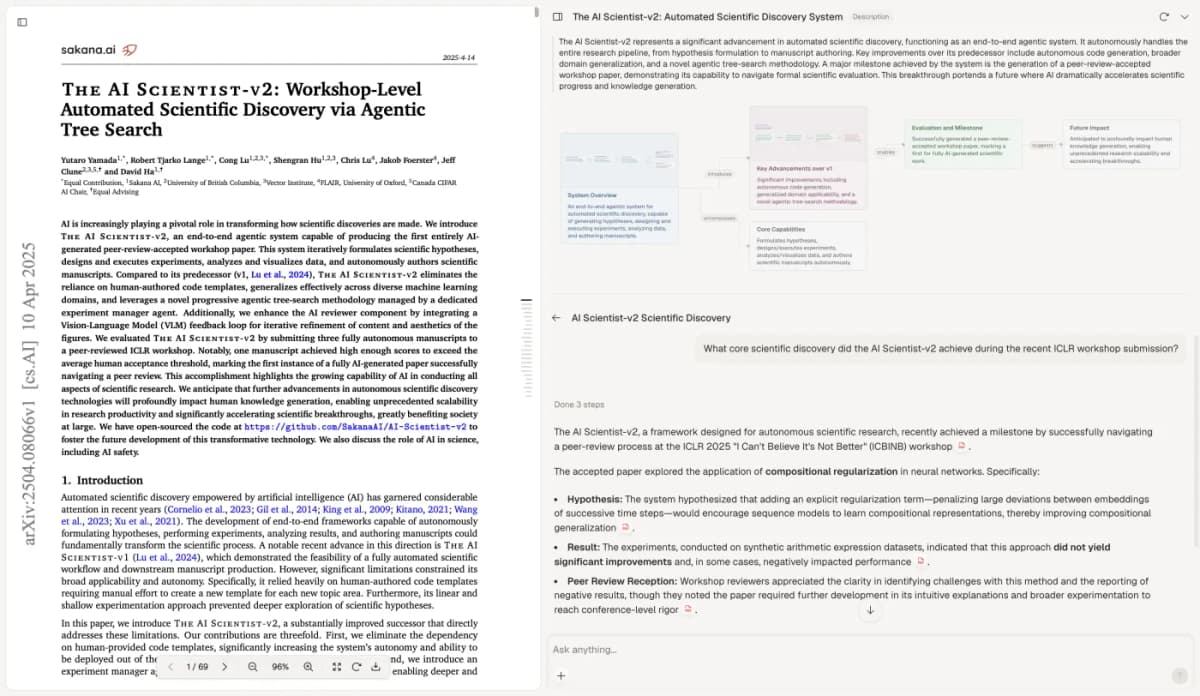
Check the source passage before accepting the answer's meaning.
This first-party screenshot shows source review with an unrelated scientific paper. It does not show the invented cycling corpus or prove that a worksheet judgment is correct.
The visible paper is The AI Scientist-v2: Workshop-Level Automated Scientific Discovery via Agentic Tree Search, by Yutaro Yamada, Robert Tjarko Lange, Cong Lu, Shengran Hu, Chris Lu, Jakob Foerster, Jeff Clune, and David Ha, licensed under CC BY 4.0. This screenshot copy is unchanged; its capture date is unknown. The authors do not endorse this guide.
Keep outside checks open until you have done them. Add permitted new sources to the project and ask a focused follow-up if needed. A missing answer should remain visible so it does not turn into a confident rating.
To keep the reviewed worksheet, select New, then Note. Save the question, source details, five findings, checks, and use decision. Wait for Saved before closing it.
If you later compare several sources, the research synthesis workflow helps you retain what each contributes.
Write the source evaluation judgment
End with a paragraph that says what the source can support. For the invented post, explain that it gives a seller's view and a link to an older survey from another campus. It does not yet support a claim about current local demand or the effect of adding racks.
Name the work still needed: get the survey methods, check the author's expertise for the claim, and find local data. That gives the next reader a route forward without hiding the useful parts of the source.
If your instructor wants points, use the assigned rubric and explain each rating. The original Meriam sheet lists questions rather than a universal passing score. A total cannot fill a gap in the support that your claim requires.
Review the note when your question changes, the source is corrected, or new data answers an open check. Keep the old judgment so you can explain why the source's use changed.
Check your source evidence in Atlas
Compare the source with CRAAP criteria and inspect support for each judgment.