

Criterion sampling is a purposive method: the team chooses cases that meet a rule important to the study. The rule names an event or experience the team needs to understand. It should show why those cases help answer the study question.
When reading a paper, check the rule against the case descriptions. Keep the cases that qualify, those invited, and those used in the findings distinct. A claim that all who met the rule were invited does not show they all took part.

Check a case against its criterion
Link the reported inclusion rule to the cases and unresolved details.
What criterion sampling selects
The rule gives the reason to seek a set of cases. In a study of people leaving a course, leaving before a set point could define the event of interest. The team seeks cases that meet that rule to learn why people left.
Curtin's sampling guide links criteria to a relevant event, role, time frame, or experience. The rule serves the study question; it does more than shrink the case list.
The purposeful-sampling methods paper focuses on the purpose of the case choice. Many studies have broad entry rules, such as being an adult or able to consent. Those rules alone do not show that criterion sampling is the main strategy. Read why the authors sought these cases and how they chose among them.
Palinkas and colleagues place criterion sampling among several purposeful strategies. A study can use one rule to find cases that qualify, then seek useful contrasts within that group.
Read the rule and its rationale
Find the event or experience the rule names. Then find when and where it must occur, and which cases it covers. A phrase such as leaving early needs the study's own meaning before you can apply it to a case.
Check what evidence shows a match. A dated record may show when a person left, while their account explains what leaving meant.
If the rule has several parts, keep them together; one part alone may not be enough.
Curtin's explanation of criterion sampling helps frame why each condition matters. The purposeful-sampling framework ties case choices to information needed for the question. A rule chosen to save time needs a different reason from one that defines the event under study.
Finally, read the case list. If a description is unclear, mark the match as unknown until a passage settles it. Qualitative research design gives the broader context for connecting a question, case selection, and data collection.
Worked example with an uncertain case
Imagine a fictional study asking why learners leave an eight-week community course. Its rule is leaving before week four after attending at least one class. The time limit keeps the study focused on leaving early after some time in the course.
Compare these original teaching cases with the full rule. Keep absent facts visible rather than guessing from nearby text.
| Fictional case | Reported facts | Criterion match |
|---|---|---|
| A | Attended week one; left in week two | Meets the stated rule |
| B | Enrolled but never attended | Does not meet attendance condition |
| C | Attended; left after week six | Does not meet departure boundary |
| D | Attended; departure date absent | Unresolved date |
Table 1: Case D stays unresolved because being in class does not show when D left.
Now suppose the recruitment passage says cases meeting the rule were invited to interview. Case A meets the rule and might have been invited. The passage does not show that A consented, gave an interview, or supplied data used in the findings.
A source note should therefore keep two questions apart. One question is whether the case meets the rule. Another is whether its data was used in the findings. Each answer needs its own source passage.
The unknown date for D is a gap in the report, not proof of a screening error. A later appendix could settle the match. Save the missing fact so you can revisit that line while keeping the rule fixed.
Separate qualifying from taking part
The classic strategy seeks cases that meet a rule set for a reason before the case choice. Curtin's criterion explanation uses an all-qualifying-cases formulation. The study report must still show what happened after those cases were identified.
Records may miss people, people may decline, or their data may be unusable. A team may also add a second step to choose among cases. The combined-strategy discussion is useful when a paper describes more than one sampling aim.
Read the counts or case lists at each stage if the paper gives them. A small set may suit a focused question, but size alone does not show depth or full coverage. Check what the authors sought to learn and what data they used.
A shared rule does not make all accounts alike. If the study seeks variation among qualifying cases, maximum variation sampling explains that separate purpose. The entry rule and the desired range serve different purposes within one study.
If authors then choose an ordinary setting among qualifying sites, typical case sampling asks what makes that setting typical. Meeting the entry rule alone does not establish typicality.
Check the inclusion note in Atlas
Add the methods passage, recruitment description, and case summaries to one project. Use material you have permission to share. Keep names and identifying details out of the note when they are not needed to understand the rule.
Open a chat and use @ to name those sources. Ask: “State the exact criterion and why it matters. For each described case, cite evidence for a match, a nonmatch, or an unresolved condition. Separate invitation from participation and analysis.” Choose Project only for new retrieval within the supplied material.
For the fictional study, an answer might describe D as an early leaver because D attended and later left. Open its source and check the dates. The source has no date for leaving, so mark that line unresolved rather than assuming it falls before week four.
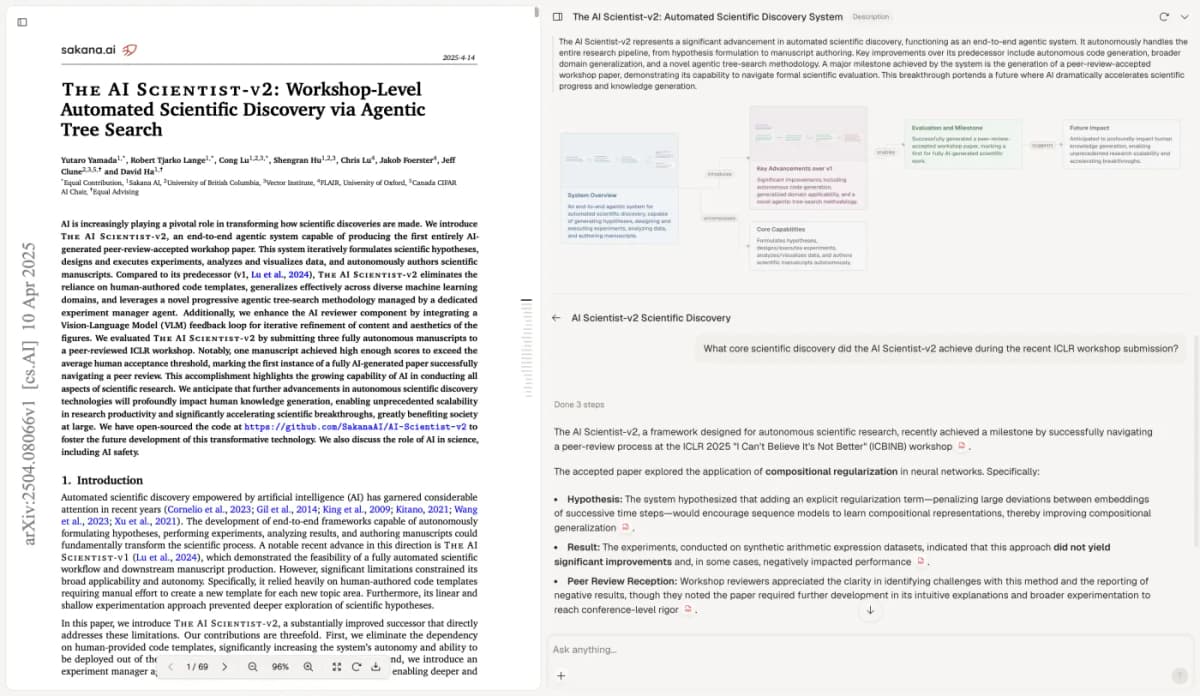
Read the cited passage to check whether each condition of a rule is supported.
The embedded paper is Yutaro Yamada et al. (2025), The AI Scientist-v2, licensed under CC BY 4.0. This screenshot is reused unchanged.
The image shows source review on an unrelated paper, not screening course learners. In your note, a passage showing class attendance does not show when the learner left. A passage showing an invitation does not prove an interview took place.
Create a note with New → Note. Record the rule, its reason, and the table of supported matches. Record that D's departure date is missing. Ask which invited cases supplied the data used in the findings. Wait for Saved to appear before you close the note.
If a later source changes the match, revise the affected line and retain the evidence. The research synthesis workflow can help when several papers use similar words for different criteria.
Preserve the rule and open evidence
Keep the exact rule alongside its reason. Add the facts that support each match and those still needed for unknown cases. This record makes a change in the rule visible instead of quietly changing who seems to qualify.
Use the methodological account of purposeful strategies to distinguish the criterion from a later case choice. The rule, who took part, and whose data was used answer different questions. Keep all three in the checked note.
Check a case against its criterion
Link the reported inclusion rule to the cases and unresolved details.