

Discriminant validity asks whether evidence from measures supports a difference between constructs that theory treats as distinct. Read what each construct means, how its score is made and what the stated result can show. Two scale names alone do not settle the question.
Distinct constructs can still be related. A negative correlation or a result that is not significant does not, by itself, prove a difference. This guide shows how to build a cited note with those limits visible. Its confidence-and-pressure case is fictional.

Check what your measures distinguish
Compare construct definitions with the paper's reported evidence.
What discriminant validity means
A construct is the concept a measure is meant to represent. This type of evidence asks whether measures can distinguish concepts that should differ. Divergent validity is often used as another name, but read how the paper defines its claim.
Rönkkö and Cho's investigation documents uses of the term and distinguishes questions about item cross-loadings from questions about whole constructs.
This complements convergent validity: whether measures of the same or related concepts have the expected links. Finding any correlation is not enough to answer either question.
Ask which constructs the paper claims to distinguish and what results support that claim. Keep the meanings, scores, group and method in the answer. A short label can hide differences in what authors actually checked.
Read the construct definitions first
Start with the authors' definition, rather than the word's common meaning. Confidence in a given task need not mean confidence in all parts of life. The scope of the construct shapes the scope of the claim.
Read the second construct with equal care. Two names may look distinct while their items overlap. Two concepts may also differ in theory while still having a strong link. The open psychology textbook places expected links within the wider measurement argument.
The version, item content, rater and scoring rules help define what a score represents. A self-report and an observer rating can differ in method even if they address related behavior. Keep those details before you read the result.
Interpret the scoring direction
A minus sign is easy to misread. High scores could mean more difficulty on one scale and greater ease on the other. The sign may reflect how the scales were scored, rather than a clear gap between the concepts.
A strong link below zero can still show that scores are closely related. The sign does not prove that the measures distinguish the constructs. Read the theory and scoring rules together.
Make five source checks before extracting the result:
- Name the target construct in the authors' terms.
- Name the second construct and why it should differ.
- Find the measure and score direction for each.
- Find the expected link, if the paper states one.
- Keep the source's claim apart from your own judgment.
If no expected link is stated, retain that gap. You may suggest a reason in your own note, but do not call it a hypothesis the authors specified in advance. The scale-development primer explains the wider checks behind a scale's intended use.
Identify the distinction the analysis addresses
A correlation between whole scores, an item cross-loading and a model-based test ask different questions. Keep the method name. Do not collapse them into one field called evidence of difference.
Henseler, Ringle and Sarstedt's original paper examines criteria in variance-based structural equation modeling. It introduces the heterotrait–monotrait ratio, or HTMT, in that setting.
That context matters when you read a claimed threshold. A rule from one model is not a universal rule for all measures. Record what your paper uses and what its authors say it evaluates.
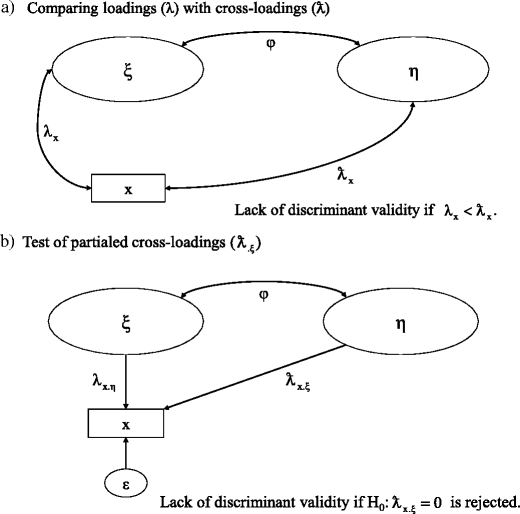
The item box connects to two construct ovals; the panels compare different cross-loading questions.
The box is an item, and the ovals are two constructs. The upper panel compares the intended loading with a cross-loading. The lower panel adds a residual term and shows a different question about partial cross-loadings.
The figure makes the need for a method label concrete. It is not a diagram of every form of discriminant evidence. Figure 1: Henseler, Ringle and Sarstedt, 2015, reused unaltered under the publisher's Creative Commons Attribution statement.
Rönkkö and Cho's published-version paper reviews and scrutinizes such methods. Read its technical argument when the choice matters, rather than assume a single cutoff settles all cases.
Also keep a null result apart from proof of a difference. A test that fails to show a link is not, on its own, strong evidence that two constructs are distinct. The textbook's validity discussion explains why a claim needs the pattern of evidence and its theoretical basis.
This guide records what a paper reports. It does not choose an estimator or teach factor analysis. Keep those choices open for an appropriate methods review.
Build a distinct-construct evidence note
Suppose a fictional paper compares task confidence with deadline pressure. Confidence means a person's sense that they can complete the task. Pressure means the urgency they feel because of a deadline. These are invented definitions, not descriptions of validated scales.
Both scores come from self-report items. High scores mean greater confidence and greater pressure. The text you checked describes a negative link but omits the detail needed to assess the claim of distinction.
Use the table to expose that gap. It is an original teaching note with no real coefficient or finding. Replace each field with checked text from your paper.
| Field | Fictional working note | Limitation to keep |
|---|---|---|
| Target construct | Sense of task capability | Not confidence in all domains |
| Proposed distinct construct | Deadline urgency | Needs a theory-based reason to differ |
| Measures and scoring | Two self-report scales; high means more of each | Check item overlap and method effects |
| Reported evidence | A negative link in the checked text | Sign alone cannot prove distinction |
| Missing evidence | Full method and uncertainty not found | Check complete results and supplements |
Table 1: A colleague writes: “The minus sign proves the scales measure distinct things.” Correct that claim. The sign alone carries neither the scoring rules nor the theory nor the full method.
Now suppose the confidence scale is actually scored as difficulty. The direction of the score changes. Correct that field before explaining what the negative result means. The label on the scale is not a substitute for its scoring guide.
A better note says: “The authors define distinct constructs, but the checked text gives only a link with unclear score direction. More detail is needed to judge the claim.” It names what to read next without inventing a cutoff.
The later methodological review is useful when framing that next question. Keep one entry per pair and version. Do not turn a result for one sample or translation into a claim for every use of the label.
Check definitions and findings in Atlas
Gather definitions, item or scoring descriptions, results and limits. Add the supplement when the details are split across files. Use material you have permission to add to the project.
Create an Atlas project, select the relevant sources and ask:
Compare the target construct with the proposed distinct construct. Find each definition, measure, score direction, expected relationship and author-reported evidence. Cite each field. Keep missing details unknown and do not certify discriminant validity.
Inspect the source behind the claim
Use the returned answer as a draft and make these checks:
- Open each citation and read the text behind it.
- Check that a definition citation supports the construct's meaning.
- Check that a result citation supports the stated method and finding.
- Correct any confusion between a measure, its score and the concept it represents.
- Save the corrected note with links and a separate judgment field.
If the answer treats a negative link as proof, return to the score direction and theory. If one paper checks items and another checks whole constructs, retain the different questions. A single pass/fail field would hide them.
Atlas helps read and compare supplied sources. It does not compute HTMT, run factor analysis or establish a distinction. Keep the final methods judgment with the researcher.
Keep the claim within the comparison
Name the constructs, exact measures, sample and method. Say what supports the difference and what remains open. If you have checked only the definitions, say that the data-based claim has not yet been assessed.
The scale-development primer describes other checks needed when building a scale. A good result for one question does not settle all uses of a measure.
Use the concurrent-validity guide when the next question concerns a same-time reference. Use external-validity appraisal when the question concerns a new group or setting. Those questions add limits beyond construct distinction.
Before finishing the note, check that labels match definitions, directions match scoring rules and claims match the stated results. Keep uncertainty visible rather than turn a weak passage into a strong certificate.
Check what your measures distinguish
Compare construct definitions with the paper's reported evidence.