

A legal brief outline connects each argument point to the facts and law that might support it. It also makes gaps visible before a draft hardens around them. Start with the issue and position supplied by counsel, then map each reason to its source.
For example, an email saying a notice was sent supports a claim about sending. It does not, by itself, prove receipt. Nor does it show that a legal notice requirement was met. The worked outline below keeps those three claims separate for review.

Outline your source support in Atlas
Compare permitted sources, check citations, and save a draft for counsel review.
What a legal brief outline does
A legal brief outline is a plan for a persuasive document addressed to a court. It joins the issues, reasons for the proposed result, supporting sources, and relief sought. Relief means the specific action you ask the court to take. The Ninth Circuit's brief guide connects legal and factual arguments with that requested action.
An outline should reveal how the argument works. A list of labels such as Facts, Law, and Conclusion gives you places to write. It does not yet show why a fact matters, which rule counsel plans to apply, or what remains unsupported.
Keep the document's purpose clear. A case brief is usually a summary of a decision for study or research; an internal memo evaluates a legal question. Rev's format guide distinguishes those uses from a court-facing brief. For objective analysis before a position has been chosen, use the legal research memo workflow.
Choose the brief and court format
Confirm the court, case stage, party, and brief type before using a template. The Ninth Circuit explains the roles of opening, answering, and reply briefs: the opening brief sets out the appeal's argument, the answering brief responds, and the optional reply addresses that response. In that court, a reply should address the other side's points rather than just repeat the opening brief.
For one named example, federal appeal briefs follow Federal Rule of Appellate Procedure 28. An opening brief has tables, issues, a case statement, a summary, the argument, and a request for relief. It also explains the court's power to hear the case and includes any required certificates.
The argument needs law and record support, plus the standard of review. That standard tells the appeal court how to review the challenged ruling.
This is one format example; a trial motion brief can take a different form, and local rules or case orders may add steps. Use the official Ninth Circuit shell brief for that court, following its own instructions.
Keep a format note beside your outline with the rules and orders, required parts, record format, length, and due date for counsel to check against the actual case. The court's briefing guide points to the briefing schedule for the opening deadline, so take that date from the schedule rather than a blog template.
Use a legal research plan to track the authorities, record sources, and open checks that feed the outline. A heading should not turn an unchecked source into a settled legal proposition.
Build the argument hierarchy
Give each main point a conclusion
A point heading states the conclusion of an argument. Compare the topic label “Notice” with the proposed statement “The record does not establish receipt of the notice.” The second gives the reader a claim to examine.
Whether that claim supports relief is a separate legal question for counsel.
Georgetown's point-heading guide describes major headings as independent grounds and lower headings as supporting reasons.
Start with the counsel-approved issues. Give each main point a distinct job rather than repeating the same reason under several titles.
For the notice example, one subpoint might concern what the sender's email says. A second might address the recipient's account. These are branches of one factual dispute. They do not become separate grounds for relief just because you assign them Roman numerals.
Use subpoints to expose the reasoning
Place the specific reasons under the claim they support. Split a branch when it holds two distinct ideas that each need analysis. Combine branches when they rest on the same point and sources. CUNY's brief-writing checklist asks whether headings and paragraph theses reveal a coherent argument.
The source page below shows one real court template's branch structure. Its first branch concerns the standard of review and record locations; the next allows a subargument. The adjacent note recommends a restrained hierarchy rather than many nested levels.
Those instructions belong to the Ninth Circuit shell, so check the rules and template for your court.
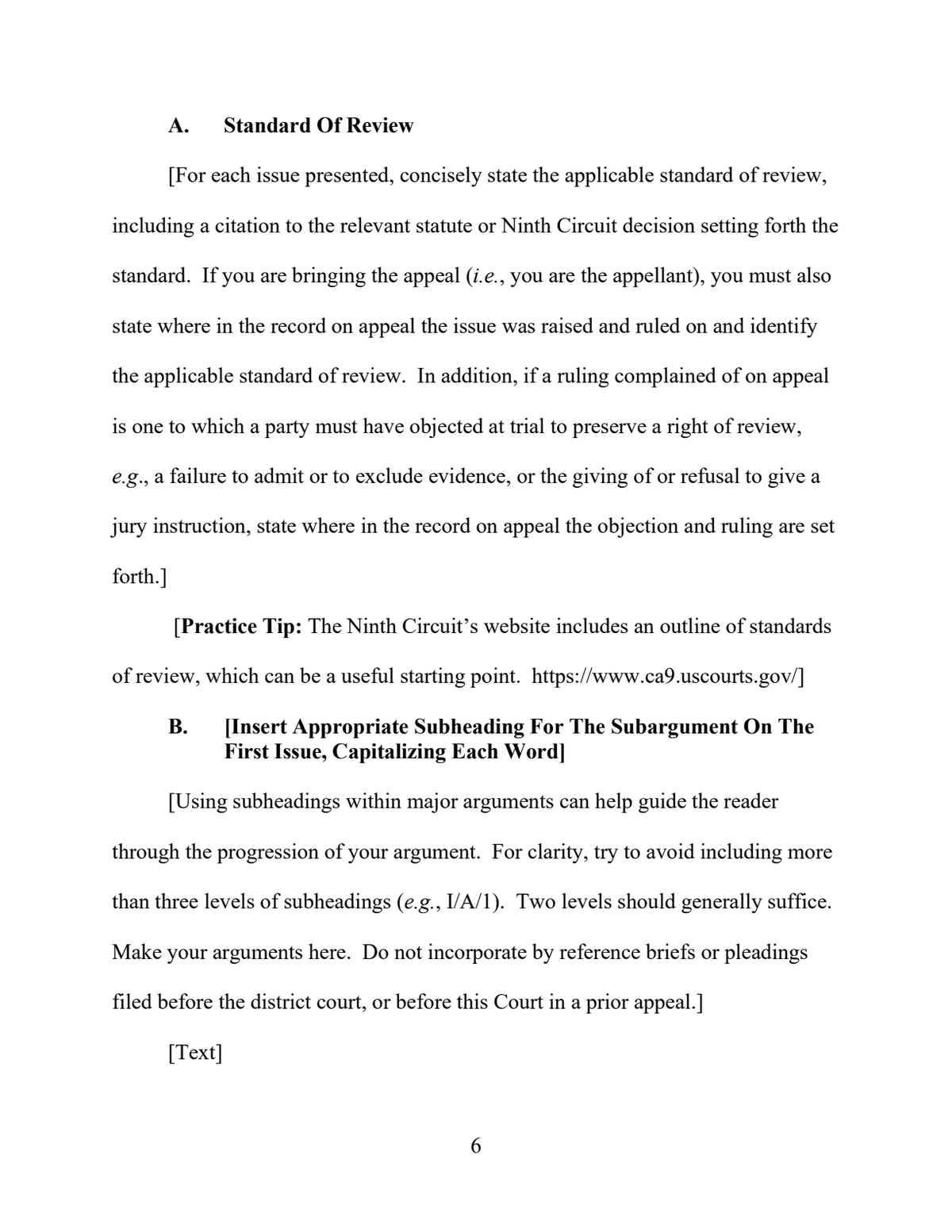
United States Court of Appeals for the Ninth Circuit, Shell Brief, PDF page 11, printed page 6. Complete source page reproduced without content changes; a United States government work, public domain in the United States under 17 USC 105.
Read only your outline's headings. Can another reader identify the requested result and follow the reasons? That test, drawn from Georgetown's guidance, can expose a vague main claim or a subpoint that does no work.
Then read the sources before making the heading stronger.
Connect each point to source support
Keep facts and legal authority distinct
The record is the case material the court can properly consider. Legal authority supplies the rule or reasoning used to analyze it. A witness statement does not establish a legal test. A court decision does not prove what happened in your case. Rule 28's argument requirement names both forms of support.
For each factual claim, record the document, passage, and proposed pinpoint citation. A pinpoint identifies the exact page or location. Check the whole passage for limits or conflicting text. If the document says “I sent it,” preserve the speaker and that wording's scope; do not silently change it to “they received it.”
For each legal proposition, counsel supplies or approves the authority, the relevant passage, and the intended use. Mark whether it supports the rule, an analogy, or a distinction. Then counsel checks its current status and fit for the court through appropriate legal research tools. A saved PDF preserves the text. Its current legal status needs a separate check.
Show the step from rule to fact
Reasoning connects the legal proposition to the facts. State that step in your outline so a reviewer can challenge it. CUNY's teaching structure separates rule synthesis, rule support, application, and counterargument. Use those roles to plan the reasoning, then choose paragraph labels that suit the brief.
Give each outline entry three fields: evidence from a checked passage, counsel's rule statement, and the proposed inference. Keeping those fields separate helps the reviewer test the reasoning. If one part is missing, label the gap. Do not hide it in polished prose or fill it with a plausible case name. Leave enough context for the reviewer to see why the source was selected.
Also distinguish your source location from the filing citation. Rule 28(e) addresses references to the record, while local rules can specify further format. An app's citation link may help you find a passage. It does not certify the appendix pagination or the court's required citation form.
Work through a legal brief outline
Start with a bounded training example
This is a fictional outline exercise. Counsel has asked a researcher to organize support for the proposed claim that the record does not establish receipt of a notice. No real legal test, case authority, or requested court order is supplied here. Those remain counsel's work.
The exercise uses three extracts that describe different parts of the same event. R1 says the sender emailed a notice on Monday. R2 says the recipient first saw it on Thursday. R3 is a later message in which the recipient refers to the notice. Use these IDs to track sources while you work; court citations need separate checks. There is no finding that any statement is true or admissible.
The outline below uses the distinct support roles in Rule 28 and CUNY's argument checklist.
Its content is original and fictional. Each row shows what a researcher can organize and what a lawyer still needs to decide.
| Argument point | Record support | Authority check | Unresolved question |
|---|---|---|---|
| State counsel's governing notice rule | No factual extract can supply the rule | Counsel selects and verifies the applicable law | What does the actual rule require? |
| R1 reports sending on Monday | Sender's stated act in R1 | Counsel checks whether sending has legal significance | Does other evidence show delivery or receipt? |
| R2 reports first seeing the notice Thursday | Recipient's account in R2 | Counsel checks which timing facts matter | Is that account supported or disputed? |
| Address the recipient's later reference | R3 refers to the notice | Counsel checks how this affects the proposed argument | What can R3 show about earlier receipt? |
| Connect the checked analysis to relief | Link only verified facts used above | Counsel identifies the available remedy and standard | Which precise court action follows, if any? |
Table 1: The rows separate source text from inference and law, so none can silently stand in for another.
Revise the claim after source review
A first draft might say “The recipient never received the notice.” The supplied extracts do not support that statement. R2 reports seeing it later, and R3 refers to it. The draft has turned a timing question into a claim of no receipt at all.
A narrower working heading is “The supplied extracts do not establish receipt on Monday.” Its subpoints can describe R1's sending account, R2's later-seeing account, and R3's unresolved timing.
The word “supplied” limits the claim to the reviewed set. It does not imply that the whole record lacks proof.
Counsel may still reject that heading. A legal rule might make a different event relevant, or other record material might close the gap. The researcher hands over the source map and question rather than selecting the legal result.
This is how an outline can expose a weak premise before it becomes a confident paragraph.
Review adverse points and unresolved checks
Keep facts that hurt the proposed claim in the outline. The official court shell's case-statement guidance warns against leaving out such facts. CUNY's checklist also asks writers to address the other side's points.
R3 belongs in the review even though it may weaken the receipt claim.
Sort open questions by what can resolve them: the missing record passage for a source gap, surrounding context for an unclear sentence, counsel's research for a legal question, or the applicable rule or order for a format question.
This helps turn “needs checking” into a task someone can finish.
Give each gap an owner and a next action. For R3, the researcher can find the full message and its date. Counsel decides what that means in law.
For the rule row, counsel selects and checks the authority. A prompt should not make that choice just because the model can answer it.
Before using a research tool, check that you may upload and use the files. Client terms, privilege, duties to keep facts private, and court limits need review outside the outline. To compare tools for reading sources, see the legal document analysis guide.
Prepare the source comparison in Atlas
Ask for a source-bounded outline
Add only permitted documents to an Atlas project and wait for them to process. Keep useful document names and working IDs so you can tell which version supports each point. Start a fresh chat when earlier context could blur the task, then mention the intended sources with @.
Supply counsel's issue and the task boundary. For the fictional exercise, a prompt could read: “Compare R1, R2, and R3 for counsel's proposed point about receipt on Monday. Separate what each extract states from possible inferences. Give supporting passages, contrary passages, and missing evidence. Do not choose a legal rule, legal position, or remedy.”
Ask for the same four fields used in the table: argument point, record support, counsel's authority check, and unresolved question. This gives you an inspectable working outline. It does not ensure that every relevant passage was found or that all three sources received equal attention.
If the output says “receipt was proved,” ask which passage supports receipt rather than sending. If a source is missing from the answer, ask about that named source directly. Bring any claimed authority back to counsel's selected materials and specialist legal research process.
Inspect passages and save the review
Open each numbered citation and compare the claim with the surrounding source text. Check names, dates, speaker, document version, and qualifying words.
If the citation does not expose a precise page or passage, inspect the source directly. Keep the court record reference as a separate field for human verification.
Check the hardest claim first. In this example, that is the jump from “sent” to “received.” Read R1 and R2 together, then test the proposed heading against R3. Correct the outline if the source says less than the answer suggests.
A legal document summarizer can assist reading, but summary quality does not settle that inference.
Save the reviewed outline through New, then Note, with a clear title and the unresolved checks. Wait for Saved before closing. Preserve the source references and revision reason so counsel can see what changed and why. Label the note as research for review rather than a final brief.
Hand the outline to qualified counsel
Give counsel the issue map, draft headings, checked passages, record pages, and selected law. Include facts that hurt the claim and questions still open. Mark any step in the reasoning that goes beyond what a source says. The reviewer should find the weak link without reading the whole chat.
Counsel checks the position, law, record, and citations, then resolves format and due-date checks. The outline is ready for review when its support and gaps are clear. Counsel must approve the final argument. Drafting and filing the brief are further steps, governed by the court's rules and the case itself.
Outline your source support in Atlas
Compare permitted sources, check citations, and save a draft for counsel review.