

A legal research plan is a working roadmap for answering a defined legal question. It records the key facts, jurisdiction, sources to consult, search terms and checks still needed. The plan helps you decide what to do next when a source changes your view of the issue.
Keep it beside a research log. The plan says what you intend to search. As you work, the log records the searches you run and what you find. Neither replaces the legal analysis in a finished legal research memo.
Atlas can help you read approved starting sources and trace proposed issues or search terms to the passages behind them. A qualified researcher still decides which law applies and checks its status in the right legal sources.

Keep the sources behind your plan
Compare starting materials and check the passages behind each research lead.
What a legal research plan contains
A plan connects each research question to a source route and a check. Suffolk's law-library guide treats it as a roadmap built around the task, issue statement, terms and sources. Where you start depends on what you already have. A case supplied by your teacher may lead you to its cited sources. If the topic is new to you, background reading may help you find a starting point.
You can adapt this outline to a supervised assignment:
- Assignment: the question, audience, requested output and due date.
- Scope: which jurisdiction and forum to research, which dates matter and what to leave out.
- Facts: what the supplied record establishes and what remains unknown.
- Source route: where to start, what to follow and why each source matters.
- Search terms: initial phrases, alternate terms and filters to use.
- Checks: authority, text, dates, later treatment and contrary sources.
- Review point: who reviews the work and what requires further instruction.
Leave room to revise this outline. A source might reveal a missing fact or a legal term you had not searched. It may also raise another issue. Date the change and say why it changed the next search. An old plan can quietly steer new work toward the wrong question if you keep following it after the scope has changed.
Robert Linz's research-planning article describes a framework of plan, log and product. When reporting progress, show both the route you proposed and the work done. A reviewer can then see how the search led to the written answer.
Define the question and its limits
Start with the person assigning the work. Ask what question they need answered, which facts they have supplied and how they will use the output. Suffolk's questions about the legal task connect the client, area of law and desired output to that scope. A background note, internal memo and filing can each call for a different depth of research and review.
Separate facts from missing facts
Write a short account of the events with a source beside each fact. Keep a claim, a document's wording and an agreed fact distinct. If the task says a letter was sent, do not assume what it said, how it was sent or when it arrived.
In her article on plans and research logs, Caroline Osborne discusses facts, legal issues and limits on research. Missing facts belong in the plan because they may change the question or the search route.
For example, a lawyer asks you to research notice under a business contract. Your fact note contains a clause and a letter, but no record of receipt. You can plan research on notice rules while marking receipt as unknown. You cannot fill that gap by turning the sender's account into a proven event.
State the assigned legal scope
Record the jurisdiction and forum your supervisor has approved: whose law to research and where the matter may be heard. If the files suggest several possible places, ask for review before choosing one. A place named in a contract does not, by itself, settle every choice-of-law or forum question.
Include the dates that matter to the task. To find what a rule required when an event happened, you may need an earlier version of the text. To plan the next step in a case, you may need the current version. State which you need before collecting files with similar titles.
Also state what the task leaves out. For the invented notice example, the lawyer might ask for a state-law roadmap that does not cover damages or federal court rules. If a source raises one of those issues, log it for review instead of silently adding it to the task. Thomson Reuters' scope questions are a prompt to revisit facts, legal issues and jurisdiction before extending the search.
Choose a source order
When the area of law is new to you, a secondary source can help you learn its terms and find leads. Secondary sources explain or discuss law. Primary sources contain the legal text or court decision itself. A guide's citation points to a source you still need to read.
Victoria's law-library guide calls for source titles and dates, leads to laws and cases, and checks for changes and later court treatment. Its Canadian examples also show why you should retain the legal setting a checklist was designed for.
If the task supplies an exact section of a statute, case or rule, inspect that source first. Use its references and a suitable guide to develop the next search. Return to background reading when the primary text uses a term you do not yet understand.
For a lease packet, a lease abstract can map operative terms and amendments before you research a dispute. It records what the documents say; counsel still determines legal effect.
Record identity and version
Keep the source's full title, who issued it, date, version and page or section. A file named rules.pdf hides details that a reviewer needs to assess its fit for the task.
The cover below names the Supreme Court of the United States, an adoption date of December 5, 2022, and an effective date of January 1, 2023. Those details identify this edition. To find whether a rule has changed or applies to your task, check the relevant court's current rules and later changes. The cover alone cannot answer those questions.
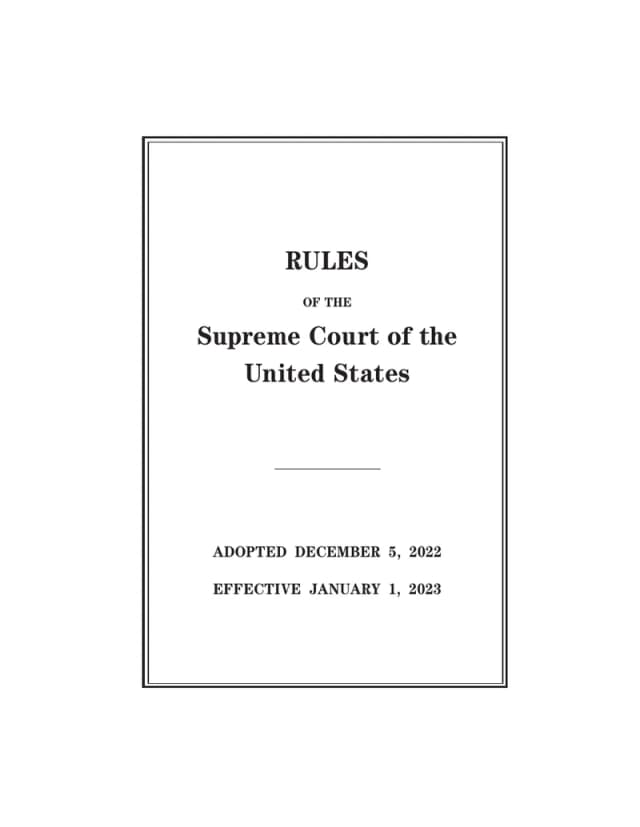
The cover of the Court's 2023 rules publication illustrates the version details to retain when adding a source to a plan.
For case law, include the court and decision date as well as the citation. For statutes, note the section and version in force at the time of the events.
Plan a check for later changes, dates when the text took effect or later court treatment where the task needs it. Victoria's primary-source checks distinguish updating legislation from finding how courts have interpreted it.
Plan the authority check
Ask who issued the source and how it relates to the chosen forum and issue. A court decision may bind one court but serve only as guidance for another. Suffolk's discussion of authority explains why jurisdiction and court level matter. The researcher must check those relationships and the point being used.
A citator helps find later references and court treatment of an authority. Thomson Reuters' research guide explains why this check matters and how negative treatment can prompt closer review.
Record the check and read the later sources that matter. An icon alone cannot tell you how to use the source for every legal point.
Work through a source roadmap
This fictional teaching assignment concerns a notice clause in a commercial supply contract. A supervisor has defined a preliminary state-law research task. No named statute, real case, legal deadline or outcome is supplied here.
The starting files are an approved assignment note, a contract excerpt and a letter. Use the following roadmap to separate the research route from the facts and authority still needing review.
| Question | Starting route | Check before use | Open gap |
|---|---|---|---|
| What notice issue is assigned? | Assignment note and contract clause | Match the question to the approved scope | Delivery record missing |
| Which primary text may matter? | Jurisdiction-specific commentary leads | Retrieve and read the relevant text | Applicability undecided |
| How have courts addressed the issue? | Case references and targeted searches | Check court, facts and proposition | Contrary cases unreviewed |
| What remains usable for this task? | Version history and citator results | Read relevant changes and treatment | Currency check pending |
Table 1: Each row names a next action and preserves the check that keeps a research lead from becoming a conclusion.
Turn the first row into searches
Begin with words from the clause, such as written notice, delivery and termination. Add legal terms found in background reading. Keep the ordinary wording too, since sources may describe similar facts with different language. Suffolk's search-term guidance includes parties, places, facts, claims and relief as routes to legal vocabulary.
Where the database allows it, filter by jurisdiction and source type before searching. Then record the exact query and any further filters. Search syntax varies. Check the database's phrase and connector rules before copying a query from another service.
If the results are too broad, narrow one part of the query or scope and note the change. If they are too sparse, try another term or a secondary source. Preserve the search that failed to find a lead so the next researcher does not repeat it without a reason.
The New Brunswick checklist's issues-and-keywords section keeps space for new terms found while reading.
Revise after reading a lead
Suppose a commentary discusses actual receipt, while the clause supplied in the assignment refers to a stated delivery method. The next step is to locate and read the commentary's authorities and compare their facts. The plan should record both concepts without deciding that they mean the same thing.
If those authorities address a different contract type or court, record the difference. A lead can help refine the search even when it does not support the final legal point. Keep any contrary account in view rather than collecting only sources that fit the desired answer.
Suffolk's case-selection questions expressly include cases that support an opposite conclusion.
Keep searches and checks in view
Use a log entry for each search or source review that affects the task. Record the date, database, terms, filters, results kept, reason for keeping them and next check. The New Brunswick law-library checklist advises recording sources you consult even when you find nothing that helps.
For the invented task, an original log entry might read:
Searched the assigned state case collection for the clause's notice phrase, with the court filter approved by the supervisor. Found a guide and two cases to inspect. Saved their citations for review. Have not read the full cases or checked later treatment. The next task is to compare the passages, court levels and facts.
This records work performed without claiming that the candidates establish a rule. Replace the general labels with the real database, query, citations and locations when you use the format for an actual assignment.
Correct an unsupported promotion
A draft note might state that the law requires actual receipt after the writer has read only a background guide. That claim goes beyond the work done in the log.
Correct the note to say that the guide raises an actual-receipt issue and names sources to inspect. Keep the primary-text review and judgment about what applies open. A later writer may otherwise treat the note as a verified rule and skip the missing checks.
Use explicit states such as lead, text reviewed, status check pending, and reviewed for this proposition. A source can be read while its legal status remains unchecked.
A status check can be complete while its relevance to these facts remains disputed.
Keep enough source detail to reopen the passage. An organized research source collection can reduce repeated searching, but the folder structure does not establish legal authority.
Retain the researcher's reasons beside the source.
Review starting materials in Atlas
Use only materials approved for the tool under your organization's rules. Keep sensitive client details out of the teaching example and check permissions before adding actual matter documents.
Add the permitted assignment note, contract excerpt and selected background source to one project. Once they have finished processing, open a chat and type @ to select the three sources. Ask a bounded source-reading question:
From these named materials, list candidate notice issues and search terms. For each, cite the passage that prompted it. Separate stated facts from missing facts. Mark any proposed legal interpretation as needing researcher review. Do not treat the background source as proof of current controlling law.
Open each important citation. Check that the proposed term appears in, or fairly describes, the passage. Read enough context to retain any qualification. If the answer joins the contract wording and commentary into one conclusion, ask it to separate what each source contributes.
For example, reject a row that says the letter was received when the source only says it was sent. Correct the fact state and keep receipt in the open-gap column. Reject an uncited legal rule or a statement that a source is current based only on its upload date.
Atlas citations help you inspect source support. Continue the roadmap's legal database and citator checks in the appropriate services and record the results yourself.
The same distinction applies to multi-source synthesis: a readable comparison still needs its supporting passages checked.
To keep the reviewed plan, select New, then Note. Save the issue, source links, corrected search terms and unfinished tasks. Wait for Saved before leaving the note.
On the next research session, update the log with the searches you ran and their results. Keep generated answers pending review until you have checked the cited text.
Set a review point and handoff
Agree on a review point that fits the task and resources you can access. Suffolk's endpoint guidance points to repeated references to sources already found. Check that pattern against the planned questions and missing work before stopping.
Time or database access may run out while an important check remains open. Report that as a progress handoff. State which searches you ran, what the sources appear to contribute, which authority checks are unfinished and what needs the supervisor's decision.
Before drafting the memo, review the plan against the log. Each completed item should have a source or recorded check behind it. Each open item should have a next action or a reason it needs further instruction. If a missing fact changes the question, revise the plan before carrying the earlier research into the written answer.
If the handoff is a court brief, the legal brief outline guide shows how checked authorities and record passages support each argument heading. The research plan still tracks open searches and authority checks.
Keep the sources behind your plan
Compare starting materials and check the passages behind each research lead.