


Scite is the better choice when you need to see how later papers cite a paper or claim. Elicit is the better choice when you need to find papers, screen them, and fill an evidence table.
Use both when the review needs separate checks. Elicit can help build the paper set. Scite can check how key papers were cited. Atlas can synthesize the sources you keep with citations you can inspect.

Synthesize selected papers in Atlas
Compare the papers you keep and inspect the cited passages behind each claim.
Quick verdict
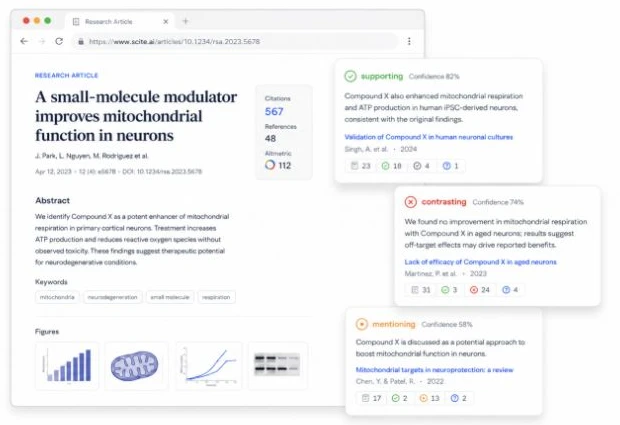
Choose Scite when the question is how later papers cite a paper, claim, author, or school. Scite's key strength is citation context. Its Smart Citations label each cite as support, contrast, or mention.
Choose Elicit when the question is how to move through a literature review. Elicit helps find papers, screen them, set fields, build tables, and keep quotes near extracted answers.
Many serious reviews need more than one tool. Use Elicit to find candidate papers and extract fields. Use Scite to check how important papers or claims have been received. Then use a source-grounded workspace to synthesize the papers you keep.
That last step is where Atlas fits. Atlas is not a Scite citation index or an Elicit review engine. Use Atlas after source selection, when you need to compare selected papers and inspect the passages behind an answer.
The comparison draws product details from official Scite and Elicit pages. For additional comparisons, see PaperGuide and Anara.
What to compare before choosing
Scite and Elicit both sit in the AI research-tool category. They serve different parts of a review. For a wider map of the category, start with the AI tools for academic research guide before narrowing to this pair.
Scite is strongest when you already care about a paper or claim. Its official product page positions Scite around discovering papers, evaluating evidence, and research answers.
Scite's annual rankings report explains that its Smart Citation data labels each cite as support, contrast, or mention. The Scite paper in Quantitative Science Studies describes the same context-and-classification model.
Citation counts still help with a first pass.
Scite adds context when you need to know whether later papers reinforce, dispute, or only cite the paper. If the decision is Scite versus an owned-source workspace, the Atlas vs Scite comparison separates citation reception from source-grounded synthesis.
Elicit is strongest earlier in the review. Elicit's official product page describes tables, step-by-step flows, source-linked claims, and research support.
Its systematic-review page covers research questions, paper gathering, screening, data fields, CSV export, and edits to earlier steps as the review changes. If the shortlist also includes paper-reading assistants, the Elicit vs SciSpace comparison is the closer workflow split.
The difference matters because feature lists can blur the jobs. Both tools can help you find and sum up papers. Neither can replace reading the studies. The better question is which check you need next.
- If the question is "do later papers support or challenge this paper?", start with Scite.
- If the question is "which studies fit my criteria, and what data should I pull?", start with Elicit.
- If the question is "what do these sources say together?", move the kept set into Atlas or another cited source workspace.
Scite vs Elicit compared
The table below compares the jobs a researcher is likely to hand to each tool. It avoids pricing and plan limits because those change quickly and are not the core decision for this query.
| Decision point | Scite | Elicit | How to verify the output |
|---|---|---|---|
| Best fit | Checking how later papers cite a paper or claim. | Finding papers, screening them, extracting data, and building evidence tables. | Start with the research job before reading feature lists. |
| Source workflow | Works best when a paper, claim, author, institution, or citation trail is already in focus. | Works best when the review still needs candidate papers, criteria, and extraction fields. | Keep a record of why each paper was included or excluded. |
| Citation behavior | Scite's Smart Citations classify citation statements by how they cite the referenced work. | Elicit supports AI-generated claims with sentence-level citations and supporting quotes in its workflow. | Open the cited paper or passage before moving a claim into a literature review. |
| Screening and extraction | Useful for context around papers, but not positioned as the main systematic-review extraction workflow. | Stronger fit for screening criteria, data extraction fields, research tables, and CSV handoff. | Treat extracted cells as draft evidence until checked against the source text. |
| Evidence caution | Citation context can show reception, but it does not prove the original claim is correct for your question. | Extraction can speed review tasks, but published methods research still stresses human review. | Check whether the cited passage supports the exact claim, method, population, and limitation. |
| When both help | Use Scite after Elicit identifies important papers, especially for highly cited or controversial claims. | Use Elicit before Scite when the paper set is still forming. | Reconcile disagreements manually rather than letting one tool overrule the other. |
| Where Atlas fits afterward | Atlas is not a replacement for Scite's citation-context index. | Atlas is not a replacement for Elicit's screening and extraction workflow. | Add the selected papers to Atlas, ask a cited comparison question, and inspect the source passages before saving synthesis. |
Table 1: This table shows Scite as the citation-reception tool, Elicit as the review-workflow tool, and Atlas as the post-selection synthesis workspace.
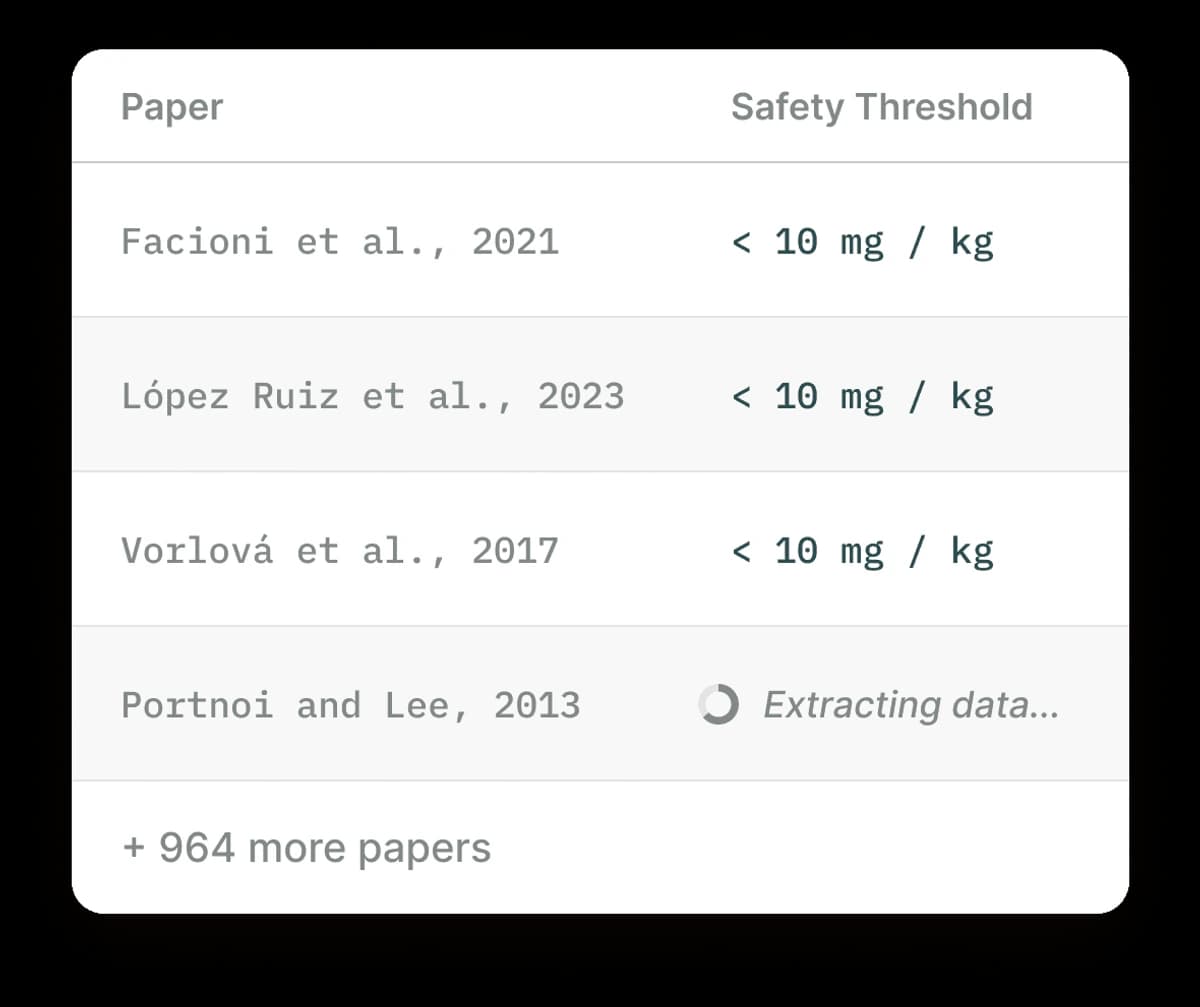
Elicit's table workflow is the visual clue for the comparison. The tool is useful when each included paper needs the same field pulled into a row, such as a safety threshold, outcome, sample, method, or limitation. That makes the review easier to scan, but it also creates a verification job: each extracted cell still needs to be checked against the source paper before it becomes evidence in a draft.
The text version follows 3 steps. First, Elicit lists papers as rows. Second, it extracts the same review field into a column.
Third, the researcher checks whether each extracted value is supported by the source paper.
Scite’s official feature page publishes the feature illustration below. It shows citation labels and an article layout, not an independent assessment of the cited claims.
Official Elicit product screenshot showing the extraction-table pattern that makes Elicit stronger for screening and data extraction than Scite.
Verify the kept sources
A strong Scite-Elicit workflow has three checkpoints:
- Use Elicit when you need to form the paper set. Define the research question, screen papers against criteria, and pull the fields that matter for the review.
- Use Scite when a paper or claim becomes important enough to check against later literature. Citation context helps when a paper carries a conclusion.
- Synthesize only the sources you are willing to stand behind. A library evaluation from HKUST notes that AI research tools can generate real citations, but those citations still may not match the argument.
Use a passage-level check before writing from any source:
- Does the source support the sentence you want to write?
- Is the caveat, method, population, or limitation still visible?
- Does another kept source disagree?
Atlas fits at that third checkpoint. After you have a kept source set, add the papers to one Atlas project and ask a question such as "Where do these studies agree and disagree?" Inspect the citation badges for the claims you plan to reuse, because Atlas citations connect answers back to source text but important claims still need passage checks.
For a literature review, I would use a handoff like this:
- Use Elicit to create the first review table and mark the studies that survive screening.
- Use Scite to inspect citation reception for the papers or claims that carry the most weight.
- Add the kept papers to Atlas and ask for a cited table with claim, proof, limit, and source columns.
- Open the citations behind the answer before moving a sentence into a draft.
Use the same plain check before you save the note:
- Does the paper say this?
- Does the quote support the claim?
- Is there a caveat nearby?
- Does another source disagree?
This workflow keeps each tool in its strongest role. Elicit reduces review-setup friction. Scite adds citation-reception context. Atlas helps turn a selected source set into synthesis that remains tied to inspectable passages.
Which should you choose?
Choose Scite if your main risk is over-trusting a paper because it has been cited often. Scite is the better fit when you need to see whether later papers support, challenge, or mention the paper.
Choose Elicit if your main risk is losing structure while building a literature review. Elicit is the better fit when you need to gather studies, define criteria, screen papers, extract fields, and export a research table.
Methods research on Elicit data extraction found useful support for review tasks. It also stressed prompt tests, field-level gaps, and human checks before relying on extracted data.
Use both if the project is high stakes. A thesis chapter, grant review, policy memo, or clinical evidence scan can benefit from both workflow support and citation checks.
Use Atlas after either tool when the paper set is selected and the next task is synthesis. Compare findings. Find points of disagreement. Draft a source-backed note. Check whether the cited passage supports the claim you plan to make.
The cutoff I would use is direct. Elicit helps you build the evidence table. Scite helps you check how papers were cited. Atlas helps you synthesize the sources you keep.
Conclusion
Scite and Elicit answer different research questions. Scite is better for citation context and citation checks. Elicit is better for structured review workflow support. The strongest workflow often combines them. Then the final source set moves into a workspace where synthesis and verification happen against the papers.
Do not let any AI research tool turn citations into a trust shortcut. The final review still depends on 3 checks. Does the passage support the claim? Does the study belong in the review? Is conflicting evidence visible?
Synthesize selected papers in Atlas
Compare the papers you keep and inspect the cited passages behind each claim.