

A semantic differential scale asks people to rate something between opposite words, such as good–bad or strong–weak. The words at each end are the anchors. They tell the person what kind of judgment to make, while the response points let them choose a position between the two ends.
The hard part is knowing what that position means. A fast–slow rating of a word, a website, and a train service may refer to different things. Before you reuse an item or interpret a result, check the object, instructions, and source for the claimed meaning. This guide shows that check using published research.

Trace anchors to their meaning
Check published anchors against the construct a study claims.
What a semantic differential scale measures
The method is used to study connotative meaning: the feelings or associations a concept brings to mind. A rating of strong–weak can concern perceived power; it need not measure physical force. Chapman, Gardner, and Lyons used word pairs to study how words feel. The task did not test whether people knew the words' correct factual meaning.
Three well-known dimensions are evaluation (good or bad), potency (strong or weak), and activity (fast or slow). These are often called EPA. The original study's methods link its chosen pairs to prior work on these dimensions. That does not mean you can place each new pair in an EPA group just by looking at its words.
Contrast it with agreement items
A common Likert item asks how much someone agrees with a statement, such as “This site is easy to use.” A semantic differential item could ask where the site falls between difficult–easy, with clear instructions about what is being rated. The task changes from endorsing a claim to placing an object between anchors. McLeod's methods guide explains this broad distinction.
Both formats still need a clear goal and support for their use. Start with your research objectives, then ask which rating task fits them. A line with seven numbered choices alone does not tell you which construct, or quality of interest, the item measures. Ask what you need to learn and whether this item can answer that question in your study.
Published anchors and proposed changes
In the Chapman study, people rated words in three separate tasks. Each task used seven response points. The good–bad task made the midpoint explicit as neither good nor bad.
Read the full methods for its sample, selection rules, tasks, and analysis before using it as a basis for a different project.
The note below separates those three published pairs from two original proposed changes for a fictional product study. The last two rows have not been tested, used to collect data, or validated for any population.
| Item or proposed pair | Source status | Claimed meaning | What the note should retain |
|---|---|---|---|
| Good–bad, rating words | Reported in Chapman study | Evaluation of the word's affective meaning | Preserve the rated word and full response labels; do not rename the task overall product quality. |
| Strong–weak, rating words | Reported in Chapman study | Potency in the word-rating task | Record the source's meaning of potency; it is not a test of physical strength. |
| Fast–slow, rating words | Reported in Chapman study | Activity in the word-rating task | Keep the object and task visible; this is not measured task completion time. |
| Difficult–easy, rating a checkout | Hypothetical adaptation | Proposed perceived ease | Specify which experience is rated and seek evidence for this new use. |
| Easy to use–trustworthy, rating a checkout | Hypothetical flawed pair | No clear single contrast | Ease and trust can coexist; rewrite or separate the goals before testing items. |
Table 1: The first three rows describe a published task; the proposed product pairs do not inherit its evidence.
Repair a claim beyond the anchors
Suppose your draft says, “The fast–slow item measures overall product quality because fast means good.” The published word-rating task does not support that claim. It used fast–slow for activity. Your draft also changed the rated object from words to a product, which creates a further question about meaning.
A safer note is: “The source used fast–slow in an activity task for words. We need to test whether this pair fits how people view speed in our product. It does not yet support our claim about overall quality.” Keep the source and the proposed use separate when you synthesize research papers.
Check the item before interpreting it
Read the questionnaire or appendix beside the source's account of what it measures. Copy the exact pair into your note and record where you found it.
Then check what people saw: the rated object, instructions, number of response points, labels, and order of the anchors. The methods may not show the whole form. If the appendix is missing, mark that gap rather than guess what it says.
Preserve the midpoint and direction
Seven points are common, but not a rule for all uses. McLeod's guide also describes other response formats. Preserve the format you are reading instead of silently replacing it with your preferred one.
Read the midpoint label. In the published good–bad task, it meant neither good nor bad. That is an answer with meaning. It is not the same as "don't know," a skipped answer, or "not applicable." The study needs a plan for how to record and handle each of those states.
Keep the scoring direction too. A larger code might point toward either anchor. Do not call every large score better, or combine items just because all have seven points. Consult the study's coding and analysis plan rather than infer scoring from the order shown in a screenshot.
Treat wording changes as changes
The Albert and Tullis textbook excerpt warns that changed pairings can carry a different meaning. Swap a word for a near synonym or a “not” phrase and people may read the task in a new way. Record the change. Your changed item is no longer the exact published one.
Apparent opposites also need evidence in use. The Cogliser and Schriesheim abstract reports that some tested pairs in a coworker scale did not work as opposite ends in use.
That is a reason to check the issue. It does not give a failure rate for your scale or show that every bipolar pair is flawed.
Compare scale sources in Atlas
Use Atlas when you have published items, methods, and construct descriptions to compare. Add only sources you may use. You can work from public instrument material without bringing in names or individual responses.
-
Add the relevant paper, questionnaire or appendix, and any source explaining the construct. Keep track of the version and where each item appears.
-
Mention the selected sources with @ in the chat composer. Keep the question bounded to those items and their reported meaning.
-
Ask: “Compare the exact anchor pairs, rated object, instructions, response points, and construct claims. Cite each supporting passage. Separate published items from adaptations, and flag missing or conflicting evidence.”
-
Open each citation and read the source context. Check that an answer about the construct comes from the methods or relevant evidence, not your draft's claim.
-
Correct the note yourself. Keep an unresolved field open if the source does not supply it; do not fill the gap with a plausible item description.
-
Choose New → Note, save the checked comparison with source references, and wait for Saved before closing the note.
Inspect the basis for the label
If an answer assigns “trustworthy” to potency, open the cited passage. Does the paper actually establish that meaning for this item, or merely mention both terms somewhere?
A citation can point to a related passage without proving the proposed link. The research assistant workflow keeps this source inspection part of the reader's job.
The authentic capture below shows a source PDF beside a cited answer. Its AI research paper is unrelated to the scale examples. It illustrates where you can check context, not an observed validation test or a completed anchor comparison.
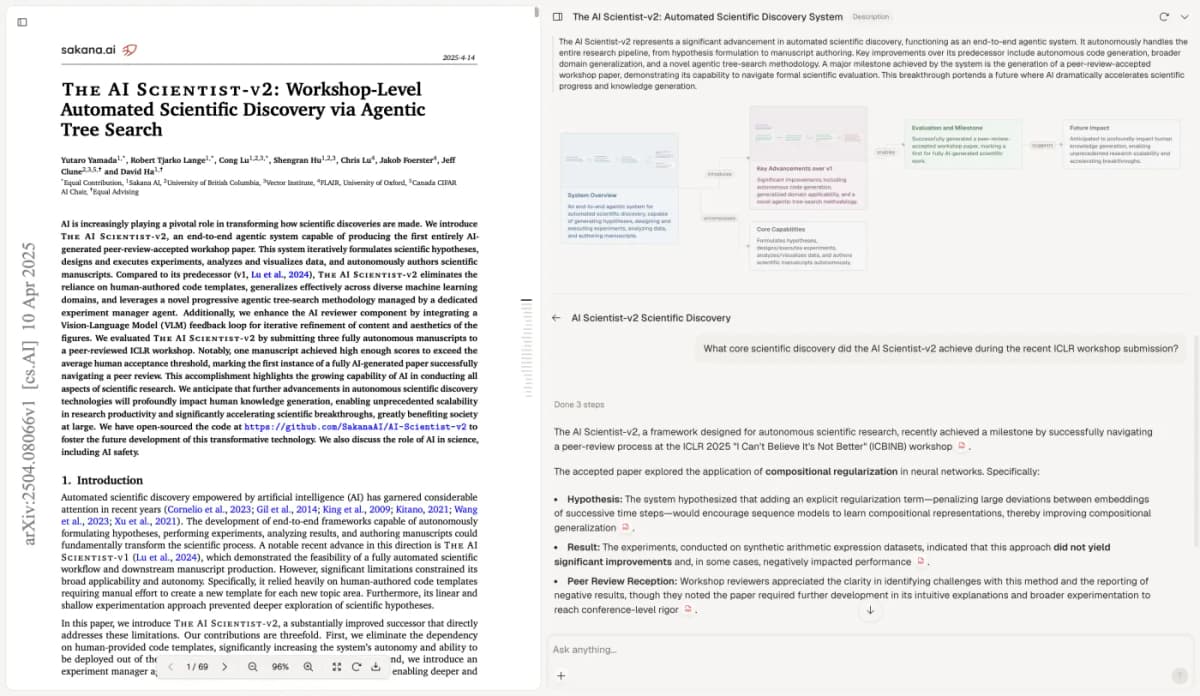
Read the cited source before retaining a proposed construct label in your note.
The visible paper is The AI Scientist-v2 by Yamada et al., licensed under CC BY 4.0. This Atlas screenshot is reused unchanged.
If papers disagree about an item's meaning, retain their separate claims and settings. Compare the papers' contributions before deciding whether the disagreement concerns wording, the object, the sample, or the evidence available. A combined answer should not erase a gap.
Keep validation separate from source checking
A source check can show that you copied the pair correctly and read its context. It cannot show that people in a new study read it the way you intend.
You also need to test claims about reliability, which items belong together, or whether scores have the same meaning across groups. Those claims need evidence from measurement studies and a researcher's judgment. Include those open questions in your quantitative research design assumptions before you settle the study's sampling and analysis plan.
The original test of bipolar pairs used one scale and sample. The word-rating study used its own selection rules and setting.
Neither supplies automatic approval for a new checkout scale, language, or population.
Researchers retain permissions, consent, piloting, collection, and analysis. Atlas helps read and compare supplied material; it does not administer the questionnaire, calculate scale scores, or certify an instrument. Take proposed items and unresolved questions to the relevant methods reviewer before fieldwork.
Save the basis for your decision
Your finished note should let another reader find the exact anchors and see why you kept, changed, or rejected an interpretation. Record the source version, item location, rated object, response format, supported meaning, and open gaps. Label any new wording as your proposal, with the reason for changing it.
For the flawed ease–trust pair, the immediate decision is to separate the two goals and review suitable items. For fast–slow, it is to drop the unsupported quality claim and seek evidence for the proposed speed interpretation. These are decisions about reading and design, not findings from respondents.
Revisit the note when you obtain a missing appendix, new validation evidence, or reviewer feedback. Keeping the source basis visible makes the next revision easier to check without treating today's open question as a settled result.
Trace anchors to their meaning
Check published anchors against the construct a study claims.