

Win-loss analysis compares buyer accounts of completed deals to learn what shaped wins and losses. It connects what buyers valued, questioned, accepted, and rejected with checked deal outcomes.
Start with a set of interviews and a choice you need to explain. Link each proposed theme to a source quote, then check whether wins challenge what you inferred from losses. Use the matrix to choose a follow-up or test within the limits of that source set.
Pragmatic Institute's guidance centers buyer experience and recommends consistent questions. The fictional four-deal example below shows how a loss explanation changes when you read the contrary cases after those interviews.

Compare buyer interviews in Atlas
Compare selected transcripts and inspect the passages behind each theme.
Define the decision you need to explain
Choose a question the interviews can address. "Why do we lose?" can mix price, product fit, procurement, and sales interactions into one explanation. A narrower question helps you select deals and compare accounts.
For example, ask: "How did rollout concerns shape the choice for first-time buyers?" Keep the product, buyer group, period, and purchase type visible. An existing customer's expansion may face different constraints from a first purchase.
Win rate measures outcomes in a defined set of opportunities. Win-loss analysis adds buyer accounts to help explain them. Choosing equal numbers of win and loss interviews does not show a 50% win rate for the pipeline. The researcher selected that packet.
Distinguish a loss to another supplier, a postponed purchase, and an unclear outcome. A seller's closed-lost label may combine them. If the buyer is still waiting for approval, check the status before treating it as a completed choice.
Prepare a comparable interview packet
Record each case
Keep each transcript with the record of the deal outcome. Use a stable case ID to connect the buyer account to that outcome without naming the buyer in every row.
Record the buyer's role, interview and choice dates, product, deal type, and outcome definition. Note gaps and which topics were covered. Accounts may differ because one interviewer asked about rollout and the other did not.
Hanover Research's guide connects the research focus to the audience and method. A sample chosen to study enterprise procurement may not answer a question about all buyers.
Check gaps and permission
List eligible deals with no interview so reviewers know whose voice is missing. If only happy customers agreed to speak, sales notes about losses do not add the missing buyers' accounts.
Use material you have permission to process. GOV.UK research-data guidance connects data use and sharing to consent and approved storage. Check your team's rules before uploading transcripts. Remove names and other identifiers you do not need, and keep the restricted ID key separately.
Keep buyer statements beside their context
Separate quotes and interpretations
Begin with what the buyer said, then write your interpretation in its own field. The GOV.UK analysis guide keeps observations, findings, and actions distinct. Check recordings when you need to confirm an exact quote.
For each useful excerpt, retain:
- The case ID and the transcript's page, line, paragraph, or timestamp.
- The speaker's role and the question being answered.
- The relevant wording and any nearby qualification.
- A candidate label describing the concern.
- Your interpretation of how the concern related to the decision.
Use a label to find related passages, then distinguish the concerns they describe. A price label may cover budget limits, an unclear package, the incumbent's cost, or the work needed to roll out the product.
Read the nearby explanation
Read nearby turns before grouping remarks. "We could not justify the cost" means something different when followed by "we had nobody to run the rollout" rather than "the budget could not cover the subscription."
Keep seller explanations in their own field. A dropdown reason and a buyer account are different sources. Klue's guide describes tagging passages and keeping buyer quotes in deal reports. Keep that link to the source when you turn a case into a theme.
Worked win loss analysis example
The deals, statements, IDs, and locators below are fictional teaching material. A researcher compares four completed first-purchase cases for the same product group. Checked deal notes show two wins and two losses to another supplier.
The packet contains these accounts:
- L-01, loss, lines 18–22: "The price was above what we hoped. But the bigger concern was moving our records with nobody assigned to the migration." The seller's note labels the loss as price.
- W-01, win, lines 30–34: "The quote was higher than our first budget. We accepted it after agreeing a staged rollout with a named person helping us migrate." This buyer also raised a price concern.
- L-02, loss, lines 40–44: "We needed audit reports for procurement. We saw a demo, but we never checked the export. We renewed the incumbent because that process was already approved." The account does not establish that the proposed product lacked the required export.
- W-02, win, lines 25–29: "Our analyst checked the audit export before the decision, and the team agreed who would own implementation." The buyer did not discuss subscription price in the supplied interview.
Compare each proposed theme across outcomes, and keep the passage that narrows or challenges the interpretation in the same row.
| Candidate theme | Loss-side evidence | Win-side evidence | Contrary case or gap | Bounded interpretation |
|---|---|---|---|---|
| Implementation ownership | L-01, lines 18–22: nobody assigned to migration | W-01, lines 30–34: named migration help. W-02, lines 25–29: agreed owner | L-02 does not address staffing | Ownership merits follow-up in this packet, without proving it caused the outcomes |
| Subscription price | L-01, lines 18–22: price above expectations | W-01, lines 30–34: higher price accepted after rollout agreement | Price concern appears in a win. W-02 price coverage is missing | Price alone does not explain the contrast between these accounts |
| Audit-export assurance | L-02, lines 40–44: export never checked | W-02, lines 25–29: analyst checked export | Unchecked export does not establish a missing feature | Investigate evaluation and approval steps before recommending a feature build |
Table 1: Each row connects a candidate theme to supporting passages and the evidence that limits its interpretation.
The seller label in L-01 could lead the team to offer a discount. In W-01, a buyer accepted a higher quote after agreeing rollout support. That raises a question about price, support, and the buyer's capacity to change suppliers, rather than settling which caused the outcome.
L-02 does not support "we lost because audit exports were missing." The buyer says the export was not checked. Ask what was demonstrated and whether procurement had enough evidence to approve a change.
Test themes against contrary cases
Check a theme across outcomes
Treat a repeated concern as a proposed finding until you have checked each case. Win/Loss Research's guidance compares themes across buyers and checks losses against wins. A concern tolerated in a win can narrow your explanation of a loss.
Here, both L-01 and W-01 raised price concerns, while describing different rollout support. That does not show that price never matters or migration support wins deals. Stronger claims need broader evidence and a suitable study design.
Count cases and missing questions
Count cases when reporting how broadly a theme appears. One buyer saying "migration" five times remains one account. If two people from one buying group spoke, record their roles and the shared deal rather than counting two deals.
Distinguish not mentioned from asked and not reported. W-02's silence cannot show that price was irrelevant when the interview has no price discussion. A missing transcript section remains a gap even if another source summarizes it.
Compare like groups before combining them. Company size, role, staffing, and buying stage can change what the same concern means. If the packet cannot support that comparison, state the limit and name the accounts you need next. Hanover's audience guidance helps frame that choice.
Buyers describe the choice as they remember it, often from one role in a larger group. Check deal records when an account conflicts with timing or a product claim. Keep those records distinct from the buyer quotes, following the observation-to-finding distinction.
Check interview themes in Atlas
Atlas can compare project sources and provide citations for you to check. Draft theme rows, then verify them against the transcripts. The market research AI tools guide covers adjacent ways to organize the material.
- Add permitted transcript copies and checked deal notes to one project. Wait for processing to finish.
- Start a new chat and use @ in Ask a question to select the sources.
- Choose Project only to keep new retrieval in the project. Earlier outside evidence remains available in an existing chat, which is why a new chat is useful.
- Ask for a comparison such as:
Compare the selected buyer transcripts with their decision notes. Draft a theme matrix with a source citation for each buyer statement, evidence from wins and losses, contrary cases, and questions not covered. Keep seller explanations separate from buyer statements. Do not infer that a theme caused the outcome or generalize beyond this source set.
Open each key claim's citation. Check the source, passage, nearby qualification, and outcome record. If the citation opens only the document, find the section yourself before accepting the row.
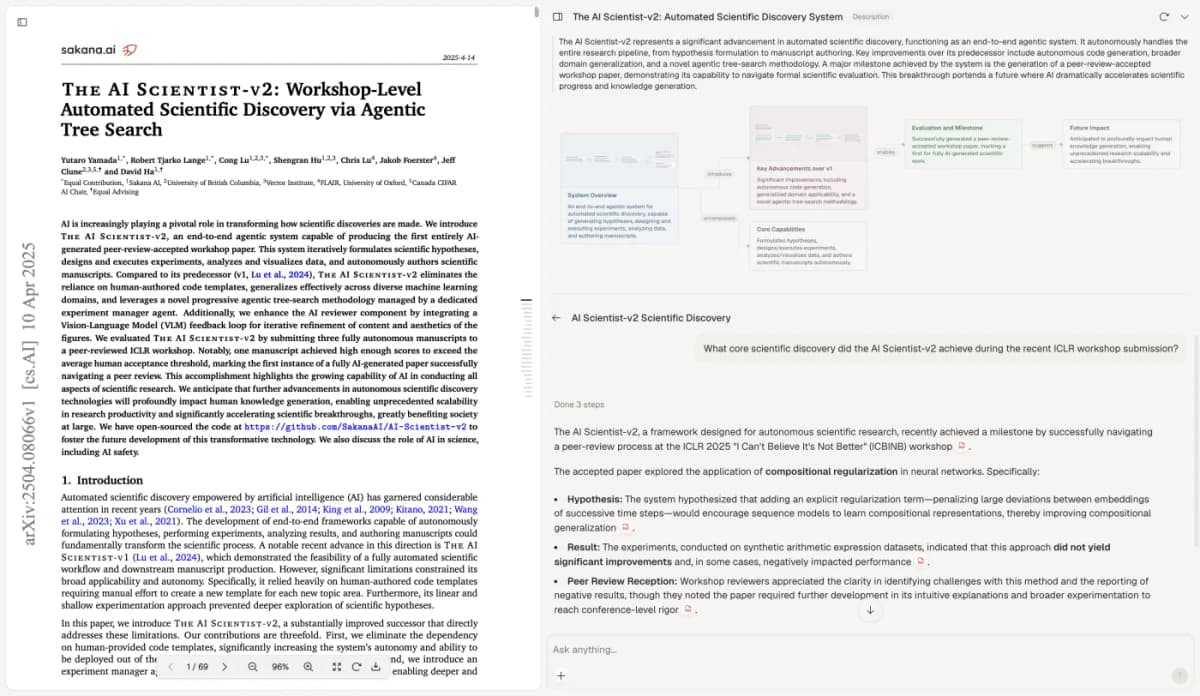
The screenshot shows a cited answer beside The AI Scientist-v2 by Yutaro Yamada and colleagues, licensed CC BY 4.0. Its paper supplies no evidence for the fictional buyer themes. This reused capture is unchanged; no author endorsement is implied.
- Correct a row that labels L-02 as a missing-export loss. Mention the transcript and ask Atlas to separate "not checked" from "not available." Reopen the passage and revise the row yourself if the claim remains unsupported.
- Check all key excerpts, outcomes, and contrary cases. Select New, then Note, to save the corrected matrix with locators and open questions. Wait for Saved before closing it.
The researcher supplies the interviews and deal records. Atlas assists their comparison rather than conducting interviews or retrieving CRM records for this workflow. You remain responsible for permission, interpretation, and checking which accounts were covered.
Assign an action and evidence check
Give a checked finding a bounded next step. Name an owner, the question or change to test, the evidence needed, and what would make the team reconsider. A theme may justify further inquiry before a product or pricing change.
For the fictional rollout theme, the onboarding lead could check how teams agreed an owner in other similar deals. Look for losses where named support was present before treating the theme as a settled finding.
For audit exports, the product marketer could review how the team demonstrated procurement requirements. Test a clearer evaluation step before assuming the product needs a new feature.
If the team changes messaging, pricing, or rollout support, plan how to check the result. A later rise in win rate does not prove that this change caused it. Product mix, deal selection, and competitors may also affect the result.
Keep the source matrix with the findings so reviewers can check their limits. For the progress buyers sought through a purchase, use jobs-to-be-done research. For broader evidence gaps, see market research challenges.
Compare buyer interviews in Atlas
Compare selected transcripts and inspect the passages behind each theme.