

A conflict of interest statement reports relevant relationships and activities that could affect, or seem to affect, the work. Write it from facts the authors have confirmed, then check it against the target journal's rules. A polished sentence cannot make a missing disclosure complete.
The useful task is to match the draft to the records: who reported what, where the draft reflects it, and what still needs an answer. That review helps you find an omission without claiming to discover interests the authors have not reported.

Check your disclosure against source records
Compare author-reported relationships with draft wording and journal rules.
What the statement tells readers
The statement gives readers context for judging the work. ICMJE's disclosure rules cover ties involving money as well as other interests. A tie that an author reports does not by itself show that it harmed the paper.
“Competing interests” and “declaration of interest” often name the same task. Taylor & Francis explains the first term; Elsevier's support guide uses the second. Use the label and scope your journal asks for.
The statement also differs from an account of who did the work. A person can have a work role and an outside tie. Record both in their proper places. The author contribution statement guide covers work roles rather than interests. Use the ICMJE authorship criteria guide to check eligibility and accountability separately from relationship disclosure.
Match 4 parts of the record
Gather the draft, each author's confirmed disclosure, and the current journal instructions. Use the version intended for this submission. An old statement may refer to another paper, a different author group, or a scope the new journal does not use.
| Part | Compare with the draft | Gap to keep visible |
|---|---|---|
| Author | Which person the relationship belongs to | Unclear initials or missing confirmation |
| Relationship | What activity or support the author reported | A type of interest omitted or changed |
| Required scope | Journal rules about relevance and reporting | Dates or details that need author review |
| Passage | Where the manuscript reflects the record | Missing, vague, or conflicting wording |
Table 1: Four record checks connect author-reported facts to a specific disclosure passage.
Do not combine all records into one vague sentence too early. If one author did paid work and another reports no interests, readers may need to know which person holds that tie.
Keep names or initials clear in the format the journal requires. A statement should help readers connect the work to the person who did it.
ICMJE's form FAQ says the completed form goes to the journal, not to ICMJE. A form stored on your computer is not evidence that the journal received it. Check the requested submission route as well as the text.
A record can also leave a question open. “No form supplied” describes your source set. It does not mean “no interests exist.” Preserve that difference in the review note so the person preparing the submission can request the missing confirmation.
Repair a draft that omits paid advice
In this fictional teaching example, Author A reports paid advice to Northbank Instruments, whose device the paper discusses. Author B has checked the target journal's scope and confirms no interests to report. Author C has not yet replied.
The draft says: “The authors declare no competing interests.” That conflicts with A's paid advice and claims a response from C that you do not have. Short wording has hidden two review problems.
A working draft reads: “A reports paid advice to Northbank Instruments. B reports no competing interests. C's response is pending.” This is text for review. Get C's response and adapt the final statement to the journal's rules before you submit it.
The Taylor & Francis examples include consulting and other financial relationships. Use such examples to spot categories that need checking. They cannot establish that an author has a relationship, or supply the dates and terms of one.
Now suppose A confirms that the original record used the wrong company name. Correct both the source record and the draft with that confirmation. Do not silently substitute a company that seems more plausible from the manuscript's topic.
A gap note might read: “Draft no-interests wording conflicts with A's record of paid advice. B has replied; C has not. Final wording and journal form remain pending.” The next reader can see which question to ask and whose answer is missing.
Check the journal before using standard wording
A sample statement helps with phrasing, but the journal sets the form, placement, and details. Elsevier's current support guide points authors to the chosen journal's guide. Check its rules for the type of paper you plan to submit.
The journal may need text in the paper as well as details in its upload system. Taylor & Francis describes both places. Filling one does not prove the other is done, so check them both before sending the paper.
Funding is related but distinct. ICMJE separates direct support for the work from other relationships and activities. A grant may need to appear in more than one place, depending on the required scope.
Do not erase the funding statement because the disclosure mentions a grant. Nor does “no funding” mean there are no interests to report. Paid advice and roles outside the study raise their own questions.
A statement also does not settle how the journal will handle a paper. Elsevier's publishing ethics policy sets out its rules. Let the journal address questions about its process; a disclosed tie does not promise that it will accept the paper.
For the surrounding submission package, use the journal cover letter guide. Keep its claims consistent with the manuscript and author forms rather than copying a generic declaration into all three places.
Compare disclosure passages in Atlas
Add the paper, current journal rules, and records you have permission to use to one project. Include only the details needed for review. The facts come from those records; a paper's subject does not show an author's outside ties.
- Use @ to select the draft, records, and journal instructions. Ask: “Compare each reported relationship with the disclosure passage. Identify omitted facts, altered wording, and missing author confirmation. Keep unknown relationships unknown.”
- Open the citation for each proposed mismatch. Read the record and nearby text to check the author, relationship, and scope. A citation to a policy shows a rule; it does not prove a personal fact.
- Correct any unsupported “all authors have no interests” claim. Ask which author-confirmed records support it. Keep unanswered requests in the gap note until the authors respond.
- Select New → Note and save the reported relationship, draft passage, proposed correction, and pending question with their citations. Wait for Saved before leaving the note.
This process helps you compare the sources and save a checked note. It does not find hidden interests or prove the records are complete. In a research synthesis workflow, keep a policy rule distinct from a fact about a person.
The Atlas view below shows a cited answer beside its source. When reviewing a disclosure, check the author and reported relationship in that source panel. The paper pictured is unrelated to the example and contains no author disclosure records.
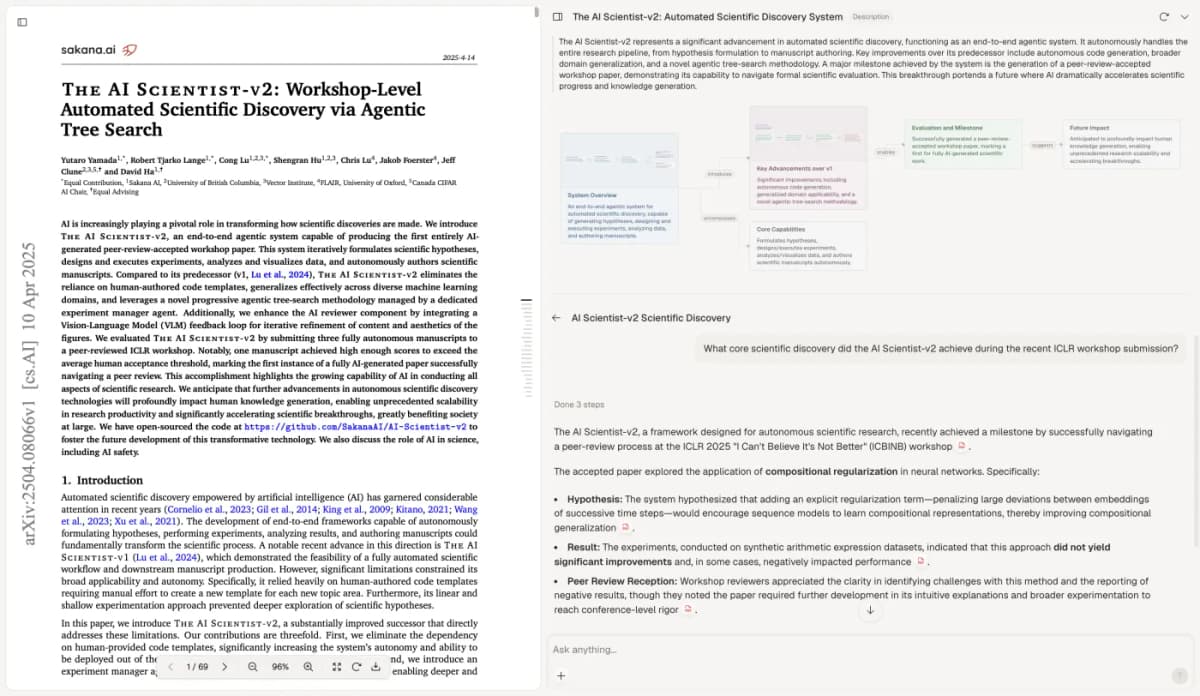
Check whether each cited record supports the proposed wording before returning the draft.
The visible paper is Yamada et al. (2025), licensed under CC BY 4.0. It appears within the unchanged Atlas capture.
Return the checked draft to the authors
Return the proposed text with open questions visible. Ask authors to confirm the facts and review the journal's scope, then check the final paper against their responses. Keep the review note distinct from the statement you submit.
When reading a published paper through research paper analysis, report what its statement says. A brief statement is not proof that no other tie exists. A tie that an author discloses is not proof that the findings are wrong.
Check your disclosure against source records
Compare author-reported relationships with draft wording and journal rules.