

The difference between a research article and a review article lies in the work being reported. An original research article presents work done by its authors. A review article brings earlier work together and explains what that body of research shows.
Read the methods and the passage you need before labeling a paper. Titles and headings can help you look, but they cannot settle where a claim comes from. Both kinds of article can add knowledge and need careful reading.
The worked note below compares a real research paper with a later survey on the same topic. It traces each claim to reported work so you can keep an original study's findings separate from a review's synthesis.

Trace each claim to the work behind it
Compare supplied papers and save a checked evidence note.
The difference is the work being reported
An original research article reports the authors' own work, such as a study, test, analysis, or new method. Taylor & Francis explains this article type. The key question is what the authors did and which claims follow from that work.
A review article analyzes earlier literature. It can compare findings, explain disagreements, or organize approaches in a field. Concordia's library guide describes this synthesis role. A careful review does more than place one paper summary after another.
These roles are useful when building a source set. An original study may supply the result you need to examine. A review may help you find that study or understand how it relates to others. UCLA's review tutorial explains that starting use.
Keep the distinction tied to a claim. A research paper's introduction may discuss other studies, while its results report its own work. Reading the whole paper as one undivided source can hide which part supports the sentence you want to write.
Compare contribution evidence and structure
Ask what the authors contributed
For an original research article, locate the work the authors carried out. This need not mean they gathered every piece of data from scratch.
They may analyze existing records or test a method on an existing dataset. Check the actual procedure.
For a review, find what the authors add by reading and combining earlier work. A map of approaches, a reasoned explanation of disagreement, or a new synthesis can be a contribution. Publisher guidance on reviews describes critical analysis as part of that job.
Avoid saying a review contains nothing new. That erases the authors' synthesis.
Instead, state whether the claim reports a new test on the topic, an analysis of earlier findings, or another kind of work. Mixed papers need that passage-level care too.
Identify the evidence being examined
An empirical paper might examine people, events, records, or model outputs. A review might examine studies and their findings.
The object being analyzed changes what a result means. Concordia's comparison helps introduce those different roles.
In your note, name what each record stands for. A row for an included paper is not a new participant. A table comparing published model tests does not necessarily mean the review authors reran those tests. Read the text explaining where the entries came from.
When a table lists one score from each cited paper, check whether the tests used the same task, data, and scoring rule. A shared column heading can hide a difference. The comparison needs to retain that difference before you use it to rank methods.
A review can direct you to an original study, but keep the two readings separate. If you have only seen the review, your note should say so.
Do not cite the original in a way that implies you checked its methods when you have not opened it.
Treat section headings as clues
Methods and Results headings often appear in papers that report tests. They can also appear in reviews. Concordia explains review methods. In a review, authors might search for papers, choose which to include, and assess them. Read what the methods were used to do.
Likewise, a long reference list does not make a paper a review. An original paper may cite many earlier works to explain its method or setting.
A short report may present original results in a compact form. The content should decide the classification.
Publisher guidance notes that structure varies by venue. Use familiar headings to navigate, then verify the basis of the claim. Do not turn an expected format into a rule that excludes research from another discipline.
Worked article-type and evidence note
The pair concerns retrieval-augmented generation, or RAG: a way to use retrieved source material in text generation. Lewis and colleagues' paper reports their models and tests. Gao and colleagues' survey organizes earlier RAG research. We use version five of the survey, dated March 27, 2024.
Locate the reported work
In Lewis's paper, sections 2 and 3 describe the approach and experiments. Section 4 reports results. The authors tested models using existing tasks and data. Their own work concerns the model and tests. It does not require a new group of people to take part.
In Gao's survey, the introduction states the synthesis scope. Later sections organize approaches and discuss evaluation. Its reference 4 points to Lewis's paper. That link is useful for tracing a statement to the earlier work rather than assuming each paper reports a new test.
This original teaching map identifies each paper's reported work and the evidence needed for a claim. It supplies no quality score, copied review table, or new empirical test.
| Item in the pair | Evidence location and role | What to check before using it |
|---|---|---|
| Lewis original work | Sections 2–4 describe models, experiments, and results using existing tasks and data. | A test claim needs the relevant setup and result; it does not apply to every later RAG system. |
| Gao survey contribution | Introduction and organized body sections synthesize earlier approaches; this note uses version 5. | A synthesis claim belongs to the survey's framing and scope; headings do not imply a new experiment. |
| Survey-to-study connection | Gao reference 4 cites Lewis's paper. | Trace the specific statement to its support; a repeated study finding is not a second independent test. |
Table 1: Lewis contributes a tested model; Gao surveys earlier work and points back to Lewis.
Correct what the note can claim
Suppose a draft note says, “Gao's survey ran a new experiment confirming Lewis's result.” The surveyed material and citation do not establish that statement. Remove the invented experiment. Keep a bounded note about how the survey places the earlier work within its account.
For the earlier experiment, inspect the Lewis methods and results. For the survey's framing, inspect the Gao introduction and relevant body section. These are different reading tasks, even though the topic is shared.
A title containing RAG does not let you swap the papers' roles. For a sentence about what was tested, go back to the test. For a sentence about how the field is grouped, check the survey's own reading of the work.
A second draft mistake would be, “Two independent experiments support this result,” with these papers as citations. A survey passage that repeats a study's finding adds no independent test. Both papers may help your argument, but say what each contributes.
Retain both papers when each serves a useful role. The research paper lets you inspect the tested setup. The survey supplies a wider map and other references to pursue. UCLA describes this use of a review's bibliography. You still need to read any further study before treating it as checked.
Check the evidence chain before citing
Begin with the exact claim you need, then find its supporting passage. Record the source, section or table, version, and the work behind it. These are evidence criteria for your note. A broad label like research article leaves too much of the reasoning unstated.
If the passage cites another paper, follow that connection when the underlying finding matters. The SIFT method explains tracing claims to original context. Keep qualifications from the surrounding text, rather than carrying only the short statement into your draft.
Check that the cited paper is the one you intended to read. Match its title, authors, and version. For the worked survey, version five is the reviewed text. A later version could change a section, reference number, or claim.
Write separate notes for a study finding and a review's interpretation of it. A source synthesis can bring those notes together while keeping their roles visible. If the review disagrees with a study's reading, record the disagreement and its basis.
When access is incomplete, state what you checked. An abstract might support a limited description of the paper, but it cannot substitute for a missing passage needed to assess a detailed methods claim. Keep that judgment open until the relevant text is available.
Keep article type separate from quality
A label does not establish claim validity
An original study can have weak methods or a claim broader than its data. A review can omit relevant work or draw an unsupported conclusion. The type tells you what kind of work the paper reports. You still need to check whether its claim is sound.
Concordia explains how explicit review methods make choices inspectable. Do not assume a review is complete merely because it says systematic. Read its search, selection, and analysis. The purpose of those details is to let readers assess the work.
For an original study, read how the evidence was produced and what limits affect the result. For a review, read how the earlier work was chosen and combined. A literature review process needs those checks rather than a tally of paper types.
For systematic reviews of healthcare interventions, the AMSTAR 2 appraisal guide connects reported review methods to item judgments and an overall confidence rating. First check that the tool fits the review; identifying the article type does not complete its appraisal.
Decide how each paper serves your question
For a claim about a study's finding, a review usually serves as secondary literature. Taylor & Francis uses that distinction. It tells you where the finding sits in a wider account, while the original paper reports the work behind it.
If your question concerns how reviewers frame a topic, the review's own words become material you study. State that use. A source's role depends on the question; it does not change the paper into a new experiment on the topic it discusses.
Assignment rules may also specify which types you can cite. UCLA advises checking the prompt. Use a review to find and understand studies when helpful, while following the requirements for the work you are preparing.
Compare supplied article passages in Atlas
Add permitted copies of the two papers and a question note. Wait for processing and confirm that the relevant methods, results, and reference passages are present. Atlas can help read the supplied texts; the final type and evidence decisions remain yours.
-
Choose the papers with @. Select the processed research paper and survey. Ask what work each reports, what evidence it examines, and which cited passage supports that reading. Keep the question focused on the pair rather than the whole field.
-
Request a provenance comparison. Ask for each proposed claim's source, location, reported work, and limit. In this example, distinguish the earlier experiments from the later synthesis. Request that missing support remains unresolved rather than filled with a guess.
-
Inspect the citations. Open each numbered citation and read the target text and its context. Locate the passage directly if the view does not reach it. An AI citation check helps keep this support review explicit.
-
Correct conflated claims. Remove the invented new survey experiment and any claim that the repeated finding is independent confirmation. Keep the survey's own contribution and version. A correction should preserve what the paper does say as well as remove unsupported detail.
-
Save the checked note. Choose New, then Note, and wait for Saved. Retain the type judgment, reason, locator, claim, and open checks. If a paper changes version or your research question changes, reopen the relevant judgment before reusing it.
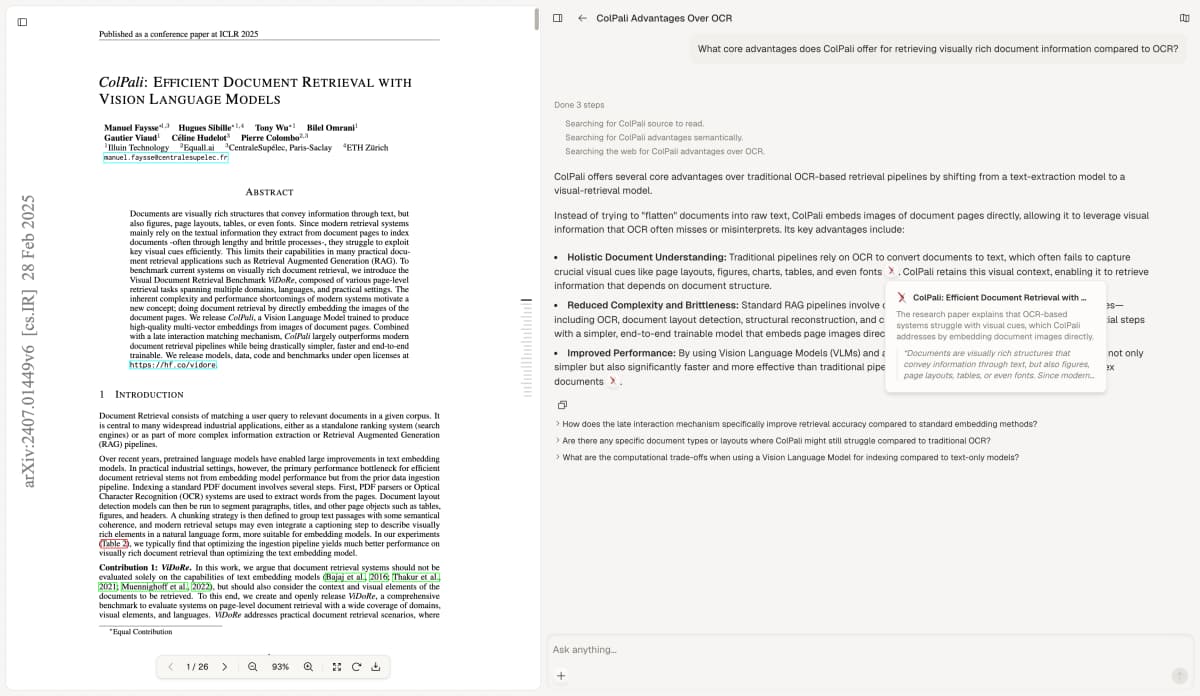
Actual Atlas capture of ColPali, by Manuel Faysse and colleagues, under CC0. This unrelated paper illustrates passage inspection; the image shows no benchmark, article-type evaluation, or product review of the Lewis/Gao pair. Atlas captured the interface without editing the displayed paper.
Atlas does not certify source independence, review completeness, or research quality. It can help compare texts and keep a note with checked support.
You decide which evidence belongs in the literature set and how to represent its contribution.
Keep the type and claim together
Before using a paper, save a short reason for its type and the passage that supports your claim. Keep these decisions together so a later reader can see whether the sentence uses a study result, a review synthesis, or background context.
For the worked pair, retain Lewis's reported tests separately from Gao's survey framing. Neither this note nor the survey's citation reruns the earlier experiment. The useful comparison is the work behind the claim, not a contest between the two formats.
Recheck the note when you add papers or narrow the question. A review can open a route to further studies, while an original article can answer a specific evidence need. Use each for the job its inspected passages can support.
Trace each claim to the work behind it
Compare supplied papers and save a checked evidence note.