

Two theories can lead to different readings of one account. A student who skips training may face a clash with work, feel out of place in the group, or face both. Theory triangulation helps you check those readings before you choose one.
Keep the passage fixed as you change the lens. If you change the people or events too, you cannot tell what the new lens adds. Write what each reading helps you see and what you still need to check.

Compare theoretical lenses in Atlas
Check each interpretation against your passages and theory sources.
What theory triangulation means
Theory triangulation uses two or more theories to read the same data. Each theory gives you a set of ideas and questions. Those questions guide what you look for in the words or events you study.
Your task is to compare the readings that follow. One lens may focus on time and money. Another may ask how a person sees their place in a group. Show what each lens adds to the reading, beyond naming both in a review.
The university methods chapter advises readers to describe and compare theories before using them to read data. Tie each idea to a passage or an event so the reader can follow how you used it.
Separate theories from sources and analysts
Ask what changes between the two readings. Here, you change the theory. With data triangulation, you change the sources. With researcher triangulation, you change who reads the data.
You can also change the method used to gather or study data. Talking to a person and watching them at work gives you two kinds of evidence. You still need two stated theories if you want to compare theoretical readings. State what changed so a reader can follow the choice.
Quirkos sets out these four types and the problems that can arise when you mix them. A study may use more than one type. State what each adds and which part of the work it changes.
A theoretical framework sets out the lens that guides a study. This task adds a check across lenses. If you need to explain why you chose just one lens, use the framework guide for that part of the work.
Define the lenses before comparing
Start with a question both lenses can address. For example, ask why students join a training group. If one lens asks about joining and the other asks about how the school gets funds, you may be answering two different questions.
Write what each lens means, where its ideas come from, and which ideas you will use. State its scope too. Does it focus on a person's choices, a group, the rules of a school, or the wider social world?
For a language-and-power lens, critical discourse analysis shows why words and social context need separate checks. Define the chosen approach before applying it. A broad label does not supply all the theory assumptions you need.
Turn each idea into a question you can check. A resource lens might ask whether more students join when bus times change. An identity lens might ask who feels at home in the group and who feels left out.
Name a finding that could challenge each reading. If few students join after the clash with work ends, timing may not be enough. If a student feels at home but cannot get there, a sense of belonging may not be enough either.
The Researching the Real World chapter separates tests of rival views from the use of several theories to make sense of puzzling data. State which job you are doing before calling the work a test.
Work through a theory triangulation example
The training records below are fictional. The two lenses use short working meanings for this teaching example. In a real study, replace these with clear accounts drawn from the theory sources you chose.
The resource lens asks whether time, travel and costs keep students away. The identity lens asks whether they see the group as a place for people like them. Use both lenses for each account so the data stay fixed.
For each row, ask what the words show, how the lens reads them, and what else you need to know. This keeps a plausible story open to a check.
| Fictional passage | Resource reading | Identity reading | Next evidence check |
|---|---|---|---|
| A student reports missing sessions that overlap a paid shift. | Work timing constrains attendance. | The passage does not establish belonging. | Check schedules and accounts after the overlap changes. |
| A student reports feeling outside the group despite an available time slot. | Availability alone may not explain absence. | Perceived exclusion may affect participation. | Ask about group interactions and other reasons for absence. |
| A student attends after a friend joins while the schedule stays fixed. | The timetable change explanation is unsupported. | A relationship may change the experience of belonging. | Check whether transport or other costs also changed. |
| A student feels welcome but misses sessions because the bus service ends early. | Transport access remains a plausible constraint. | Belonging alone does not explain attendance. | Compare the account with transport times and alternative travel options. |
Table 1: Each row retains an interpretation and the evidence needed to challenge it.
The first row shows a clash with work. It tells you little about whether the student feels left out. Keep that gap in the note instead of filling it with a claim about how the student feels.
The third row makes belonging worth a closer look. Yet the friend might also give the student a lift. Ask about travel before saying the new sense of belonging caused the change. The words still allow more than one reading.
The fourth row challenges a claim that belonging is all that matters. It concerns this student in these conditions. To challenge the whole theory, you would need to build a wider case with more data and a clear argument.
Inspect a published theoretical analysis
Owens and colleagues compared theory schemes with people's accounts in a study of mental and physical healthcare. The study asks about parity of esteem, or the standing of the two forms of care.
Their model links domains of a care system with three levels: macro, meso and micro. These run from wider policy through how services work to people's lives. The levels help place a claim within its scope.
The rings and sectors below show how those levels and domains meet around parity of esteem. This is the model built for that study. Check its fit with your question before using its terms for your own work.
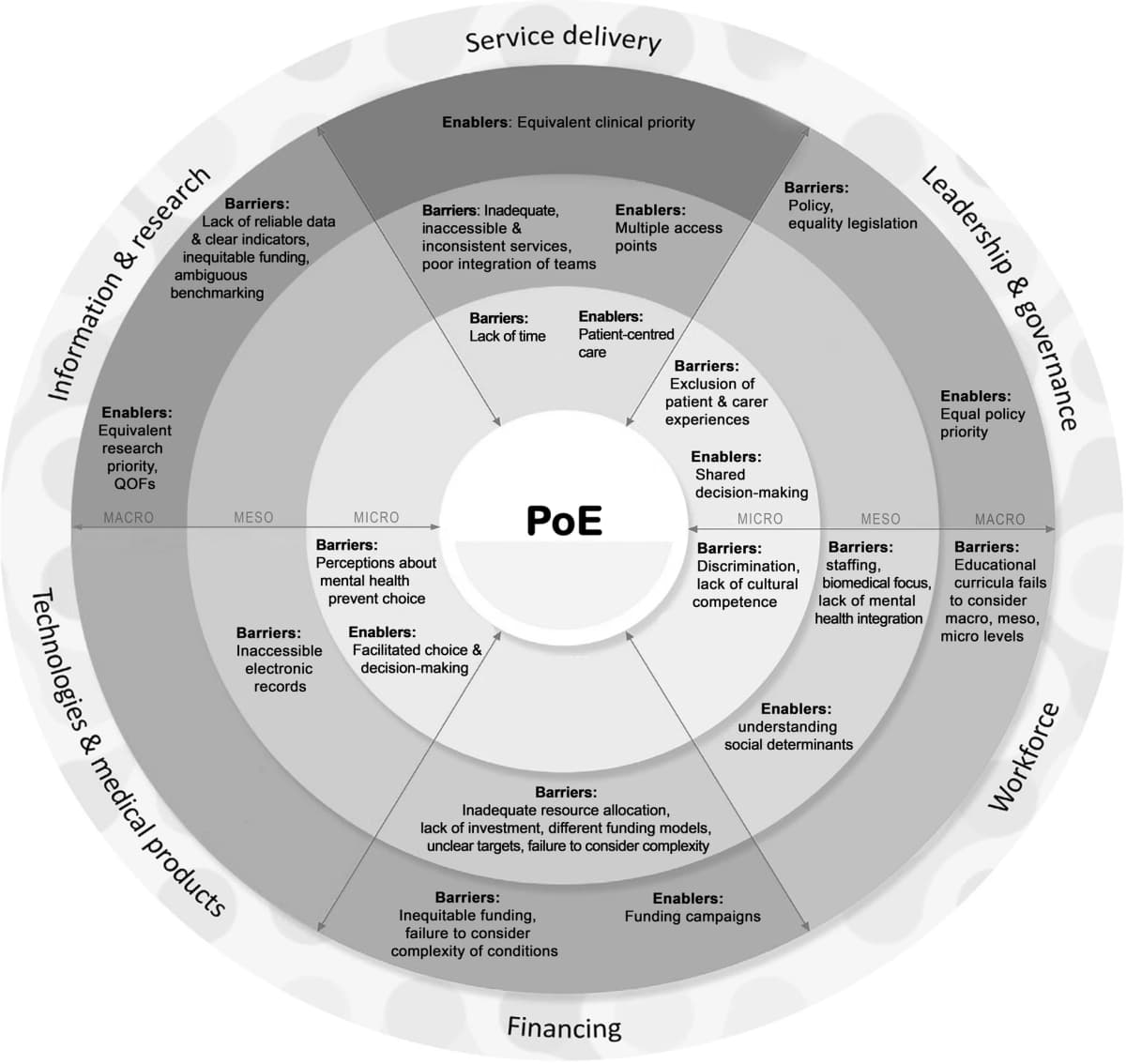
The model places policy, how services work, and people's lives at different levels. Figure 1 by Owens, Lovell, Brown and Bee, CC BY 4.0, encoded as WebP with its content unchanged.
The diagram's organization can also be read in text:
- The macro ring concerns wider policy, the meso ring concerns how services work, and the micro ring concerns people's lives.
- Sectors are service delivery, leadership and governance, workforce, financing, technologies and medical products, and information and research.
- The model places things that help or hinder care where a ring and sector meet, so the reader can trace links across levels. In service delivery, it places lack of time at the micro level and multiple access points at the meso level. These are findings from this study, rather than rules for every corpus.
Use this example to ask where your own claim applies. A claim about bus times may sit at a different level from a claim about school policy. Choose terms and levels that fit your question and your sources.
Interpret differences without forcing agreement
Some readings can work together. A bus route and a friend may both matter. They may also matter at different levels. Explain how the readings relate before deciding that one must defeat the other.
Other readings make rival claims about the same event. Ask what you could see or hear that would help tell them apart. If the data fit both, say so. Familiarity with one theory is not a reason to choose it.
Theories can also differ in what counts as knowledge and what they assume is real. Sim and Mengshoel discuss this in metasynthesis. Using several frameworks does not, by itself, resolve those deeper differences.
Keep the accounts separate if joining them would hide a conflict. A claim about what an event means to one person may need a different kind of support from a claim about a rule that holds across people.
Pitre and colleagues' abstract proposes feminist intersectionality, critical, and symbolic interaction lenses for family research. That proposal serves a stated purpose. It does not tell you which lenses every study must use.
Compare supplied lenses in Atlas
Create an Atlas project with the excerpts you may upload, the theory sources and your draft readings. Give each source a clear name. You need to tell a claim from a theory text apart from a person's account.
Open a chat. In Ask a question, type @ and select the excerpt source and both theory sources. Ask for a bounded comparison using the definitions you supplied:
Use the two supplied lenses to read passage P3. For each lens, show the idea used, the reading, the words that support it, words that challenge it, and what is still unknown. Keep the readings separate where the lenses differ.
Select Send, then open the numbered citation beside each claim. Check both the theory source and the person's account. The account can show what they said, but you also need to check the idea used to read it.
Suppose the answer says a friend caused the student to join by changing their identity. Revise that to a possible reading. Keep the other reading, that shared travel cut costs, and ask which passage supports each claim.
Save the checked readings through New and Note. Include the source names, your change and the question still open. Wait for Saved. You can then return to the note when new data change the case.
Atlas helps you compare supplied sources, while you choose the theories and judge their use. Check consent and access rules before adding people's accounts. A source-linked answer still needs your review of what it claims about their motives.
Report the reasoning and remaining questions
Explain why you chose each lens, which data you read, and how you dealt with conflict. Give one traced example of how an idea changed your reading. The reader needs to follow that step, beyond seeing a list of theory names.
For the fictional training example, a methods note could say:
We read the selected training accounts through resource and identity lenses. For each account, we noted the words that supported a reading, other ways to read them, and gaps in the data. We kept both readings where we could not tell them apart.
In a real study, follow that note with the lens meanings and source locations. State whether the check changed your reading, narrowed a claim or showed what data to seek next. Those details make the method clear.
Before you finish, ask whether a gap in the text has been used as proof against a theory. The question may never have been asked. Keep that limit clear in the conceptual framework and in the final account.
Compare theoretical lenses in Atlas
Check each interpretation against your passages and theory sources.