
Atlas vs Coda (2026): An In-Depth Research Comparison
Atlas is a visual research workspace. Coda is a docs-meets-spreadsheets workspace with packs and automations. Compare on paper deconstruction, citation.
- Byline

Summary
For this 2026 comparison, use Atlas for citation-grounded research synthesis and Coda for docs, tables, packs, and team automations.
The article compares cited answers, Knowledge Maps, source moves, packs, formulas, and saved context.
Atlas traces claims to source passages, while Coda organizes team workflows through docs, tables, and automations.
Teams can keep Coda for operations and use Atlas for research corpora that need verifiable answers.
Note: We make Atlas, so this comes from the team that built one of the products. Where Coda has the better answer for a given research job, the article says so plainly. See the table rows where Coda wins and the "When to choose Coda" section below. The boundary is clear: Atlas fits source-backed research. Coda fits docs, tables, packs, and team workflows.
Atlas is a visual research workspace for people who need to understand a body of papers. Think thesis, treatment plan, product teardown, or lit review.
Coda's tracker-and-app workspace, now branded Superhuman Docs, combines pages, tables, formulas, packs, and automations for building internal tools out of docs. This article keeps the Coda name because readers still use it in this query.
The difference appears after the first answer. Atlas maps each paper into a Knowledge Map and a whole project into a Semantic Map. It also ties each answer to sources, so you can see why a passage supports a claim.
Coda's docs, formulas, and packs are strong when the doc itself is the working tool. If you need to defend the answer, Atlas earns the comparison through Knowledge Maps, Semantic Maps, and cited proof tied to sources in the same project.
Atlas

Add cited research to your Coda workflow
Upload the PDFs behind your Coda docs and inspect each supporting passage.
Quick verdict: Atlas vs Coda
Choose Coda when the team needs collaborative docs, formula-driven tables, Packs, buttons, and automations. Choose Atlas when a project begins with papers or reports and each answer must trace back to a supporting passage.
Many teams keep Coda as the operational workspace and add Atlas for the research corpus behind it. Coda remains the stronger internal-app builder, while Atlas handles paper maps, cited synthesis, and source checks.
How we compared Atlas and Coda
This comparison separates operational documents from source analysis. If the job is to run a doc, table, tracker, or automation, Coda gets the credit. If the job is to read sources, map arguments, and ask cited questions within one project, Atlas gets the credit.
Price rows use public plan pages as of the article update date. Product rows stick to shipped surfaces.
- Best primary job: Atlas is for reading, mapping, and citing research sources. Coda is for docs, tables, trackers, packs, and internal apps.
- Paper structure: Atlas uses Knowledge Maps to show claims, evidence, and links. Coda uses source tables and doc pages.
- Project navigation: Atlas uses the Semantic Map to cluster sources, notes, chats, and citations. Coda uses embedded tables and filtered views.
- Answer grounding: Atlas shows the claim, source passage, and proof note together. Coda may show links or citations, but not the same claim-level reasoning trace.
- Workflow tools: Coda wins on formulas, buttons, integrations, and automations. Atlas is not a docs-and-automation tool.
- Companion pattern: keep Coda for live operations. Use Atlas when the research sources need cited depth.
Feature comparison table:
| Atlas | Coda |
|---|---|
| Citation grounding: claim, source passage, and proof note stay together. | Citations or links may appear, but Coda is not built around claim-level proof. |
| Knowledge Maps: each paper becomes a claim-and-evidence map. | Doc pages and source tables organize reading notes. |
| Source migration: PDFs move into Atlas projects and become mapped sources. | Markdown, HTML, and CSV exports preserve doc prose and source lists. |
| ✗ Atlas does not have Packs, formulas, or doc buttons. | ✓ Coda supports Packs, formulas, buttons, and automations. |
| Shared research use: Atlas helps defend answers from source passages. | Shared doc use: Coda supports live collaboration and internal apps. |
Table 1: The main split is proof, maps, source moves, and team workflow.
Coda Family Atlas, Atlas Lithium, Notion, Airtable
The SERP for "atlas vs coda" can pull in nearby entities. Coda Family Atlas is a parenting guide, while Atlas Lithium is a mining company that appears in stock-comparison results for the CODA ticker. This article compares the Atlas research workspace with Coda.io.
Coda is also often compared with Notion and Airtable. Those alternatives do not change the split here: Coda is best at docs plus tables, while Atlas is built for source-backed research.
How is Atlas different?
Coda and Atlas both touch reading and reasoning over sources. They diverge on three capabilities that decide whether the output is defensible work. This section walks through those differences.
1. Maps for papers and projects
Atlas builds two kinds of map as you read. A Knowledge Map breaks one paper into claims, evidence, definitions, and labeled links. You see the paper's spine first, then click into its supporting passages.
A Semantic Map shows a whole project as a canvas. Sources, notes, chats, and citations cluster by topic, extending the project-navigation method in the second-brain apps guide. You can view the same canvas from a new angle without reading the folder again.
"It's like an ultimate GPT. I can finally see what I've read." Kyle Lao, CEO & Co-founder of MenSC Labs
Coda does not break each paper into a claim-and-evidence map. It also does not redraw a research project by topic angle. If you have spent an afternoon trying to recover an old paper, the Knowledge Map is the surface that pays off first. Visual maps make a body of papers legible at a glance.
2. Atlas explains each cited claim
The hallucination problem in AI research tools is often more specific than "the model made something up." The bigger risk is a citation that does not support the claim beside it. Atlas shows each answer as a claim, a source passage, and a short proof note. You can click into the paragraph and read the highlighted sentences in context.
Atlas tracks this with the H/V ratio. It checks generated sentences against the source passage. A sentence fails when the cited passage does not back it up. Atlas targets H/V < 0.1 on the citation benchmark, and we publish the method in Verifiable AI Research (2026).
The citation-checking workflow explains how to inspect the passage before reusing a claim. Coda's answers may include citations or links, but they do not show the same claim-level reasoning trace. Linked citations can be sufficient for casual Q&A. A thesis sentence, legal brief paragraph, or treatment summary benefits from the added passage-level trace. Every Atlas claim traces to its source.
3. Project-scoped research context
Coda connects tables, pages, and automations inside docs and workspaces. Atlas uses a narrower research boundary: sources, notes, chats, citations, Knowledge Maps, and the Semantic Map stay together inside one project.
That boundary suits a multi-year literature review when the same project holds its papers and cited findings across semesters. A separate project begins with its own evidence base.
The practical result is that related research surfaces share a focused project context. Coda remains stronger for flexible team docs and operational workflows.
Comparing Atlas and Coda
Atlas and Coda live in different categories. Atlas covers paper maps, project maps, cited AI answers, and project-scoped research context. Coda covers docs, tables, packs, and automations. Coda's table-and-doc model is broader for internal tools. Atlas is deeper at the source layer. The sections below compare the surfaces that matter most.
Paper deconstruction (Knowledge Map)
The Knowledge Map is Atlas's per-paper surface. It breaks one paper into an argument map with claims, evidence, and labeled links. The node text is source-faithful, so each map stays close to the paper's own wording. Breadcrumbs let you move from the main thesis to a specific paragraph.
| Atlas | Coda |
|---|---|
| Multi-level argument structure ✓ | Doc pages with embedded source tables |
| Labeled relations (motivates, causes, enables) ✓ | ✗ |
| Faithful-to-source node text ✓ | ✗ |
| Hierarchical breadcrumbs ✓ | ✗ |
| ✗ | Docs-meets-spreadsheets with formula language ✓. Coda's strength is spreadsheet logic for docs and internal tools. |
Table 2: Atlas maps each paper's argument, while Coda gives teams formula-driven docs.
Good to know: The bottom row belongs to Coda. Atlas does not ship that surface. Topic chips can support a quick thematic scan. The Knowledge Map adds the claim-and-evidence structure needed to recover a paper's argument weeks later.
Project and corpus view
The Semantic Map is Atlas's project surface. It places sources, notes, chats, and citations on a canvas where related items cluster by topic. You can view the same canvas under a different topic angle without another ingest.
| Atlas | Coda |
|---|---|
| Spatial embedding of sources + notes + chats ✓ | Embedded tables of sources |
| Auto-labeled topic clusters ✓ | ✗ |
| Topic-angle re-projection ✓ | ✗ |
| One project-scoped evidence view ✓ | ✗ |
| ✗ | Packs ecosystem (integrations + custom packs) ✓. Coda connects docs to outside tools through Packs. |
Table 3: Atlas maps a project by topic angle, while Coda Packs link docs to outside tools.
Good to know: Coda's strength on that row is genuine. If your work depends on it, that's the boundary. The Semantic Map helps when 200 papers stop being a folder and start acting like a corpus. You can view the same sources from a new topic angle without re-reading them.
Citation-grounded answers
Atlas shows the claim, the source passage, and the reason the passage supports it. You can jump to the paragraph, read the highlighted lines, and check the reasoning yourself. Coda AI instead works across doc content, tables, and connected workspace data.
| Atlas | Coda |
|---|---|
| Claim-source-justification triples ✓ | Coda AI Q&A over docs (no claim-source-justification) |
| Reasoning traces (why this passage supports this claim) ✓ | ✗ |
| Jump-to-source with passage highlight ✓ | ✗ |
| H/V ratio < 0.1 benchmark published ✓ | ✗ |
| ✗ | Automations and buttons (workflow logic) ✓. Coda is stronger when a team needs a repeatable doc workflow. |
Table 4: Atlas ties each answer to a claim, source, and proof note. Coda is stronger for doc workflows.
Good to know: Both tools have a citation surface. The distinction is whether it explains why a passage justifies a claim and identifies which passage was cited. A source link can serve everyday Q&A. A thesis sentence or brief paragraph benefits from the passage and proof note together.
Literature-grounded annotations
Atlas annotates each paper on ingest. Citations inside the paper become objects you can inspect. When the cited source is open-access, Atlas pulls the relevant passage. You can see how a paper builds its argument across sources without leaving the reader. The citation tool guide separates this source-checking job from reference storage and team-doc collaboration.
| Atlas | Coda |
|---|---|
| Auto-annotate on ingest ✓ | ✗ |
| Multi-citation synthesis (how citations build the argument) ✓ | ✗ |
| Resolve cited sources (open-access) ✓ | ✗ |
| Exact passage / page / paragraph anchors ✓ | ✗ |
| ✗ | Team collaboration on shared docs ✓. Coda gives teams a stronger shared-doc workspace. |
Table 5: Atlas pulls cited-source evidence into the reader, while Coda is stronger for shared docs.
Good to know: Atlas resolves citations inside the paper you are reading. When a paper cites an open-access source, Atlas pulls in the cited passage. This is not web grounding. It shows how one paper builds its argument through the sources it cites.
Project-scoped context
Atlas keeps citations, notes, Knowledge Maps, Semantic Maps, and chats inside one project. A separate project starts with its own sources and context.
| Atlas | Coda |
|---|---|
| Project-scoped research context ✓ | Per-doc tables and references |
| Sources + notes + maps + chats share one project ✓ | Tables and pages share a doc ✓ |
| Separate projects isolate unrelated context ✓ | Workspaces organize related docs ✓ |
| Sources must be added to each relevant project | Pages can be copied or synced between docs |
| ✗ | No-cost plan with generous doc and viewer count ✓. Coda has the better entry point for cost-sensitive teams. |
Table 6: Atlas keeps research context inside a project. Coda has a lower-cost start for teams.
Good to know: Atlas keeps one project's evidence together across sessions. Separate projects preserve distinct evidence boundaries, while Coda can connect operational data across team docs.
Price comparison
Atlas is a paid product with no perpetual no-cost plan. You get a short evaluation sample with 10 sources and 5 lifetime AI chats. After that, Atlas Pro is $20/mo or $204/yr with unlimited sources and unlimited AI chats. The paid tier includes Knowledge Map, Semantic Map, cited answers, and project-scoped research context.
Coda's current plans live on the Superhuman Docs pricing page. Its plan prices cover collaborative docs and automations. Atlas plan prices cover research maps, cited answers, and saved context.
| Atlas | Coda |
|---|---|
| Free: ✗ (evaluation sample only: 10 sources · 5 lifetime AI chats) | Free: No-cost plan: unlimited viewers, doc-makers pay ✓ |
| Pro: $20/mo or $204/yr (unlimited sources · unlimited AI chats · all features) | Paid: Pro $10/doc-maker/mo · Team $30/doc-maker/mo · Enterprise custom |
| Pro unlocks Knowledge Map, Semantic Map, and claim-source-justification ✓ | ✗ |
Table 7: Coda is easier to start for free. Atlas Pro bundles maps, cited answers, and saved context.
Source workflow comparison
Use Coda as the live operations layer when tables, buttons, Packs, and shared docs are the deliverable. Use Atlas when the PDFs behind that Coda document need maps, cited answers, and source-level proof.
The AI citation analysis guide gives the checking rubric. The cited-chat guide shows when a source link serves a quick check and when a claim needs passage-level support. Test the split with one source from a current Coda doc: run a Knowledge Map, ask one cited question, and open the supporting passage.
When to choose Atlas vs Coda
Choose Coda when the deliverable is a shared doc, tracker, or internal app. Choose Atlas when the deliverable depends on source passages that a reviewer must be able to inspect.
The combined workflow also works well: keep live tables and automations in Coda, then use Atlas to map and verify the papers behind them.
- Want paper structure deconstructed multi-level? Go with Atlas. (Knowledge Map)
- Want answers that explain how each citation justifies the claim? Go with Atlas. (claim-source-justification)
- Want one focused evidence base for maps, notes, and cited chat? Go with Atlas. (project-scoped context)
- Want docs-meets-spreadsheets with packs and automations for team workflows? Go with Coda.
- Tied: maintaining a team reading list with embedded data**: both work fine, for different jobs. The wedge only opens up once you're building a corpus you'll return to.
Recommendations by user type
- PhD researchers: Atlas. During lit review, the Knowledge Map helps you recover each paper without re-reading. During thesis writing, each Atlas claim stays tied to a passage. Coda works for one-off tasks. Atlas keeps the selected sources, maps, and cited chats together inside the thesis project.
- Students doing literature reviews and thesis research: Atlas for dissertation, thesis, and lit-review work. The Knowledge Map saves the most time during source review. Within that project, the source set and its Semantic Map remain available for later questions.
- Knowledge workers (consultants, analysts, PMs, journalists): Atlas when reading and citing papers is the core work. Coda when internal tools and shared workflows are the daily need.
- High-stakes personal research: Atlas for medical, legal, purchase, or deep self-study work. High-stakes burst research is where cited proof earns its keep. Coda is a fine starting tool. Atlas is the tool you graduate to when you need to defend the answer.
Coda should own the operational layer: tables, buttons, packs, workflows, and docs that behave like small internal apps. Atlas should own the research layer: papers, Knowledge Maps, source-backed answers, and reusable synthesis.
When the document is the product, Coda is the better tool. When the document depends on a source corpus you must defend, Atlas is the better companion.
Migration and worked example
Migration provides a second proof surface for the comparison. Start with one Coda research doc, export its source list, and upload the underlying papers to Atlas. Then ask one synthesis question and open the cited passage before moving any answer back into the Coda workflow.
If that source check is faster than tracing the same claim through the Coda table, keep Atlas for the research corpus and leave the operational doc in Coda.
Migrating from Coda to Atlas
Coda's data model combines doc pages, tables, and Packs. Pages hold rich text and embedded views. Tables hold rows that can be referenced across pages. Packs let a doc talk to Notion, Slack, Jira, Figma, and many other services.
Coda's official export guide covers PDF, CSV, copy-and-paste, and account-level export options.
A research workspace in Coda often grows as one doc with project subpages. It may have a "Sources" table with title, author, URL, status, and notes. Packs may pull metadata from Zotero, Google Scholar, or another reference manager.
Moving to Atlas trades that table-and-pack layer for research surfaces. You get a map per paper, a map per project, and source-backed answers. The practical question is what survives the move.
What migrates cleanly:
- Page prose: export each Coda page as Markdown or HTML, then paste the notes into Atlas as project notes.
- Source-list tables: export the table as CSV, then upload the underlying PDFs to Atlas.
- PDF attachments: download them from Coda and drop them into the right Atlas project.
Each uploaded PDF is mapped into a Knowledge Map on ingest. Notes written in Coda's rich-text editor migrate as prose. They become first-class Atlas notes only after you re-anchor them to a passage in the Atlas reader. That pass is usually worth it because it gives each note a stable jump-to-source link.
What does not migrate: Packs, buttons, formula columns, and Coda lookup logic. Atlas does not have a Pack runtime. Its ingest is PDF-first, with URL fetch for open-access sources. You are not moving an internal tool. You are moving a research corpus out of one.
If your Coda doc is mostly a tracker with PDF attachments, the move can fit into one afternoon. If it is a hand-built literature-review app with Packs, three tables, and review buttons, keep Coda for the operational steps. Use Atlas for the source corpus underneath. That hybrid is the pattern we hear about most during the first month.
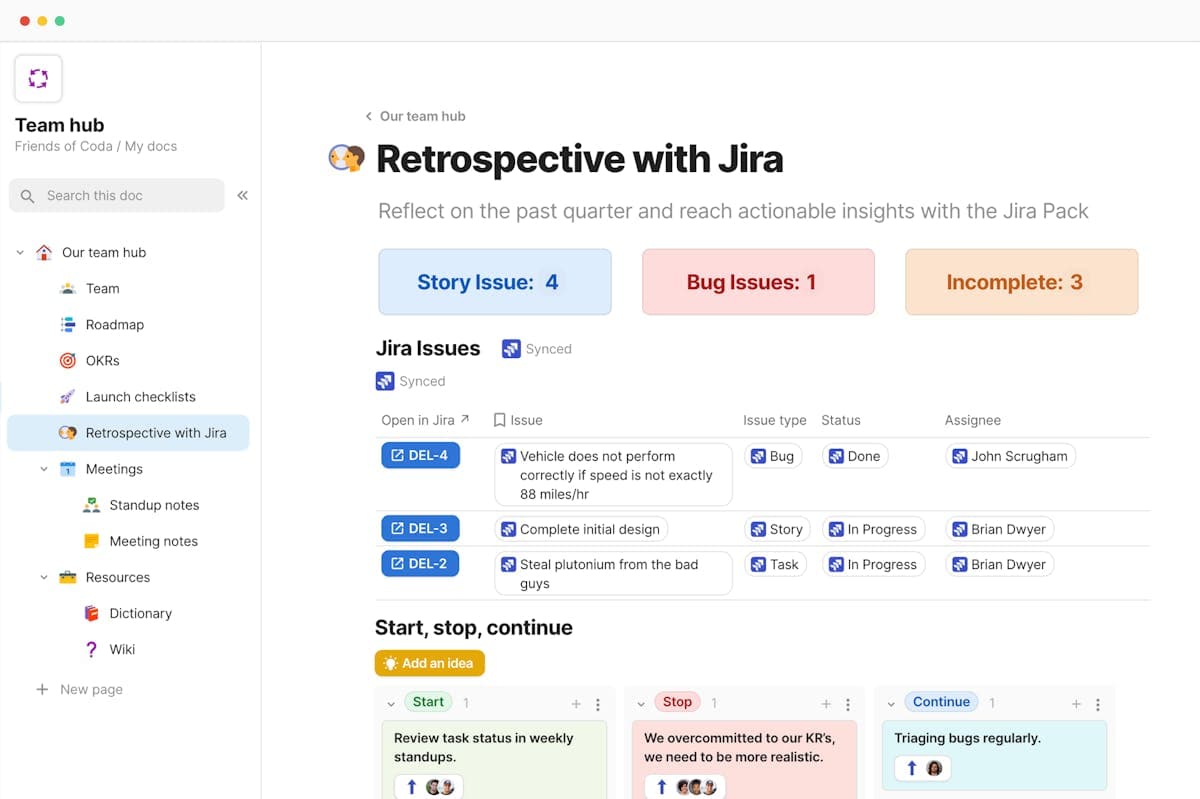
Coda's official Trackers and apps page shows why the product is strong for doc-based team tools. The screenshot supports that comparison with visible pages, synced Jira rows, status fields, and a retrospective board in one workspace.
That is the product split in practice. Coda stays best for live operational docs. Atlas becomes useful when the source files behind those docs need maps, cited answers, and source-level proof.
A worked literature-review example
For a concrete example, imagine you are a second-year PhD writing the related-work section of a paper on RAG. You have 24 PDFs covering early RAG papers, retrieval encoders, eval benchmarks, and the recent agentic-RAG line.
In Atlas, you upload all 24 PDFs into a project called "RAG lit review." Each paper gets a Knowledge Map on ingest. You can open a paper and see the thesis at the top, claims and evidence below, and labeled links between them. The node text stays source-faithful, so the map reflects the paper's own argument.
You skim five Knowledge Maps to recover the early-RAG line without rereading the prose. Then you open the Semantic Map. It shows clusters for retrieval, generator, eval, and agentic work. You view the map through the angle "what counts as faithfulness" to see which papers group together.
Now ask how the definition of faithfulness shifted between the 2020 RAG paper and the 2024 agentic-RAG line. The answer returns claim-source-justification triples. Each claim has a source passage, a short proof note, and a jump-to-source link.
The AI citation checker guide shows the same passage-verification step. You can add the triples to your draft, verify each highlighted passage, and leave with a related-work paragraph you can defend.
The Coda path for the same task. You build a Sources table with one row per paper. Columns cover title, year, authors, status, and notes. You read each paper in a PDF viewer and copy key passages into the notes column by hand. You build a second page for the prose and reference the table by lookup.
Coda AI can answer questions over the doc. Its citation surface usually anchors to a sentence or link, while Atlas anchors the claim, passage, and proof note together. There is also no per-paper argument map. The source table records the papers you read and notes you wrote by hand.
Coda shines if that table is the deliverable, such as a public reading list or course syllabus. Atlas shines if the deliverable is a written argument that must cite back to passages.
When Coda is the right call
Coda is the better tool for a specific shape of work. Reach for it first when the doc itself is the deliverable.
Use Coda for interactive docs with embedded apps. Examples include project trackers, OKR rollups, and sprint dashboards. It also fits shared work docs, such as meeting notes, runbooks, and decision logs.
Coda can run hiring or light CRM trackers where rows move through states like applied, screening, onsite, and offer. It also suits doc-plus-sheet hybrids where the sheet logic is the value, such as budgets, capacity models, and planning grids.
The Packs ecosystem is the other reason Coda often wins. If your stack already pivots on a Notion database, Jira board, Slack channel, and Figma file, Coda can pull them into one doc. Buttons and automations can then act on that data.
Atlas does not have an equivalent runtime by design. Its advantage is depth inside a research corpus. Choose Coda when you need to turn a doc into a small team app. Choose Atlas when you need to trust an answer before using it in a thesis, brief, or treatment plan.
Common objections and edge cases
"Can Atlas replace Coda for our team's general docs?" Atlas is a research workspace, while Coda is a docs-meets-spreadsheets workspace with Packs and automations. The tools serve different jobs, and many groups run both.
Coda holds project trackers, runbooks, and hiring pipelines. Atlas holds the research corpus underneath, including papers, Knowledge Maps, and source-cited answers. Giving each tool its own role is usually simpler than forcing either one to cover both.
"What if my Coda doc has Packs feeding live data into the source table?" That data layer stays in Coda because Atlas does not have a Packs runtime. Keep the live-data Pack table as the metadata system of record.
Export the source PDFs into an Atlas project for mapping and reasoning. Then link back to the Coda row from your project notes. Each tool keeps the layer it handles best.
"Is there a one-click import from Coda?" No. Coda exports pages as Markdown or HTML and tables as CSV. Atlas ingests PDFs and project notes. The move is manual: download PDFs, upload to Atlas, and paste prose into project notes. A typical corpus of 20 to 200 PDFs can usually move in one afternoon. Many users tell us the move is useful because it forces a second look at what is in the corpus.
Atlas
Add cited research to your Coda workflow
Upload the PDFs behind your Coda docs and inspect each supporting passage.
Frequently Asked Questions
Atlas makes that explanation the core of its citation surface. Every answer is rendered as a claim-source-justification triple: the claim, the passage it draws from, and a one-sentence explanation of why the passage supports the claim. You can click into the source paragraph and read the highlighted sentences in context. Coda may cite at the sentence level or link to sources, but it does not render the reasoning trace that connects the claim to the passage. That trace helps when you need to defend a thesis sentence, a brief paragraph, or a treatment-plan summary. Read more about how Atlas grounds claims in Verifiable AI Research (2026): What It Actually Means.