

Design based research studies learning through cycles of design, use, review, and change in real settings. A team builds or revises a lesson, tool, or course while asking how it works and what it tells them about learning. The goal is both a better design and a clearer account of how people learn.
When you read a study, trace the path from a learning problem to a design choice. Then ask what the team saw and why it made the next change. A polished final lesson can hide weak links in that path.
Use a cycle note to connect each design version with what learners did and why the team changed it. The graph lesson below is made up. It shows how to check a claim, not a measured classroom result.

Trace a design revision to evidence
Compare design versions, research findings, and the theory behind each change.
What makes a study design based
The Design-Based Research Collective's paper links learning theory with the design and study of learning environments. In plain terms, the team studies what people do with a design and uses what it learns to revise both the design and its ideas.
A set of new worksheets is only part of that work. Ask which learning idea each version puts into practice. Then ask what the study adds to that idea. The original account of design cycles makes this link to theory central.
The approach can overlap with action research in teamwork and local change. DBR also seeks theory and design principles that others can use and test. Read the aims and claims of the project, rather than deciding from its label alone.
Trace the evidence through each cycle
Read each design version with the account of how it was used and what the team found. These four questions help you check links that a final score can hide.
| Part of the cycle | Source to locate | Question to keep open |
|---|---|---|
| Design | Materials and learning rationale | Which feature is meant to help learners? |
| Use in context | Lesson records and setting | Did learners use the design as planned? |
| Analysis | Learner work and account of findings | What supports the team's reading of the data? |
| Revision | Changed feature and stated reason | Which finding supports this change? |
Table 1: Each row links a design choice to a source you can inspect and a question you may still need to answer.
These are reading prompts, not fixed stages for every study. Scott and colleagues' physiology study describes four phases and notes that they can overlap. The authors draw on written work, class recordings, and interviews.
For your own note, keep a source location as well as a finding. “Students struggled” is too broad. Look for the task, what students did, and how the team read that response. A reader of research results needs that link to assess the claim.
Keep planned use apart from actual use. Did a teacher add a cue, change the groups, or skip a task? Such changes may affect what you can say about the design. The Collective's discussion of context treats the setting as part of how a design works.
Worked example of a learning revision
Imagine a made-up lesson in which students read two graphs. Version one asks them to choose the graph that supports a claim and say why. The aim is to make their use of data visible.
A made-up class note says several groups chose by the shape of the lines and said nothing about the axes. This supports a concern about how they did this task. It does not show that they lack all graph-reading skills.
Connect one observation to one change
Version two adds a prompt: describe the axes before choosing a graph. The team thinks this may help students focus on the variables. The class record should show when the prompt was used and what students did with it.
The cycle note could read: “In the first task, some groups chose by shape. The next version asks them to name the axes first. We think this may help them compare variables. We have not yet tested its effect on their reasoning.”
This keeps what the team saw apart from what it hopes to see. It also gives the next cycle a clear question. Inspect students' descriptions and reasons, including those that still rely on shape.
The published physiology case shows why several kinds of learner work can matter. Your own data choices should fit the learning question, rather than copy a list of methods from another project.
Correct an unsupported conclusion
Suppose a draft says, “The new prompt improved students' understanding.” The made-up sources do not support this. They show a planned change, with no result from the second cycle.
Write instead: “The prompt was added to address choices based on shape. Its effect on students' reasoning still needs to be tested.” Keep links to the class note and the new task beside this correction.
If later work shows stronger reasons, update the note and retain the earlier uncertainty. Record the task and how the work was judged. State whether the students or setting changed. This helps you tell a tested change from a good idea.
Keep improvement and explanation separate
A gain in a later cycle is worth studying. It may reflect the design, more practice, a new group, a changed test, or several things at once. Start with what the data show before naming a cause.
DBR seeks to explain how learning takes place in a designed setting. The original methods paper still calls for links between process and outcome. The method name alone cannot prove that one prompt caused a gain.
A practical gain and a theory claim are also different. A faster lesson may solve a class problem without showing how students build an idea. Read the theoretical framework when the study's learning claim needs more context.
Different sources may tell you about different parts of the cycle. Data triangulation offers a closer look at those source choices. If you use several methods, methodological triangulation helps you compare what each can show. Keep disagreements in view; a larger source set does not settle them by itself.
Compare design-cycle sources in Atlas
Open a project with the design versions, lesson account, findings, and theory sources. Use only material you have permission to share. Follow the study's rules for consent and learner data.
Wait until the sources finish processing, then start a chat. In Ask a question, type @ and select the sources for one cycle. Choose Project only to prevent new web or literature retrieval. Earlier chat context remains available, so name the cycle records you want to compare. Ask: “Compare version one, the class note, and version two. Show what students did, what changed, why it changed, and what still needs testing. Cite each source.”
Then open the citations for the claims that matter. Check both the version and the passage around the cited text. A theory paper can give a reason to try a prompt without showing that it helped in this lesson.
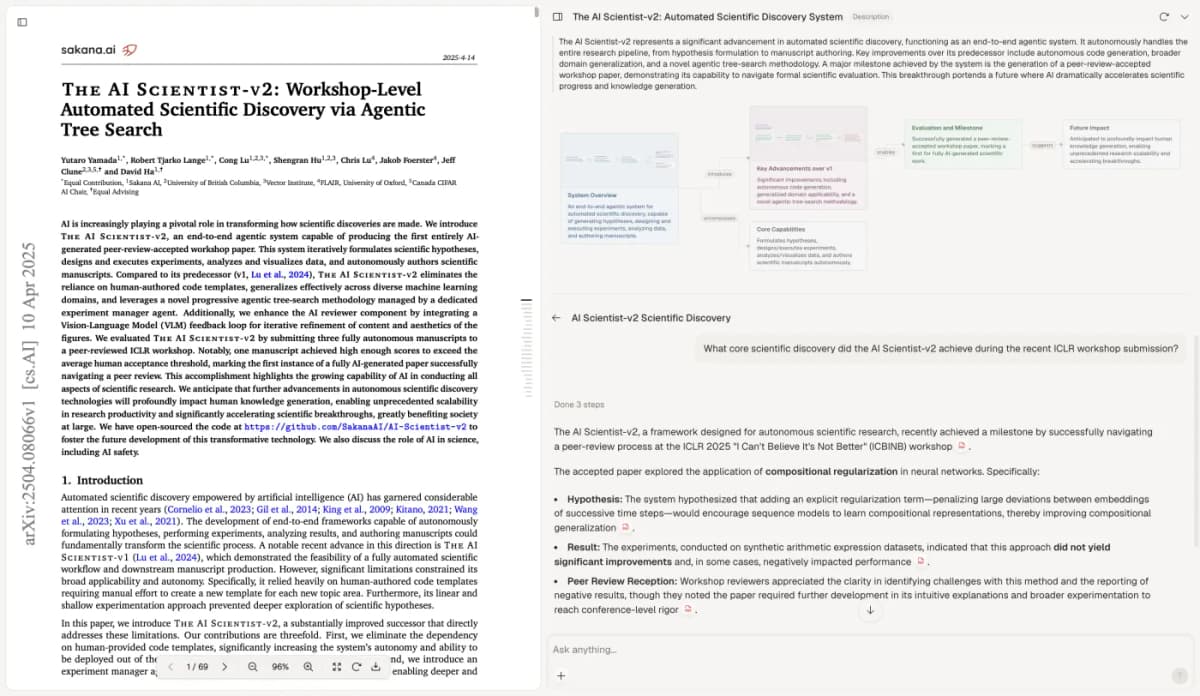
The source and cited answer can be read together. This real capture shows an unrelated AI paper; the same source-checking task applies to your design-cycle records. Paper shown: Yamada et al., The AI Scientist-v2, CC BY 4.0. The paper is displayed unchanged.
When an answer mixes planned gains with actual results, the note needs a correction. In the made-up lesson, the prompt has an untested effect. Keep that limit beside the design choice so a later reader can see why the wording changed.
To retain the checked work, select New, then Note. Add the version, class finding, reason for the change, and next question with source links. Wait for Saved before closing it. A research log can help you track later checks.
Atlas helps compare supplied sources and keep a checked note. You still judge how the data bear on theory and which change to try next. A cited answer needs review just as the first draft did.
Write a bounded design principle
A design principle is a guide for what to try, for which problem, and under what conditions. Say whether it is backed by findings or remains an idea to test. The Collective's account of shareable theory helps frame this purpose.
For the made-up lesson, write: “When students choose graphs by shape, ask them to describe the axes first. Check their reasons to see whether this helps them compare variables.” This is a proposed principle, not a finding from a real study.
Return to the note when a new cycle or review comment arrives. Check what changes: the data, the reason, the design, or the scope of the claim. Keep the source passage and open question so the next change has a clear basis.
Trace a design revision to evidence
Compare design versions, research findings, and the theory behind each change.