
Methodological triangulation uses more than one method to study a shared research question. The methods may show different parts of the problem, support a similar claim, or conflict. First ask what each method can show and whether the findings concern the same people, time, task, and meaning. Then decide what you can say from them together.
A survey and a route record can use the same word, such as “easy,” while asking different things. You need to know what each adds before assuming one confirms the other.
Use a comparison note to record what each method adds, where the findings agree, and which differences remain unresolved. The visitor case is made up. It shows how to keep a conflict visible without forcing the results to agree.

Compare the contributions of your methods
Check what each method adds and where the findings differ.
What methodological triangulation combines
The review by Arias Valencia discusses method choice and limits. Choose methods for the question, rather than just adding more. A larger set still needs a clear reason for each choice.
Between-method triangulation brings distinct methods together. Within-method approaches vary parts or steps within a method. Describe the actual work, since the terms and boundaries differ across accounts.
Keep the related forms separate. Data triangulation varies sources, while researcher triangulation varies analysts or observers. A study can use these together, but each changes a different part of the work.
Method triangulation can sit within a mixed methods research design. It need not always bring numbers and words together. Heesen and colleagues note that methods can differ within each broad kind too.
Map what each method can show
State one question before you compare methods. In a study of how people find an entrance, these methods can tell you about related parts of the task. They do not all measure the same thing.
| Method | What it may show | Limit to preserve |
|---|---|---|
| Survey | How easy people say the task was | Wording and recall shape the answer |
| Observation | Routes and pauses during the task | A route does not reveal every reason |
| Interview | A person's account of choices | An account is not a full record of actions |
| Document analysis | Planned route and signs | A plan does not show actual use |
Table 1: The map shows what each method adds to the question and where its findings stop.
The Jamaica youth-centres study reports a survey used with several other methods. Its abstract gives a real case of this approach. Your own method set still needs to fit your question.
Wording matters too. Read the interview protocol to see what people were asked. A question about the whole visit differs from one about whether the entrance was found in the end.
The role of a plan is different again. Qualitative document analysis can examine what plans and records mean in context. Do not treat an intended route as proof that people followed it.
Worked example of conflicting navigation findings
Imagine a made-up survey in which people give favorable answers to “Was it easy to find the entrance?” Route notes describe some trying a side door first. One person says they found the entrance in the end but felt unsure at the start.
Calling all three findings “easy navigation” hides the wrong turn. Calling them a direct conflict may also go too far. Check what “easy” meant and when each source captured the task.
Test the apparent conflict
The survey may capture an overall view after success. The route notes show actions along the way. The interview can explain the early doubt. These may offer different useful views, often called complementarity.
A checked note could say: “Some people may rate the task well while still taking a wrong turn. The sources cover different parts of the visit. We need the exact survey wording and time before judging whether the findings conflict.”
Flick's discussion helps frame triangulation beyond a simple confirmation slogan. The made-up note keeps the question open rather than claiming that every method supports one result.
Correct a forced-agreement claim
Suppose a draft says, “All methods confirm that the signs were clear.” The route notes do not support that wording. Nor does an overall ease rating show the effect of the signs alone.
Write instead: “The survey gives a favorable overall view. The route notes show a wrong turn, and the interview describes early doubt. The role of the signs remains unclear.” Keep each source passage beside its part of the claim.
If the records do not show whether the same people took part in each method, retain that gap. You can compare reports, but cannot claim a change within one person that the records do not show.
Examine differences before combining claims
Check wording, timing, people, and unit of analysis: the thing being studied. A survey of people and a record of group routes may support different claims. Matching words alone do not show that the units match.
The methods review discusses conflicting results and how to weigh what each method adds. Explain why a finding receives weight. Do not let the count of methods make that choice for you.
Methods can agree while sharing a blind spot, such as the same narrow task definition. The original formal argument supports triangulation under stated assumptions. It does not prove that every real-world method set will yield a sound claim.
A conflict can guide the next question. It may show a method limit, a setting difference, or a real tension in the task. Keep it in the record until you have a reason to narrow or revise the claim.
Compare method findings in Atlas
Open a project with the method descriptions, findings, and source excerpts. Use only material you have permission to share and wait until processing finishes. Start a chat and use @ in Ask a question to select the sources for one comparison. Choose Project only to prevent new web or literature retrieval. Earlier chat context remains available, so identify the method reports you want to compare.
Ask: “Compare what these methods add to the entrance question. Show where they agree, cover different ground, or conflict. Cite each finding. Note differences in wording, time, people, and what was studied.”
Open the citations for the main claims. Check that a rating points to the survey, a route to the route notes, and a reason to the interview. Read the surrounding text for limits on the claim.
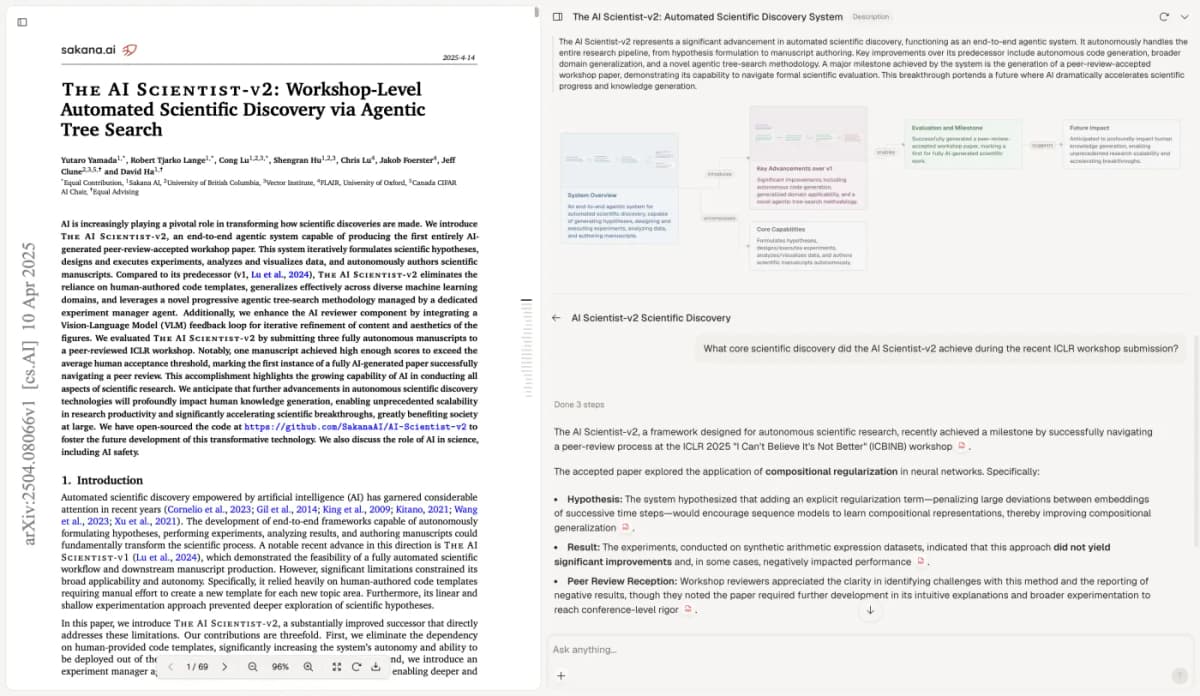
The cited answer can be checked beside its source. This real capture shows an unrelated AI paper, not visitor data; apply the same source check to your method reports. Paper shown: Yamada et al., The AI Scientist-v2, CC BY 4.0. The paper is displayed unchanged.
An answer that forces agreement needs a correction. Retain the wrong turn and early doubt. Ask it to keep each source's role separate when a combined claim is hard to trace. You still choose how to weigh the findings.
To retain the checked work, select New, then Note. Add the comparison and its source links. Wait for Saved. Atlas helps compare supplied reports, while the researcher makes the final methods judgment.
Save the bounded combined account
Keep the shared question, what each method adds, how the findings relate, and the supported claim. Add limits that could change the reading. The applied study shows why naming a method set is just the start of this account.
For the made-up visit, retain favorable reported ease alongside the wrong turn and early doubt. Mark survey timing and overlap between groups as unknown. The note gives you a sharper question rather than a forced consensus.
In design based research, this check can help explain why a design was revised. Keep it tied to the specific cycle and question. A new source alone does not prove that the next design is better.
Compare the contributions of your methods
Check what each method adds and where the findings differ.