
Notion AI Alternatives (2026): 7 Best AI Workspace Tools
The 7 best Notion AI alternatives in 2026. Atlas, ClickUp Brain, Coda AI, Mem, Obsidian Smart Connections, Anytype, and AppFlowy compared on AI features.
- Byline

Summary
The best Notion AI alternative depends on whether you need source-cited synthesis, project-management AI, open-source control, or local-first notes.
The updated guide compares Atlas, ClickUp Brain, Coda AI, Mem, Obsidian Smart Connections, Anytype, and AppFlowy.
Use Atlas for source-grounded synthesis, ClickUp Brain for project work, Coda AI for doc-database workflows, and AppFlowy for open-source Notion-style work.
The right switch depends on workspace fit, source citations, self-hosting, pricing, capture needs, and whether Notion already runs the team.
Notion AI launched as a paid add-on for the Notion workspace. It does three jobs well: summarize a page, draft from a prompt, and answer questions about your workspace. The 2024-2026 wave of rivals goes deeper on cited answers, fast capture, project work, or open code.
This guide ranks 7 Notion AI alternatives tested across the four jobs people use AI workspaces for.

 Atlas
AtlasAsk cited questions across research sources
Upload your documents and trace each answer back to the exact passage.
Why switch from Notion AI?
For the deeper framework, Cognitive Load, Vendor Lock-in, and Knowledge-Graph Density, applied across eight leading second-brain apps, see our second-brain apps guide.
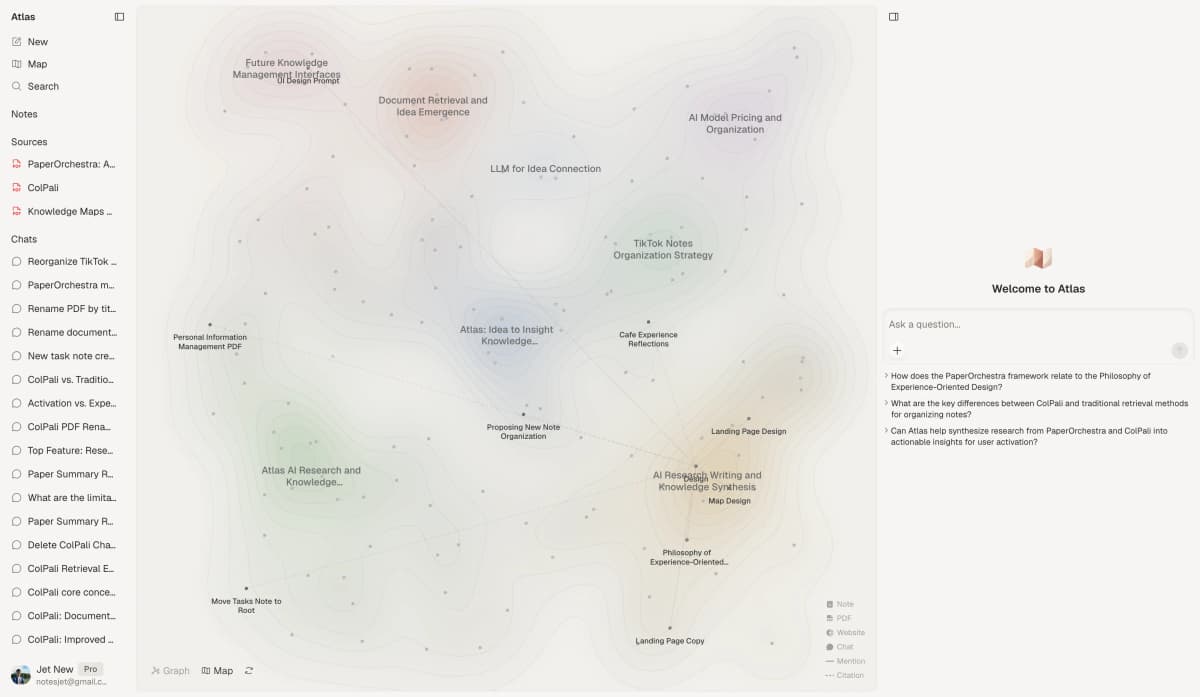
Switch for source depth when workspace answers are not enough. Notion AI summarizes pages and answers workspace queries. Atlas's mind-map view shows how concepts connect across notes and PDFs, then cites the passage behind each answer.
Switch for ownership when closed cloud SaaS is the problem. AppFlowy, Anytype, and Obsidian let you keep data local or self-hosted.
Switch for specialization when one workflow matters more than an all-in-one workspace. Mem is built for fast AI-first capture. ClickUp Brain is built for project management plus AI. Coda is built for doc-as-spreadsheet workflows.
How to choose a Notion AI alternative
Judge each tool by the job that made you search. Start with source proof. Then check export, team rights, and the real price after AI is included.
For research and study, citations matter more than writing polish. For teams, task context and access rules matter more. For open-code buyers, local files and API-key control matter most.
Use a citation-trace test before switching. Upload the same source set to each tool. Ask one question that needs a quote-level answer. Then check whether the answer links to the exact passage. If the tool only links to a page, treat it as workspace search. If it links to the paragraph or chunk, treat it as research-grade AI.
This test is quick. It also exposes fake confidence. A useful research tool should show where the answer came from.
Do not skip this step. It saves cleanup time later.
7 best Notion AI alternatives
1. Atlas: Best for cited synthesis
Atlas turns notes, PDFs, and research into a map with cited Q&A. It connects ideas across files and cites the passage behind each answer.
Choose Atlas if your main problem is research answers, not workspace drafting. The Atlas and Notion comparison explains where each workspace fits. Atlas Pro is $20/month.
2. ClickUp Brain: Best for project teams
ClickUp Brain is the AI add-on for ClickUp's project tool. It can write task notes, recap updates, and answer from docs and tasks. It fits teams that already run work in ClickUp.
Choose ClickUp Brain if ClickUp is already the team's project hub. It costs $7/user/month as an add-on.
3. Coda AI: Best for structured docs
Coda AI works inside Coda's doc-meets-spreadsheet workspace. It writes text, recaps docs, and fills table rows from prompts. It is stronger than Notion for docs that act like sheets.
Choose Coda AI if your team runs ops in docs with tables. Coda Pro starts at $10/month, with AI included on higher tiers.
For an Apple-first writing app with bundled AI, Notion vs Craft compares the solo-user path.
4. Mem: Best for quick capture
Mem is an AI-first notes app. You write quickly, then Mem organizes notes through tags, links, and chat. It feels much lighter than Notion's structured-workspace model.
Choose Mem if you want fast capture without folder hierarchies. Mem has a free tier, and Pro is $14.99/month.
5. Obsidian + Smart Connections
Choose Obsidian + Smart Connections if you want local files plus AI. The app and plugin are free, but you pay your model provider. For Apple-only note apps, see Notion vs Apple Notes. For more options, see Apple Notes alternatives.
6. Anytype: Best for private notes
Anytype keeps notes local first, with P2P sync and end-to-end encryption. Its object model feels close to Notion databases. AI support is still early.
Choose Anytype if privacy and local files matter more than mature AI. It is free.
7. AppFlowy: Best open-code workspace
AppFlowy is an open-code Notion-style app with AI through an OpenAI API key. You can self-host it under the AGPL license. In 2026, it is the closest open-code match to Notion.
Choose AppFlowy if your team wants a full Notion-style app with open code. The app is free, and cloud hosting starts at $0/month with usage limits.
Other alternatives for narrower needs
These tools did not make the top 7 because they solve a narrower job. Check them if that job is your real reason for leaving Notion AI.
- Docmost is a strong fit when you want an open-source wiki that feels closer to Confluence or internal docs than a personal AI workspace.
- AFFiNE is worth a look when you want docs, whiteboards, databases, and AI in one local-first app.
- Tana fits graph-first teams that want notes, tasks, and projects as linked nodes instead of pages.
- Slite fits teams that care more about a maintained knowledge base than a flexible block workspace.
Comparison table
Use this table to narrow the list before reading pricing. Atlas is strongest for cited answers. ClickUp Brain and Coda AI make more sense when the work already lives in those apps.
| Tool | Best For | Free Tier | Paid From | Open Source | AI Q&A |
|---|---|---|---|---|---|
| Atlas | AI synthesis | Yes | $20/mo | No | Yes (cited) |
| ClickUp Brain | PM-heavy teams | No | $7/mo add-on | No | Yes |
| Coda AI | Doc + DB | Yes | $10/mo | No | Yes |
| Mem | AI-first capture | Yes | $14.99/mo | No | Yes |
| Obsidian + SC | Open-source local | Yes | $0 (BYO API) | Yes | Yes (BYO) |
| Anytype | Local-first encrypted | Yes | $0 | Yes | Limited |
| AppFlowy | Open-source Notion | Yes | $0 | Yes | Yes (BYO) |
Table 1: Notion AI rivals compared by use case, free access, entry price, code access, and AI question answering.
Best Notion AI alternative by use case
Use the following shortlist when one requirement matters more than the rest. Test the leading choice with your own documents before moving the whole workspace.
- Choose Atlas for cited research answers.
- Choose ClickUp Brain for teams that live in tasks.
- Choose Coda AI for docs plus tables.
- Choose Mem for AI-first capture.
- Choose Obsidian + Smart Connections for local files.
- Choose Anytype for private notes.
- Choose AppFlowy for the closest Notion-style app with open code.
If Notion AI falls short on citations, upload the same documents to Atlas and ask a question that requires evidence from more than one source. Open the cited passages before you reuse the answer.
Annual pricing for individuals and teams
The headline price of Notion AI is $10/user/month on top of an existing Notion plan. Here's what the real annual bill looks like compared to alternatives:
| Tool | Solo annual | Team of 5 annual | What's included |
|---|---|---|---|
| Notion + Notion AI | $216 ($96 Plus + $120 AI) | $1,080 | Workspace + AI add-on |
| Atlas Pro | $240 | $1,200 | Synthesis + cited Q&A |
| ClickUp Business + Brain | $228 | $1,140 | PM + AI |
| Coda Pro | $120 | $600 | Doc + AI on Pro+ |
| Mem Pro | $179.88 | N/A (no team tier) | AI-first capture |
| Obsidian Sync + Smart Connections | $96 + ~$60 OpenAI | $480 + API | Local + BYO AI |
| AppFlowy Cloud Pro | $96 | $480 | Self-host or hosted |
| Anytype | $0 | $0 | Free, local-first |
Table 2: One-year costs for a solo user and a five-person team, using public entry pricing available in 2026.
Individual pricing
The cheapest paid option in 2026 is Coda Pro at $10/month for solo use. AI is included on the Pro tier. Notion's split price is $216/year for one user before Business or SSO costs.
Team pricing
For teams, the bring-your-own-key model wins on cost but loses on simplicity. Obsidian Sync plus a shared OpenAI key can cost roughly half as much as Notion AI for five people. The tradeoff is operational work: API quotas, model choice, and rate limits. AppFlowy Cloud sits in between. Hosted AI starts at $8/user/month, or a self-hosted setup can run on a low-cost VPS.
Privacy, data residency, and self-hosting
AI workspaces send note content through model APIs. That makes data handling more sensitive than it is in plain note tools. Here is each tool's stance in 2026:
- Notion AI runs on OpenAI systems under Notion's enterprise contract. SOC 2 Type II, ISO 27001, GDPR, and HIPAA are available on Enterprise. US data residency is the default, with EU residency on Enterprise. Notion says it does not train models on your data in its AI Privacy Statement.
- Atlas stores notes in user-controlled storage and runs on-device AI for embeddings and summaries when possible.
- ClickUp Brain runs on a mix of OpenAI and Anthropic backends. SOC 2 Type II, GDPR, and HIPAA are available on Enterprise. Data is not used for training.
- Coda AI uses OpenAI under contract, SOC 2 Type II, GDPR. No data used for training.
- Mem uses OpenAI under contract, SOC 2 Type II.
- Obsidian + Smart Connections has the strongest privacy story for solo users. Notes stay in local Markdown files. AI calls go from your machine to your chosen API, such as OpenAI, Anthropic, or a local Ollama model.
- Anytype is fully local-first with end-to-end encryption and P2P sync. AI features are still limited and use user-supplied API keys when enabled.
- AppFlowy can be fully self-hosted on Docker or Kubernetes, including the AI layer. You can use an OpenAI key or Ollama for offline AI.
Teams with strict rules should shortlist Notion Enterprise + Notion AI, ClickUp Enterprise + Brain, or self-hosted AppFlowy with Ollama. Solo users who want fully on-device AI should start with Obsidian + Smart Connections and a local Ollama model.
AI answer quality and source citations
AI workspaces vary in how reliably they ground answers in your notes. Watch for two failure modes. In the first, the model invents a page reference that does not exist. In the second, retrieval fails silently and the model answers from general training data.
In practical 2025-2026 testing across long-form workspaces, Notion AI cites the top retrieved pages. It rarely points to a specific paragraph or quote. ClickUp Brain and Coda AI behave similarly. Atlas gives more proof because answers link back to the exact passage in the note or PDF.
Mem's AI is conversational and capture-focused. It is better for "what did I write about X last month" than for sourced answers. Obsidian + Smart Connections returns specific note chunks beside the AI answer. The answer quality still depends on the model you choose.
Use this scorecard when citation depth is the deciding factor. The key question is not whether a tool can answer from your files, but whether it lets you audit the answer fast.
| Tool | Citation trace level | What to check |
|---|---|---|
| Atlas | Exact passage | Does the answer link back to the source passage in the note or PDF? |
| Notion AI | Page-level source | Does the answer cite only the page, or the paragraph that proves the claim? |
| ClickUp Brain | Workspace item | Does the answer point to the task, doc, or comment that supports it? |
| Coda AI | Doc or row context | Does the answer show which doc, row, or table cell was used? |
| Mem | Memory recall | Does the answer find a prior note, or does it paraphrase without a source? |
| Obsidian + Smart Connections | Note chunk | Does the plugin return the note chunk beside the model answer? |
| Anytype | Limited AI trace | Does the current AI feature expose a source link at all? |
| AppFlowy | Depends on setup | Does your OpenAI or Ollama setup return a cited source object? |
Table 3: Citation trace levels for Notion AI rivals. It shows whether answers point to a page, item, chunk, or exact passage.
If citations matter more than polish, shortlist Atlas, Obsidian + Smart Connections, or a custom AppFlowy stack.
Final recommendation
Notion AI is fine if Notion is already your workspace. Switch when you need deeper answers, faster capture, project context, or open code. Pick Atlas for cited answers. Pick ClickUp Brain for project work. Pick Coda AI for docs plus tables. Pick Mem for capture. Pick Obsidian for local files, Anytype for privacy, and AppFlowy for a full Notion-style app with open code.
AtlasAsk cited questions across research sources
Upload your documents and trace each answer back to the exact passage.
Frequently Asked Questions
Atlas (Pro $20/month) leads for AI-grounded knowledge synthesis with source-cited Q&A across notes and research. ClickUp Brain ($7/month add-on) is the best Notion AI alternative for project-management-heavy teams. Coda AI ($10/month) wins for doc-and-database workflows. Mem ($14.99/month) is the AI-first capture tool. Obsidian + Smart Connections is the best open-source pick. Anytype and AppFlowy are the open-source local-first Notion alternatives with growing AI support.