

Ethnomethodology studies the practical methods people use to make everyday activities clear and orderly. It asks how people produce that order in what they do, rather than treating it as a rule that explains itself.
At a service desk, one person asks, “Are you next?” Another points to a person behind them. That small exchange helps make queue order visible. It gives an analyst something to inspect, but it does not reveal every person's intentions or prove a general queue rule.

Check an interaction record
Compare permitted records, inspect cited passages, and save a checked note.
What ethnomethodology studies
The “methods” in the name are members' ways of doing social life. Members are the people involved in a setting, not members of a research panel. Their methods can include asking, pointing, checking a form, giving an account, or treating an action as routine.
Harold Garfinkel developed the approach. His book Studies in Ethnomethodology first appeared in 1967, as the publisher record confirms. The focus remains on how ordinary actions make a social world clear.
A review of the field describes work on everyday life, organizations, and science. This is a wider interest than talk alone. A form, a screen, or the placement of an object can help people carry out and recognize an activity.
Read the core concepts in context
Indexicality means that the sense of an expression or action depends on its local setting. “Next” at the desk gains meaning from the people present, their positions, and the current task. A word list alone cannot settle who is next.
Accountability concerns how actions are available to be seen and understood as actions of a certain kind. It does not just mean moral blame or being answerable to a manager. The question and pointing response make a local order clear to those present.
Reflexivity concerns how an action both draws on and helps constitute its setting. Asking who is next treats a queue as needed and helps organize the service encounter as a queue. This is different from a researcher's reflective account of their own role.
The Western Sydney scholar abstract identifies these concepts as central to studying local methods. Use each concept to ask a specific question about the recorded activity and explain what the record supports.
These short explanations are starting points. The details depend on the phenomenon and theoretical account. Keep your chosen account visible in the research note so a reader can see why a concept matters to the case.
Choose records that preserve the activity
The scholar chapter abstract points to detailed records of local activity. Start with a clear question about an activity. For example: “How do staff and visitors settle who should be served next?” That is more focused than asking for all the social rules in a building.
Use records you are permitted to collect, inspect, and supply to a tool. Depending on the question, they might include transcripts, field notes, screen records, or descriptions of gestures and objects. Choose the method and permissions through the study's proper review process. A qualitative research design should state why the records fit the question.
Preserve the context that makes the record usable:
- Keep the order of actions and enough of what came before and after.
- Note the source, time, setting, and how the record was made.
- Mark absent gestures, unclear speech, and gaps in the recording.
- Separate what was recorded from what you added during analysis. Use a research log to retain those choices.
Ethnographic research design can help with the broader fieldwork question. An interview about what usually happens can be useful, but it is a reported account; it is not the same record as an observed service encounter.
Work through a fictional service-desk exchange
Imagine a short record: a visitor asks if another person is next; that person points behind them; the visitor turns and waits; a staff member then calls the person who was indicated. This invented scene illustrates the questions an analyst might ask. No field data were collected for it.
The table below keeps each action close to its possible role in the local practice. The last column prevents the analyst from silently filling missing context.
| Recorded action | Proposed practice | Supporting response | Gap or assumption |
|---|---|---|---|
| Visitor asks who is next. | Makes service order a needed question. | Other person points behind them. | Earlier queue formation is not recorded. |
| Person points behind them. | Indicates another proposed for next service. | Visitor turns toward that person. | Gesture target needs a clear source record. |
| Visitor turns and waits. | Treats the response as needed to waiting. | No objection is recorded. | Silence alone does not prove agreement. |
| Staff calls the indicated person. | Continues this local service sequence. | That person approaches the desk. | Wider staff policy remains unknown. |
Table 1: A narrow claim is possible: in this invented sequence, the question, pointing, and staff call help make the next service position clear. “Everyone accepts a first-come rule” goes beyond the record.
For a real case, add source locations and inspect what follows each action. A correction, objection, or request for clarity may change your reading. The field review locates such practical work within a broad research tradition. This table teaches a way to frame questions; a real study needs an account suited to its own records.
Separate participant evidence from analyst assumptions
Look for how people themselves treat an action. A response can make a prior move clear, while a correction can expose a different reading. Keep these details close to the claim you write.
Avoid explaining a move only through a hidden motive. “The visitor wanted to dominate” needs evidence beyond turning toward someone. A record of an action may support how it was treated in that moment without settling why the person acted.
Conversation analysis is closely related and gives systematic attention to talk and exchange. This guide's task is broader: trace how a practical activity becomes clear through records, objects, gestures, and responses.
Semiotic analysis asks how signs produce meaning through forms and codes. Choose it when that is your main question. Neither label lets you skip the source detail or claim an audience's private beliefs. Primary-source analysis helps establish the record's origin before you interpret it.
A breaching experiment deliberately disrupts a taken-for-granted routine. It is not a required step here. Do not improvise disruptions in real settings; use ethically reviewed methods suited to your study and question.
Trace the source passages in Atlas
Add permitted transcripts, field notes, and a clear research question to an Atlas project. Use readable accounts of needed gestures when needed, while retaining the original record for your own inspection. Atlas cannot reconstruct what the source omits.
Open a chat and use @ to select the records. Ask a bounded question:
In these records, trace how people settle the next service position. Cite each action and response. Separate recorded details from analyst assumptions, and mark missing context. Do not infer private intentions or a general queue rule.
Atlas can compare the selected records and help organize proposed passages. It does not replace full record review or the researcher's choice of method.
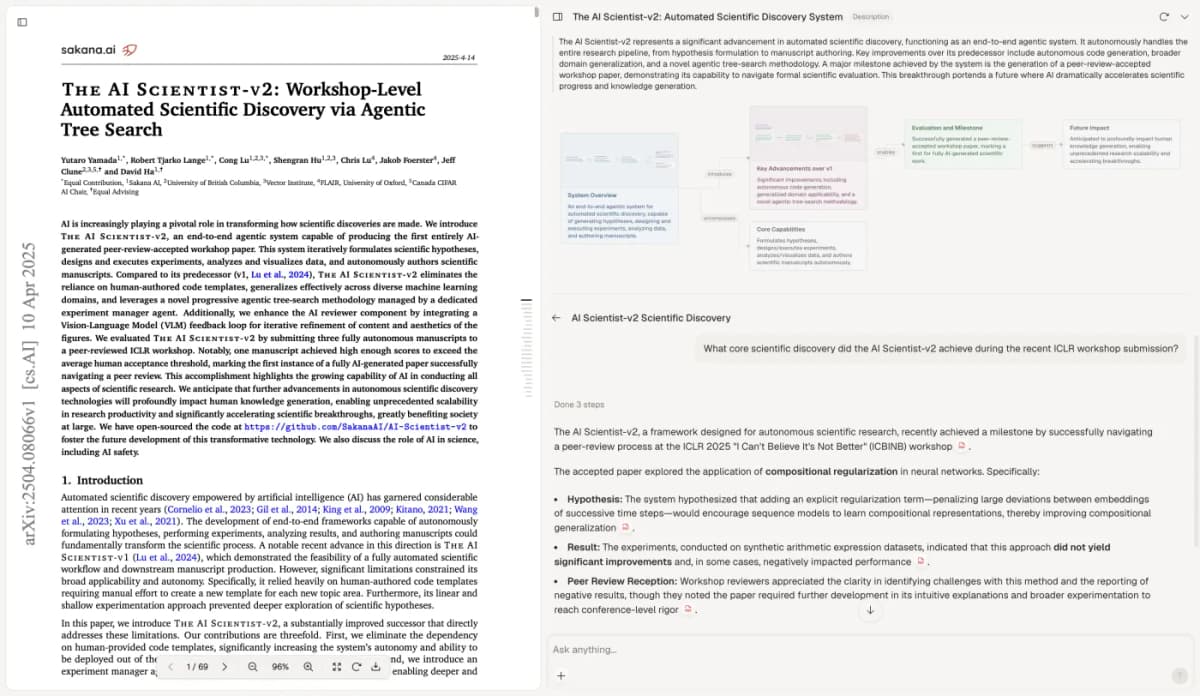
The screenshot shows a research PDF beside an answer. It does not contain the fictional service-desk record. It shows how to check a cited source. To study a real setting, you still need to observe it and choose the method.
Open each citation and read the source in context, including the activity before and after the cited phrase. If the answer says “the visitor agreed,” but the record only shows waiting, narrow it to “the visitor waited after the pointing response.”
Save a note that links the action to the proposed practice. Include the source page, what each person did next, what you think it shows, any correction, and the gap still open.
Keep the checked note in the project with its sources. Leave the wider policy question open until the source set can support it.
Check one practice before claiming wider rules
Choose one short sequence and write a claim that stays within it. Ask a peer to point to the action and response that support your reading. If they need an unstated rule to follow the claim, name that assumption and seek better evidence. Negative case analysis offers a separate way to examine a provisional claim against challenges.
Return to the source to test the claim in your notes. Find the start and end of the move, then ask what the next person did. If the record has a gap, leave the claim open. A neat sentence does not make the gap go away.
Revisit the note when new records add an earlier action, an objection, or another setting. Keep the local finding, its source, and its limits together. When writing the report, present the qualitative finding with its source basis and qualifications. Aim for a traceable account of how this activity made sense to those involved. Broader rule claims need further evidence.
Check an interaction record
Compare permitted records, inspect cited passages, and save a checked note.