

A market research plan links a business decision to the questions, people, sources, and methods needed to answer it. It also sets out costs, dates, owners, and limits. Write it before you collect data so each task has a clear purpose.
Use the plan to test what you know. What can your sources already tell you? What still needs direct research? This guide uses a made-up lunch service to show how those choices work.

Check the evidence behind your plan
Match market questions to sources and open research gaps.
Start with the decision
Name the action the research will inform. “Should we test weekday lunch delivery in one office district?” gives the study a place, an offer, and a decision. “Learn about food trends” can grow until the budget runs out.
Keep the decision apart from the market research questions. The team decides whether to run a pilot. Research asks who buys lunch nearby, where they buy it, and what keeps them from ordering. Agree on what would lead the team to proceed, change the offer, or stop.
The SBA market-research guidance covers demand, market size, location, saturation, and prices. Treat those as prompts to narrow, rather than fields you must fill with confident estimates. An unanswered question is a useful planning result when it prevents an unsupported decision.
What the plan should contain
Questions and intended use
For each question, write why the answer matters and who will use it. A price question may shape the offer. A question about rival services may shape the service area. Keep the research goal apart from a sales target. Selling more meals is what the business wants. It is not a question a study can answer on its own.
FlexMR’s planning guide separates the target audience from the sample. Your audience is the group you hope to learn about. Your sample is the people who take part. State both. Say how people can enter the study and which groups may be missed.
Methods and practical constraints
Choose a method for the question. Interviews can explore reasons and words people use. A survey can measure replies from a defined sample.
Past records can show what people did. First check how those records were made and whether they fit the question. Qualtrics explains the fit limits of secondary research: someone else’s data may not answer your exact question.
Plan how you will use the data before you collect it. Say how you will review interviews or group survey replies. Name who does the work, time limits, costs, and consent needs. Say who receives the findings. OpenStax’s research sequence places planning and sampling before collection and reporting.
Worked plan for a lunch service
This example is fictional. A team wants to test lunch delivery in one office district. It has a report about the wider market and old customer notes. It must decide whether to run a pilot. No study results, sales forecasts, or survey replies are supplied here.
The Census Business Builder is one source of local context. Data about people and businesses can help describe a service area. They do not show that workers there will buy your meals.
Use the four rows below to separate existing context from planned collection and the limits of each possible answer.
| Research question | Source to check | Proposed method | Bias or gap to record |
|---|---|---|---|
| Who might buy lunch in the district? | Local population and business data, with dates | Review official area data before recruitment | Residents are not the same as workers present at lunchtime |
| What do people use today? | Past customer notes and current competitor menus | Compare documents; then interview eligible workers | Existing customers may differ from people who never bought |
| Which delivery barriers matter? | Old interview passages about timing and pickup | Explore those themes in new interviews | Old complaints may reflect a previous service model |
| Would the proposed price be acceptable? | Current alternatives and a defined offer | Plan a price study with a qualified researcher | Stated willingness to pay is not an observed purchase |
Table 1: Each row pairs a question with evidence, a proposed method, and a limit the researcher must review.
Repair the demand claim
A draft note might say, “The regional report proves demand for our lunch service.” Check the gaps. Does it cover the right area, type of service, date, and offer? Open the report and find what it measured before using it to support a launch.
A bounded replacement is: “Use the regional report as market context. Local demand for this offer remains untested.” If the report does not describe the district or relevant category, narrow the context claim further.
The SBA distinction between existing and direct research helps explain why a new customer question can remain open after reading broad market data.
Decide what needs new research
Old notes about late delivery give you a reason to ask about timing. They do not show how common the concern is today. Keep the passage, date, and group it describes. Then decide what the next study needs to do. Explore reasons? Measure how many people share the concern? Test an offer?
Keep planned interviews apart from the evidence you have read. An interview analysis workflow can help you review notes and check claims once you have them. The researcher still owns recruitment, consent, and study quality.
For interviews about current buying choices, use customer discovery questions to ask about past decisions and barriers. Keep those accounts separate from promises to buy a proposed offer.
Check sampling and source limits
Who is absent from the evidence?
A mailing list may include loyal buyers but miss people who rejected the offer. Office interviews may miss remote workers or staff on other shifts. List who is missing next to your target audience. Keep those gaps visible when you write the report.
Do not choose a sample size because it looks large. Start with the question, how precise the answer needs to be, who can take part, and what it costs.
Get expert help if you need to estimate results for a whole population. The OpenStax sampling discussion is a starting point. It does not approve your sample.
Which sources fit the decision?
For each report, record who wrote it, when it came out, and when its data were collected. Note the place, group, and terms it covers. A new report can still use old data. Two reports may describe different markets rather than disagree.
The industry analysis guide helps you check their industry boundaries and drivers. A source synthesis method helps you keep each source's scope clear.
Consent and data handling belong in the plan. Collect only what you need. State how you will use it and check the rules for your group and setting. Business.com’s planning guide includes ethical concerns. A template does not resolve them for you.
Build a checked plan in Atlas
- Add the selected market report, prior customer research, and decision brief to one project. Use materials you have permission to process. Keep dates and document names clear so you can distinguish old context from new research.
- In Ask a question, type @ and select the sources. Name the question you want answered instead of asking for a complete market strategy from unspecified material.
- Ask: “Using these sources, draft a question-source-method-bias plan for deciding whether to test lunch delivery in this district. Cite existing evidence. Mark proposed fieldwork separately. Leave unsupported demand claims open.”
- Open each citation and read the surrounding passage. Check whether it supports the stated population, place, and time. Use this paper-analysis approach when a source’s method or scope needs closer reading.
- Correct broad wording. If Atlas treats the regional report as proof of local demand, replace that claim with the bounded context statement above. Ask for a specific passage if the cited material is missing or unhelpful.
- Select New → Note and save the checked plan, source details, unanswered questions, and responsible person. Wait for Saved before closing the note. Keep proposed study choices distinct from facts found in the documents.
The capture below shows a source beside a cited answer. Compare the two to check a claim. The paper on screen concerns AI research. It is not evidence about the fictional lunch service or a test of this plan.
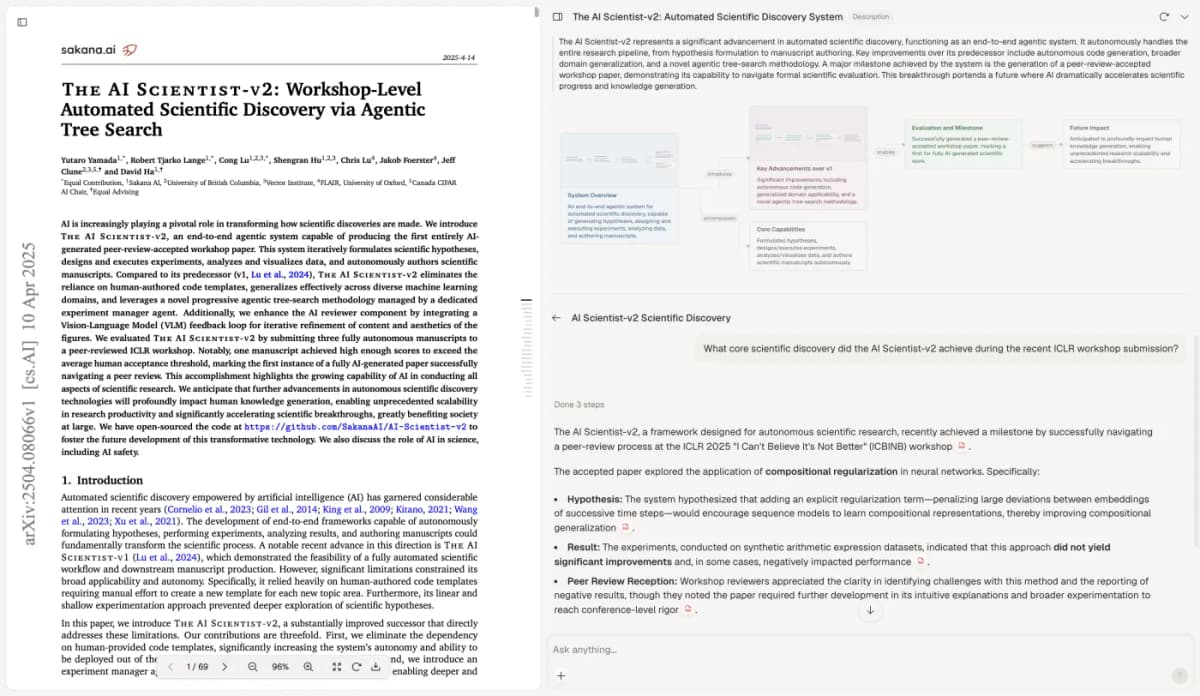
Read the source and the answer together, then narrow any claim that goes beyond the passage. The visible paper is The AI Scientist-v2: Workshop-Level Automated Scientific Discovery via Agentic Tree Search, by Yutaro Yamada, Robert Tjarko Lange, Cong Lu, Shengran Hu, Chris Lu, Jakob Foerster, Jeff Clune, and David Ha, licensed under CC BY 4.0. The screenshot copy is unchanged; its capture date is unknown. The authors do not endorse this guide.
Approve the fieldwork handoff
Before you collect data, review the decision and questions. Check who will take part, how you will reach them, and what you will do with their replies. Check dates, costs, and owners. Resolve consent and access issues. Agree on which limits must appear in the final report.
Keep the plan short enough for partners to use, with supporting material available separately. FlexMR’s concise-brief guidance is useful here: the plan should focus the work rather than become a report written before the evidence exists.
Once the research is done, use a market research report template to present the methods, checked findings and next step. Report the work performed and evidence gaps rather than copy planned activities into a results section.
Revisit it when a material constraint changes, and record why the question or method changed.
Check the evidence behind your plan
Match market questions to sources and open research gaps.