


Most students confuse recognition with recall. You recognize facts when you see them, but exams ask you to pull them back without hints. Mind mapping helps because you have to sort a topic, link the parts, and rebuild it from memory.
For exam prep, a good mind map is not a poster. It is a retrieval plan. Each branch should tell you what to recall, what proof or example belongs with it, and when you will test it again.

Atlas study notes
Explore study maps for lecture notes, chapters, and research papers.
The 3C Recall Map Framework
The 3C Recall Map Framework is the rubric this guide uses to judge whether a study map is ready for exam prep. Use it before you trust a map. Compress means the whole topic stays small enough to redraw, usually 20-40 nodes. Cover means you can hide the source and rebuild the main branches from memory. Correct means every weak branch points to one source passage, one example, or one practice question.
| Test | Pass condition | If it fails |
|---|---|---|
| Compress | The topic fits in 20-40 nodes | Split the topic into a smaller sub-map |
| Cover | You can redraw the main branches with the source covered | Mark missing branches red and test again tomorrow |
| Correct | Each red branch points to one source, example, or practice question | Add proof before you keep reviewing |
Table 1: 3C recall checks for exam mind maps.
The 3C test keeps the map tied to exam behavior. A branch is not "done" because it looks neat. It is done when you can cover the source, redraw the branch, and explain why it belongs there.
Three rules make this practical during revision. A map that takes more than 10 minutes to redraw is too large for exam recall. A red branch should create one next action: reread one source paragraph, solve one problem, or write one evidence sentence. A branch with no proof, case, example, or formula attached has not reached exam-ready knowledge.
Mind-mapping exam-prep methods compared
Use this table to pick the right map for the study task in front of you. The key is not the drawing style. The key is whether the map makes you recall, compare, or connect ideas before the exam.
| Method | Time investment | When to do it | Recall benefit |
|---|---|---|---|
| One map per chapter | 30-45 min/chapter | During the term, week of coverage | High, builds as you go |
| One master map per course | 2-4 hours | 2 weeks before exam | Highest, forces synthesis |
| Blank-page recall map | 15-20 min | Day of, week of exam | Highest, pure active recall |
| Cause-effect flow map | 20-30 min/topic | For systems, processes | High for sequenced content |
| Compare-contrast map | 20-30 min | For close concept pairs | High, sharpens distinctions |
Table 2: Exam-prep map formats by revision stage.
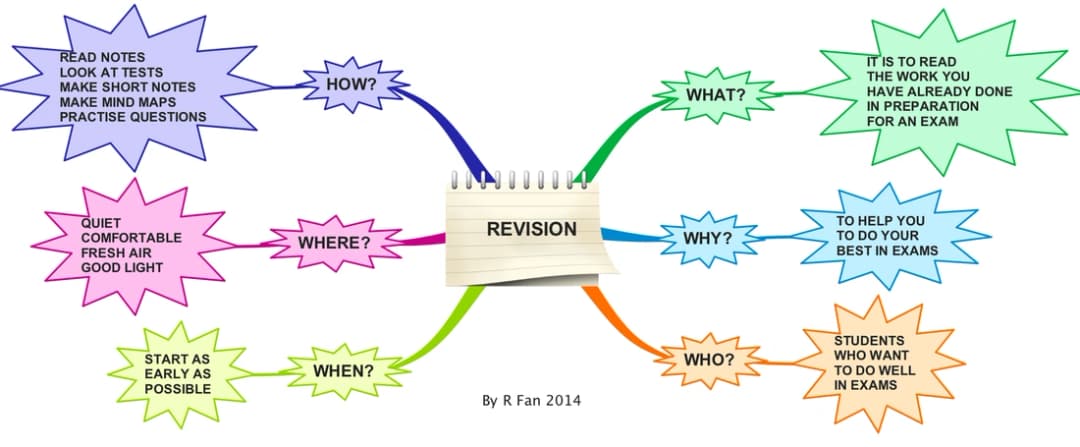
R Fan’s 2014 revision mind map organizes exam preparation around what, why, who, where, when, and how. It is a planning example; the 3C recall checks above are a separate framework.
Build an Exam-Ready Map
Quick Answers Before You Start
Who should use this? Use exam mind maps when a subject has many linked ideas: biology systems, legal tests, history causes, economics models, or essay plans. If the task is pure memorization, use flashcards first.
How do I use a template? Treat any template as an empty starting page. Put the exam topic in the center. Add four to six main branches, then mark each branch green, yellow, or red after a blank-page test.
Can I turn a map into an outline? Yes, but do it after recall. Exporting or rewriting the map as an outline is useful for final review, especially if you also use visual note-taking methods, mind maps from documents, or structured college note-taking methods.
What resources help? Start with your course materials, then add one outside source only when a branch stays red. If the weak branch comes from a chapter, use a focused textbook note-taking pass. For tool choice, use a dedicated mind-mapping software comparison. For broader study workflow, use the student guide to AI research.
Subject Templates That Help
Do not use the same map layout for every exam. Match the branch pattern to the kind of thinking the paper will test:
| Subject type | Use this branch pattern | Why it works |
|---|---|---|
| Biology or medicine | System > process > trigger > failure point | Helps you explain what changes when one part breaks |
| History or politics | Event > cause > actor > consequence > evidence | Turns a timeline into an argument map |
| Law or policy | Rule > elements > exceptions > cases > risk | Keeps conditions and edge cases separate |
| Economics or business | Model > assumption > graph > shock > prediction | Makes the exam answer follow the model's logic |
| Literature or philosophy | Claim > passage > device > interpretation > objection | Converts close reading into essay structure |
Table 3: Branch patterns by subject and exam task.
For essay exams, export the map into an outline only after you pass the blank-page test. The center becomes the thesis, main branches become body sections, and red branches become the places where you need another quote, case, or worked example. If your map starts looking more like a web than a tree, compare it with a concept map and decide whether cross-links matter more than radial review.
Export a Map Into an Essay Outline
Do not export every branch. Export only the branches that help the examiner follow your argument.
Use this four-column outline:
| Map item | Outline role | Keep if | Cut if |
|---|---|---|---|
| Center topic | Thesis or direct answer | It answers the exam prompt | It only repeats the topic |
| Main branch | Body paragraph | It makes one claim | It is just a category name |
| Leaf node | Evidence or example | It proves the branch claim | It is trivia you cannot use |
| Red branch | Research task | You need it to answer the question | It is outside the likely exam scope |
Table 4: Map-to-outline choices for essay exam planning.
The export rule is simple: a green branch can become a paragraph, a yellow branch needs one more example, and a red branch stays out of the outline until you fix it. This stops the map from turning into a bloated essay plan.
Why Mind Maps Help Exam Prep
Mind maps work for exam prep because they force active processing. You must choose the key ideas, decide how they relate, and place them on the page. That moves you from recognition to recall, which is what exams test.
In this guide, "mind map" means a central topic with branches that show recall cues, proof, examples, and weak spots. If the page looks colorful but does not tell you what to test next, treat it as decoration.
They Force Active Processing
You can't create a mind map passively. You have to decide what the key concepts are, how they relate to each other, and how to organize them spatially. Every decision is an act of learning.
Compare this to highlighting, where your pen can move while your mind drifts. Rereading has the same trap. Familiar text feels easy, so your brain says "I know this" before you test it.
They Mirror How Memory Works
Your brain stores facts in linked networks. When you remember one idea, related ideas become easier to reach.
A mind map puts that network on paper. When you study from the map, you practice moving through links instead of reading a list from top to bottom.
They Reveal Gaps
A mind map of a topic you know well looks full and linked. A map of a weak topic has thin branches and empty spots. Those gaps are easier to see than they are in a long set of notes.
They Compress Information
A well-made mind map can fit a topic on one page. Instead of rereading 30 pages, you review one map and see the main pattern.
For a complete introduction to mind mapping as a study tool, see our complete guide on mind mapping for exam success.
The Exam Prep Mind Map Method
The method is a three-pass loop. Use it the same way each week:
- Build the map with sources nearby. Start from memory, then check your notes and add what you missed.
- Redraw the map with no sources. Use a blank page, set a timer, and rebuild the topic from memory.
- Study only the gaps. Mark missing branches, review those items, and test them again after a longer gap.
A pretty map is optional. A map you can recreate under pressure is the goal.
Phase 1: Build Topic Maps
Start three to four weeks before the exam. For each major topic, create a complete mind map:
-
Gather your materials. Use lecture notes, textbook pages, practice questions, and past exam prompts for this topic.
-
Identify the central concept. What is this topic about? This goes in the center.
-
Add main branches from memory first. Before looking at your notes, write down everything you already know. This baseline recall tells you where you stand.
-
Fill in from your materials. Now consult your notes and textbook. Add what you missed. Pay special attention to things you forgot. These are your weak spots.
-
Add links. Draw lines between ideas on different branches. Label them if it helps, such as "causes," "depends on," or "contradicts."
Time investment: 45-60 minutes per major topic. It feels slow, but building the map is active study as well as preparation.
Phase 2: Run a Blank-Page Test
Start two to three weeks before the exam. This is where mind maps become a powerful recall tool:
-
Take a blank page. Write only the central topic.
-
Recreate the mind map from memory. No notes, no textbook. Just your brain and the blank page.
-
Check against your original map. What did you remember? What did you forget? What did you get wrong?
-
Mark your gaps. Use a different color to fill in what you missed. These marked areas become your priority study targets.
-
Repeat in a few days. The gaps should shrink each time.
This is active recall in visual form. Each attempt makes that knowledge easier to bring back later.
Phase 3: Space Your Map Reviews
Use this simple review pattern:
- Day 1: Create or review the mind map
- Day 2: Blank page test
- Day 4: Blank page test
- Day 7: Blank page test
- Day 14: Final blank page test, if you have time
The longer gaps match how memory works. When you recall the map after a longer wait, the memory gets stronger.
Phase 4: Make Exam-Day Quick Maps
On the day before the exam or the morning of it, create simplified "quick maps" for last-minute review:
- One page per major topic
- Only the most important concepts and relationships
- Heavy use of color and simple visuals
- These are your final review documents
Spend 15-20 minutes reviewing your quick maps before the exam. They act as a warm-up and bring the full topic network back into reach.
Why Visual Networks Help Study
A mind map helps when it lowers the load on working memory. Cognitive load theory says working memory is limited, so learning materials should cut wasted mental effort and make structure clear. A good exam map does that by grouping related ideas under one branch instead of scattering them across pages of notes.
Use the "one branch, one job" rule. A branch should either define, compare, explain a cause, give an example, or mark a weak spot. If a branch tries to do three jobs at once, split it. If a map has more than 40 nodes, make a smaller sub-map before the page turns into another thing to memorize.
For semester-long use, keep one map per weekly topic and one master map for the course. At the end of each week, add only three items to the master map: the main idea, the hardest link, and one likely exam question. By exam month, your review map is already built.
Pick a Tool for Each Study Job
Paper is best when the goal is memory. You slow down, choose branches by hand, and notice what you cannot recall. That friction is useful during the first map and the blank-page test.
Digital tools are better when the goal is storage, sharing, or cleanup. Use them after the hard recall work. If you digitize a map too early, you may spend the study session arranging boxes instead of testing memory.
For dense readings, use AI only as an answer key. Upload notes, chapters, or papers to Atlas, generate a starting map, and compare it with the map you drew from memory. If Atlas shows a branch you missed, add it to your weak-list and test it again tomorrow.
Use this AI workflow only after you have tried recall once:
- Draw your own map from memory.
- Upload the source set to Atlas or another cited AI study tool.
- Ask for a map of the same topic with source-backed branches.
- Compare the AI map with your memory map.
- Add only the missed branches that you can trace back to the source.
That order matters. If AI makes the first map, you may skip the hard recall step. If AI makes the second map, it becomes a check on your own work.
| Study situation | Best format | Why |
|---|---|---|
| First pass through a lecture topic | Paper | Forces slow choices and exposes gaps |
| Group review | Shared digital map | Lets classmates add missing branches |
| Research-heavy exam with many readings | Atlas-generated source map | Checks whether your own map missed source-backed concepts |
| Final 24-hour review | One-page quick map | Uses the final session for recall instead of redrawing the map |
Table 5: Study tool formats by task and timing.
Use Maps to Lower Pre-Exam Stress
An exam mind map can reduce panic by turning a vague fear into a visible list. Use this 10-minute workflow when you feel behind:
- Put the exam name in the center of the page.
- Add three branches: topics I know, topics I partly know, and topics I cannot explain yet.
- Circle the last branch and use those items as your next study block.
The map does not need to prove that you are ready. Its job is to stop you from treating the whole course as one giant problem.
Track Mastery With a Map Scorecard
Mind maps work best as a weekly habit. A one-night cram session leaves no time for spaced practice. Dunlosky, Rawson, Marsh, Nathan, and Willingham's 2013 review rated practice testing and distributed practice as high-utility learning methods because they work across many ages, subjects, and test types.
Use that research as a simple scorecard after each blank-page test:
| Mark | What it means | What to do next |
|---|---|---|
| Green | You redrew the branch with no help | Leave it alone until the next review |
| Yellow | You remembered the idea but missed detail | Add one practice question for that branch |
| Red | You could not rebuild the branch | Restudy the source, then redraw that branch tomorrow |
Table 6: Scorecard marks for blank-page recall tests.
Keep the scorecard on the map itself. If most branches are green two reviews in a row, stop polishing that map and move to practice questions. If the same branch stays red after two attempts, ask for help, use a different source, or build a smaller sub-map for that branch only.
How Parents and Tutors Can Help
For younger students, the adult should ask recall questions while the student builds the map. Start with the student's blank-page map. Ask what branch is missing. Ask what example proves the branch. Ask what question the exam could use.
If the student cannot answer, point them back to the source instead of giving the answer. This keeps the work on retrieval. For more support tools, pair the map with flashcards, visual note-taking methods, or a simple study notes workspace when the source set is too large to check by hand.
Strategies for Different Exam Types
Multiple Choice Exams
Multiple choice tests ask you to spot small differences between similar ideas.
Mind map focus:
- Map common confusion points explicitly (what's the difference between X and Y?)
- Create branches that organize similar concepts with clear distinguishing features
- Include specific examples under each concept
- Map common wrong answer patterns for your subject
Technique: Create a "confusion map" around ideas students often mix up. For each pair, add branches for the key differences.
Essay Exams
Essay exams need clear claims, proof, and examples.
Mind map focus:
- Map potential essay topics with argument structures
- Each topic branch should include a thesis, supporting points, proof, and likely objections
- Practice creating quick mind maps under time pressure (the first 5 minutes of an essay exam)
- Cross-connect evidence that supports multiple arguments
Technique: For each likely essay topic, map the main claim, support, proof, objection, and reply. In the exam, spend 3-5 minutes sketching a quick version before writing.
Problem-Solving Exams (Math, Physics, Engineering)
Problem-solving exams test whether you can choose the right method and use it.
Mind map focus:
- Map problem types and their solution strategies
- For each strategy, map the conditions that tell you when to use it
- Include key formulas and equations on relevant branches
- Map common mistakes and how to avoid them
Technique: Create a decision-tree map with "What kind of problem is this?" at the center. Add branches for problem types, then list the steps for each one.
Practical and Lab Exams
Practical exams test steps, checks, and technique.
Mind map focus:
- Map procedures as sequential branches
- Include critical checkpoints and safety notes
- Map common errors at each step
- Include sensory cues (what should it look like/feel like at each stage)
Technique: Walk through the map while miming the steps. Pairing the map with movement can help procedural recall.
Combining Mind Maps With Other Study Techniques
Mind Maps + Flashcards
Use mind maps for big-picture understanding and flashcards for specific details.
How: Create the mind map first. Then make flashcards for facts, terms, and details on the outer branches. Review the cards, then return to the map so the facts stay tied to the larger topic.
Mind Maps + Practice Problems
Use mind maps to organize your problem-solving knowledge, then test it with practice problems.
How: After practice problems, update your map. Add new problem types, methods, and mistakes. The map becomes a record of what practice taught you.
Mind Maps + Study Groups
Mind maps are excellent collaborative study tools.
How: Each person maps the same topic alone. Then compare maps. What did someone include that you missed? Use the discussion to fix weak spots and build one shared master map.
Mind Maps + AI Tools
AI can accelerate the mind mapping process without removing the active learning component.
How: Upload lecture notes or textbook chapters to Atlas. Let it create a source-backed map, then compare that with the map you drew from memory. Did you miss a key idea or link?
Atlas is useful when your study material is spread across notes, chapters, and readings. It can pull from those uploads in one workspace and show cited answers beside the map. For this low-stakes study workflow, treat it as a check on your own recall rather than the main study method.
The active recall still happens when you create your own map. The AI just gives you a more complete answer key to check against.
For more on AI-assisted approaches to visual study, see our guide to creating mind maps from sources.
Building Your Exam Prep Schedule
Use this four-week schedule for one course or several exams:
Week 1: Build Foundation Maps
- Monday-Friday: Create one complete mind map per major topic per day
- Saturday: Review all maps created this week, noting weak areas
- Sunday: Rest (seriously. Spacing requires breaks)
Week 2: Test and Fill Gaps
- Monday-Wednesday: Blank page tests for Week 1 topics (one per day)
- Thursday-Friday: Fill gaps, update maps, create maps for remaining topics
- Saturday: Blank page tests for Week 2 topics
- Sunday: Light review of all maps
Week 3: Integrate and Connect
- Monday-Tuesday: Create cross-topic connection maps (how do different topics relate?)
- Wednesday-Thursday: Blank page tests for all topics (you'll be faster now)
- Friday: Practice exam under timed conditions, then update maps
- Saturday: Focus on weakest topics based on practice exam
- Sunday: Light review
Week 4: Compress and Review
- Monday-Tuesday: Create quick maps (simplified one-page summaries)
- Wednesday-Thursday: Final blank page tests
- Friday (pre-exam): Review quick maps only. Trust the process.
- Exam days: 15-minute quick map review before each exam
Common Mistakes in Exam Prep Mind Mapping
Starting Too Late
Mind mapping works best with spacing. Start 3-4 weeks out so you have time for blank-page tests.
Making Maps Too Detailed
Your mind map should capture key concepts and relationships. Put smaller details from your notes on flashcards. If you're spending 3 hours on a single topic map, you're going too deep. Aim for 20-40 nodes per topic.
Never Testing Yourself
Creating the map is only step one. The blank page test is where the real learning happens. If you create beautiful maps but never try to recreate them from memory, you are training recognition. That puts you back in the highlighting trap.
Ignoring Cross-Connections
Exams often test links between topics. This is especially true in essay exams and advanced courses. Map how topics affect each other.
Studying in Isolation
Compare your map with a classmate's. You will usually find a missed branch, weak example, or unclear link.
Start with one topic today
Start with one hard topic today.
Pick your most challenging exam topic. Spend 45 minutes creating a mind map. Tomorrow, try to recreate it from a blank page. The gap between what you drew from memory and what was on the map tells you exactly what to study next.
If your exam uses dense readings, see how Atlas turns documents into mind maps. Upload lecture notes, textbook chapters, and readings, then use the map as a source-backed check against your own blank-page map.
Your exams will test what you can recall. Reading alone does not build that recall, so start testing your knowledge today.
Atlas study notes
Explore study maps for lecture notes, chapters, and research papers.