

Reading can stay passive if you only highlight. Nielsen Norman Group defines mind maps as visual maps that start from one central idea and branch into linked topics. For books, use a stricter rule: every branch should answer your reading purpose. This guide shows a practical way to do that for nonfiction, textbooks, business books, and fiction.
I mind-mapped six nonfiction books over 28 days. A pre-reading scan took about 12 minutes per book. Chapter mapping took about 7 minutes per chapter. A final pass for cross-links added 24 minutes per book. After 14 days, I tested recall on 8 core arguments per book and scored 71%. Books I only highlighted scored 38%.
This was an informal, single-person test, not a controlled study. The sample was six books, I knew which note-taking method I had used, and I scored my own recall. Treat the results as a record of one reading experiment, not evidence that everyone will recall the same percentage.
| Reading workflow | Mapping work | Review method | 14-day recall |
|---|---|---|---|
| Recall-first book map | 12 min scan, 7 min per chapter, 24 min final pass | Rebuild key branches before checking notes | 71% |
| Highlighting only | Highlights while reading | Re-read highlights | 38% |
Table 1: Six-book recall results for book maps and highlighting-only notes.
I now use that result as the 12-7-24 rule for book maps: 12 minutes to scan the book, 7 minutes to map each chapter from memory, and 24 minutes for the final link pass. If a book needs much more time than that, I split it into an overview map and a second map for the densest section.

Generate a book Knowledge Map in Atlas
Upload a PDF book, inspect its map, and verify themes against passages.
What a Book Mind Map Is
A book mind map is a visual index of the choices you made while reading. The center names the book's main claim. The branches show arguments, examples, doubts, actions, and links to other books.
"A useful book map should let you explain the book without reopening it. If it only lists chapter order, it is an index."
Use a five-minute fit test when you finish. Cover the book. Explain the argument from the map alone. Mark any branch that needs the book open beside it. Those branches need clearer labels or better evidence.
Book-mapping approaches compared
Choose the map type before you read deeply. A chapter-tree is fastest when the author has a clear table of contents. An argument map works better when the book is trying to prove a claim. A concept map differs from a mind map because its labeled connections can show relationships between ideas that do not share one central branch.
| Approach | Central node | Branches | Best for | Time per book |
|---|---|---|---|---|
| Chapter-tree | Book title | Each chapter as a top branch | Non-fiction with strong chapter structure | 60-90 min |
| Argument map | Author's thesis | Premises → evidence → counterargument | Academic/argumentative non-fiction | 90-120 min |
| Character/plot map | Protagonist or theme | Characters, arcs, themes | Fiction, narrative non-fiction | 45-60 min |
| Concept map | Core idea | Concepts and how they connect | Idea-dense philosophy/science | 90-150 min |
| Question map | Research question you brought | Where the book answers, gaps | Reading for a specific purpose | 30-60 min |
Table 2: Book mind-map approaches by center node, branch style, reading goal, and time budget.
Pick a Reading Purpose Before You Map
Choose the job of the map before you start reading. A map for recall should keep definitions and examples. A map for a book club should keep questions and points of disagreement. A map for work should keep decisions, actions, and frameworks you may reuse.
Write the purpose in the corner of the page. It becomes a filter. If a detail does not help that purpose, leave it out or move it to a note outside the map.
| Purpose | Template | Keep | Drop |
|---|---|---|---|
| Remember the book | Book summary map | Core claim, 3-7 branch groups, key examples | Long quotes |
| Explain the plot | Story map | Characters, setting, conflict, turning points | Minor scenes |
| Test the argument | Argument map | Claims, evidence, assumptions, objections | Repeated anecdotes |
| Apply the ideas | Action map | Principles, habits, decisions, next steps | Background history |
| Connect research | Question map | Terms, methods, sources, open questions | General commentary |
Table 3: Book mind-map templates by reading purpose, content to keep, and content to drop.
Choose Useful Shapes and Colors
Use symbols before decoration. A circle can mark a claim, a square can mark proof, a diamond can mark a question, and a star can mark an action. Keep that code the same across books so you can scan old maps quickly.
Color should answer a question. If you are studying, use color to separate definitions, examples, and exam risks. If you are reading for work, use color to separate principles, decisions, and next steps.
When Book Map Templates Help
Templates help when the blank page slows you down. Students can start with a textbook or exam-topic template. Researchers can start with an argument or question template. Managers can start with an action map that keeps decisions, risks, and follow-ups. Our guide to visual note-taking methods compares mind maps with sketchnotes, flowcharts, and Cornell notes when a branching template does not fit the material.
Drop the template once the book's own structure becomes clear. The template is scaffolding for the first pass. The finished map should match the book and your reading purpose.
Why Should You Mind Map a Book?
Mind mapping a book can improve comprehension because it forces you to choose and rank ideas. It also gives you a one-page review sheet. Over time, those maps make it easier to connect books that would otherwise sit in separate notes.
Mind mapping a book gives you:
- Better comprehension. You cannot map everything, so you have to decide what matters most.
- Long-term recall. A map creates a visual snapshot you can revisit faster than linear notes.
- A reusable reference. Instead of rereading a 300-page book, you can review one page in minutes.
- Connections to other reading. Book maps help you see shared themes across your reading list.
For more on connecting ideas across your reading, see our guide to creating mind maps from sources.
Before You Start: The Pre-Reading Scan
Don't start mind mapping on page one. Spend 10-15 minutes scanning the book first:
-
Read the table of contents carefully: This is the author's mind map, the structure they chose for their ideas.
-
Read the introduction and conclusion: These tell you what the book promises and what it delivers. They frame everything in between.
-
Skim chapter headings and subheadings: Get a feel for the territory before you explore it in detail.
-
Note the book's core argument: In one sentence, what is this book trying to convince you of? This becomes your mind map's center.
This scan takes minutes but saves hours. You'll read with purpose instead of passively absorbing. When the book is a course text, the same scan-and-question process is covered in our guide to taking notes from a textbook.
Step-by-Step: Mind Mapping a Book
Use this sequence before you worry about polish:
- Write one center node that states the book's main claim.
- Add 3-7 main branches from the table of contents or the author's argument.
- Read each chapter, close the book, and add 3-7 keyword branches from memory.
- Mark evidence, objections, examples, and action items with different colors.
- Draw cross-links only when you can name the relationship between two ideas.
- Finish with a synthesis layer for takeaways, questions, and links to other books.
Finish each chapter before updating the map. Mapping from memory exposes what you understood; reopening the book afterward shows what you missed.
Keep the map small enough to review in five minutes. Split an overloaded branch into a separate detail map instead of shrinking the text or copying full sentences.
Step 1: Create the Central Node
Write the book's core idea in the center of your page or digital canvas.
Weak center: "Thinking, Fast and Slow" Strong center: "Two thinking systems shape all human judgment"
The title tells you what book you read. The core idea tells you what the book is about, so use the core idea.
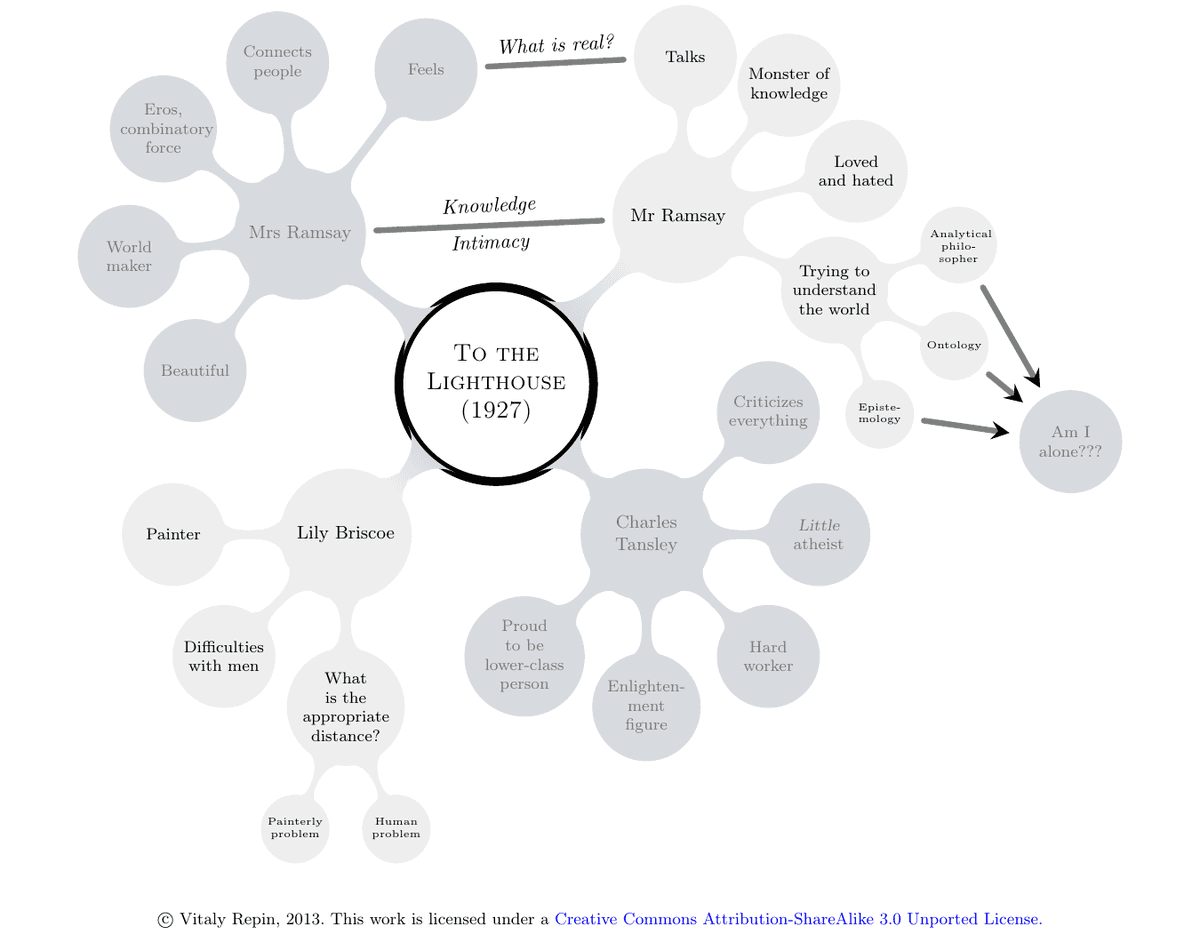
Keep the center node to one claim, usually 6-12 words. If the center says only the title, the map becomes a filing system. If it says the author's claim, every branch has a job: support, qualify, challenge, or apply that claim.
Step 2: Add the Main Branches
Create a primary branch for each major section or part of the book. Most non-fiction books have 3-7 major sections or themes. These become your main branches.
You don't need a branch for every chapter. Group related chapters into thematic branches. Look for the author's big structural divisions.
For a chapter-driven book, start with the table of contents. For an argument-driven book, group branches by claim, evidence, objection, and implication. If you cannot explain why two chapters belong together, keep them separate until the synthesis pass.
Example for "Thinking, Fast and Slow":
- System 1 (Fast Thinking)
- System 2 (Slow Thinking)
- Heuristics and Biases
- Overconfidence
- Choices and Prospect Theory
- Two Selves
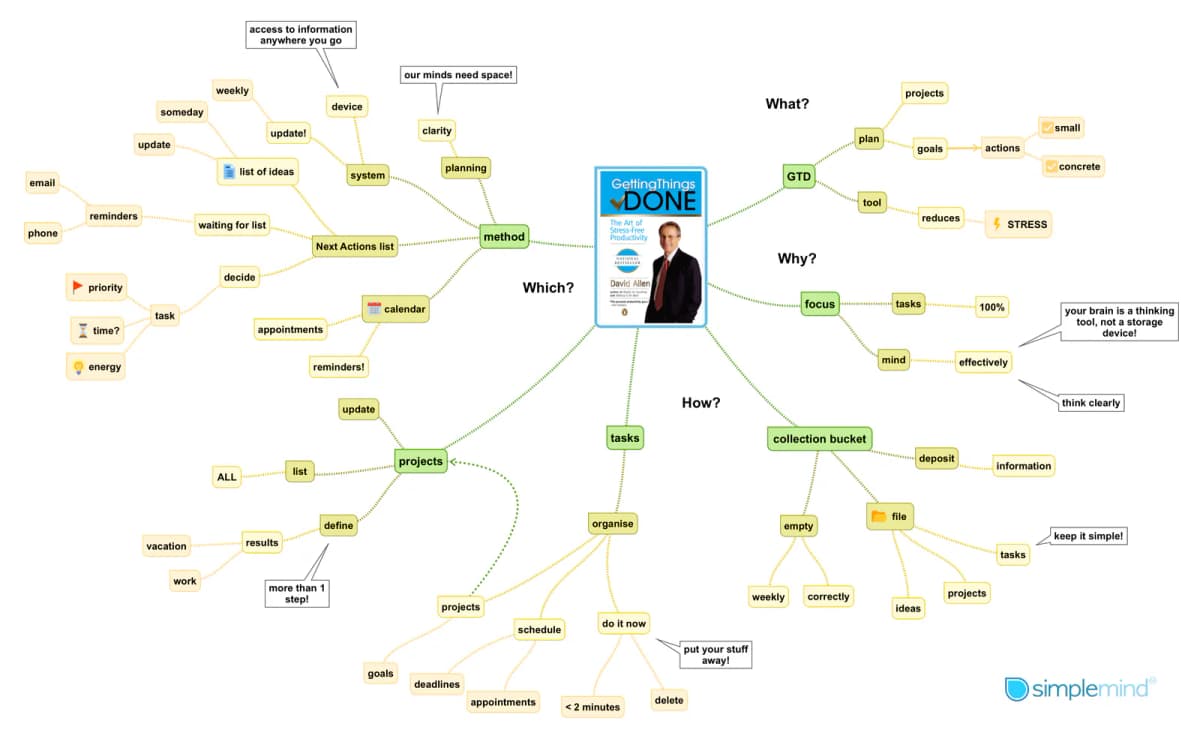
The pictured map puts Getting Things Done in the center. Its main branches group the book into method, projects, tasks, focus, and review areas. That is the useful pattern to copy: one central claim, a few branch groups, then short labels that help you remember what belongs under each group.
Step 3: Map Each Chapter
Now read the book. For each chapter:
-
Read the full chapter first: Don't stop to map while reading. Let the ideas flow.
-
Close the book: This is important. Mapping from memory forces active recall, which strengthens learning.
-
Add sub-branches: From the relevant main branch, add the chapter's key points. Use keywords instead of sentences. Aim for 3-7 sub-branches per chapter.
-
Check and supplement: Open the book again. Did you miss anything critical? Add it. Stop before the map turns into a transcript.
Keep each sub-branch short enough to scan in one glance. Strong branch labels look like "loss aversion," "habit cue," or "status anxiety." Weak labels look like copied sentences from the book.
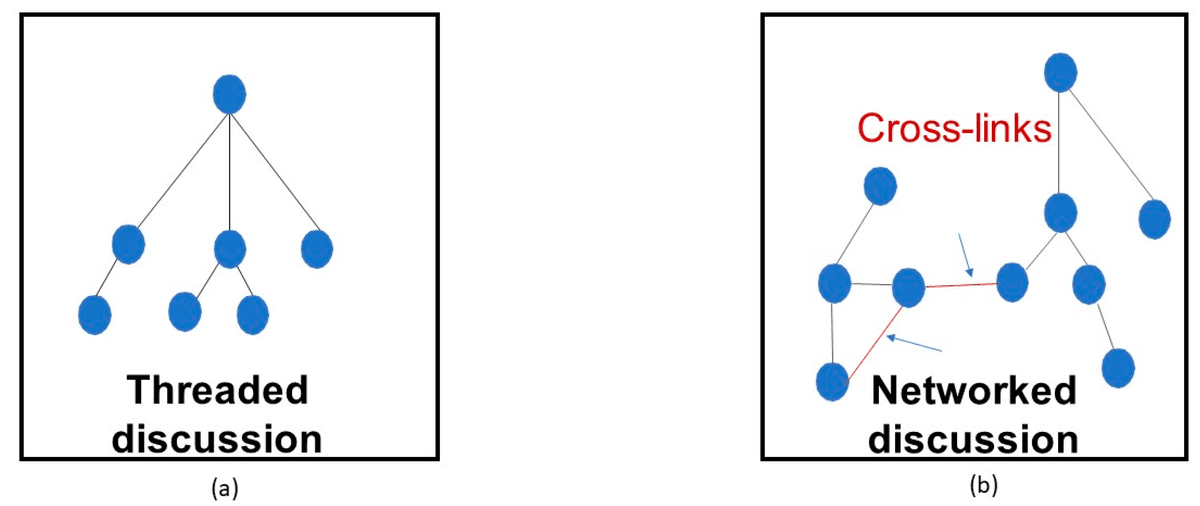
Step 4: Add Cross-Connections
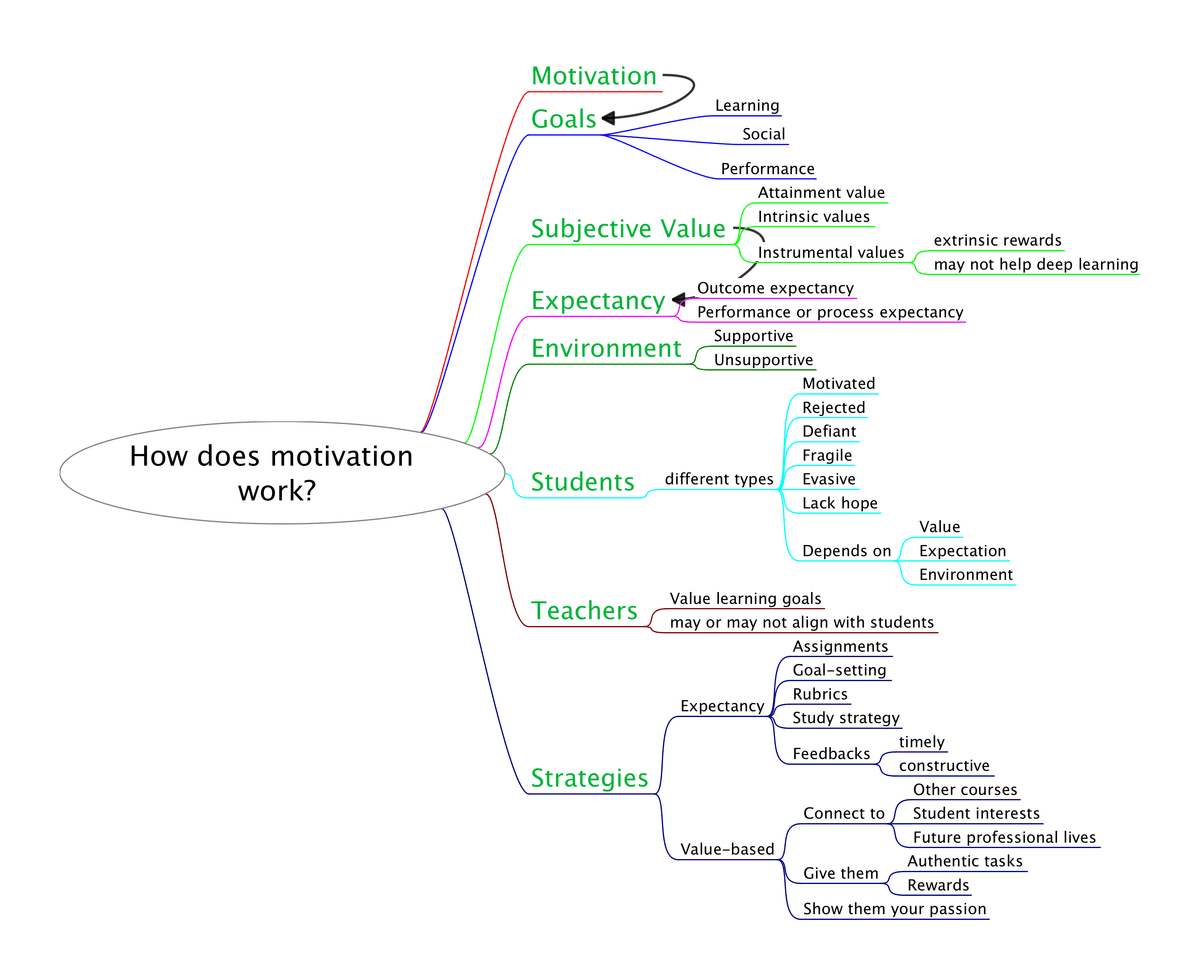
After mapping several chapters, step back and look at the whole map. Draw lines between related ideas on different branches. These links often show relationships the author left implicit.
Example: In "Thinking, Fast and Slow," connect "anchoring bias" (under Heuristics) to "overconfidence" (under Overconfidence) because anchoring contributes to overconfident judgments.
Use color only when it carries meaning. For example, blue can mark the author's claims, green can mark evidence, red can mark objections, and yellow can mark actions you want to take. If color is only decorative, it will make the map harder to review.
Step 5: Create a Synthesis Layer
Once you've finished the book, add a final layer to your map:
- Your key takeaways: What are the 3-5 insights you want to remember?
- Questions: What do you disagree with? What needs further exploration?
- Action items: How will you apply what you learned?
- Connections to other reading: How does this relate to other books or ideas?
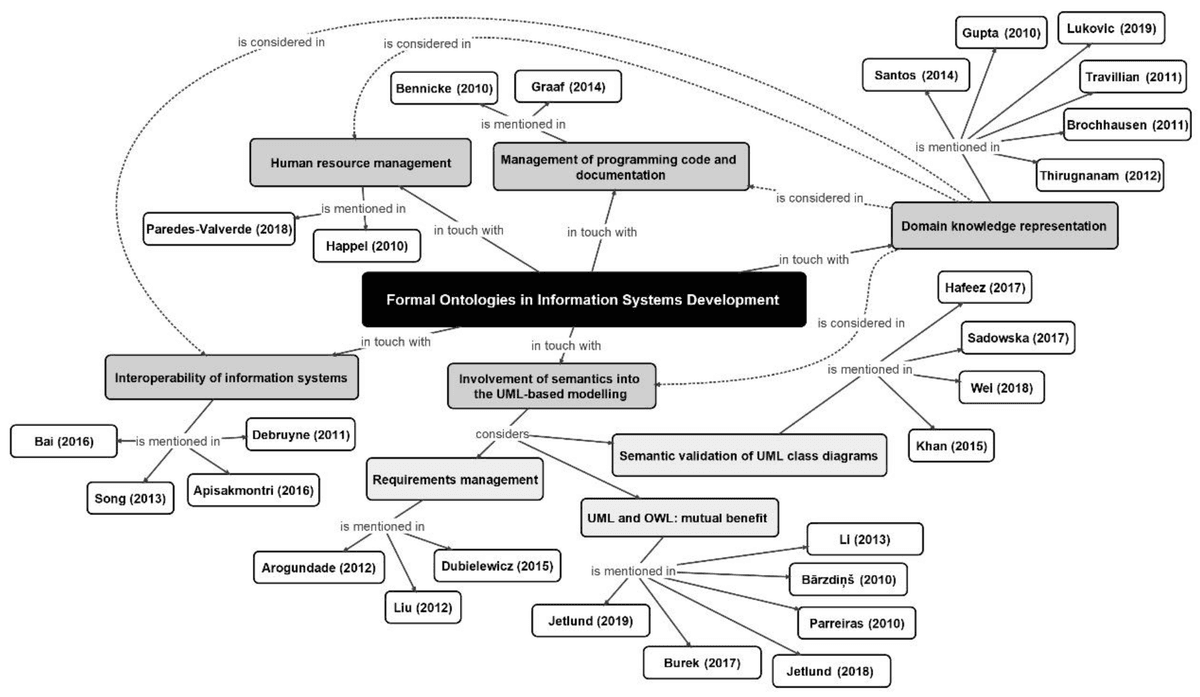
This synthesis layer transforms your map from a summary into a thinking tool.
Optional: Generate a Map From PDF
If the book is a PDF or research text, use an Atlas Knowledge Map after your pre-reading scan, not before it. Compare the generated first-level branches with your manual branch plan. Our comparison of AI mind-map generators explains which tools can build a map from a document and which require you to enter the structure yourself.
Keep the branches that match your reading goal. Rename branches that use source wording but do not help you remember the idea. Then ask cited questions such as "Where does the author define the core framework?" and "Which chapters support this claim?" The final map should still reflect your judgment.
Mind Mapping Different Book Types
Use the book's structure and your reading goal to choose the map format. An argument-driven book needs claims and evidence, while a textbook needs concepts, definitions, and processes.
The examples below show what belongs in the center, main branches, supporting branches, and cross-connections for four common book types.
Non-Fiction (Ideas and Arguments)
Books like "Sapiens," "Atomic Habits," or "Thinking, Fast and Slow" usually build one main claim with evidence and examples.
Mapping strategy:
- Center: The book's central thesis
- Main branches: Major arguments or themes
- Sub-branches: Key evidence, examples, and supporting points
- Cross-connections: How arguments reinforce each other
Tip: Focus on the author's reasoning chain. Why does one point lead to the next? Capture the logic behind the facts.
Textbooks (Structured Knowledge)
Textbooks are dense and structured. They are built for learning and review.
Mapping strategy:
- Center: The subject or course topic
- Main branches: Major units or themes (may not match chapters exactly)
- Sub-branches: Key concepts, definitions, formulas, processes
- Cross-connections: How concepts from different units relate
Tip: Create one mind map per major exam topic. A smaller map you review beats a complete map you ignore.
For more on using mind maps for exam preparation, see our guide to mind mapping for exam success. If you need a shorter revision workflow, the mind-mapping exam-prep method shows how to turn a syllabus into topic maps and recall checks.
Business and Self-Help Books
These books often repeat one simple message through stories and examples. The map should keep the lesson and drop most of the padding.
Mapping strategy:
- Center: The book's core principle or framework
- Main branches: Key strategies or steps
- Sub-branches: Actionable advice (not the stories, the lessons from the stories)
- Special branch: "Apply to my work/life" with specific action items
Tip: Many business books fit on one page with 15-20 nodes. If your map is much bigger, you may be keeping too many anecdotes.
Research and Academic Books
Academic books carry dense claims, evidence, and citations.
Mapping strategy:
- Center: The book's research question or central claim
- Main branches: Major arguments or theoretical frameworks
- Sub-branches: Evidence, methodology, key studies cited
- Cross-connections: How different arguments support or contradict each other
- Special branch: Limitations, criticisms, and open questions
Tip: Mark strong and weak claims with color or symbols so the evidence strength is visible at a glance.
Choose Paper, Software, or Atlas
Paper Mind Maps
Best for: Your first few book mind maps, books you're reading physically, when you want maximum retention
The physical act of drawing engages motor memory alongside visual processing. You remember more of what you draw by hand. Paper also avoids notifications and app switching.
Practical approach: Use a blank A3 or A4 sheet turned sideways. Start in the center and use at least three colors. Treat the result as a thinking tool.
Digital Mind Maps
Best for: Books you want to reference long-term, books you'll update or extend, when you want searchability
Digital maps are easier to edit, search, and share. You can reorganize branches without starting over. And they're always accessible.
Practical approach: Use a dedicated mind-mapping tool instead of a general drawing tool. MindMeister, XMind, and Coggle preserve the branch structure, which saves setup time and keeps the map organized. For more options, see our best mind mapping software comparison.
Use Atlas for PDF Book Maps
If you have a digital copy of the book (PDF or ebook), you can use AI to accelerate the process.
A PDF or research book is the best fit for this workflow. Atlas can generate a first Knowledge Map before you draw your own. Use it to check the structure, then finish the map by hand. If you are deciding between document-based tools, our NotebookLM mind-map guide explains what its automatic maps show and where source-level verification still matters.
- Upload the PDF or source text to Atlas.
- Open the generated Knowledge Map and scan the first-level branches.
- Compare those branches with your table-of-contents scan.
- Add your own theme labels where the AI map is too literal.
- Ask cited questions such as "Where does the author define the core framework?" and "Which chapters support this claim?"
This does not replace the learning that comes from building a map yourself. It helps you see the book's structure faster. It can also surface themes you missed and connect the book to other sources in your workspace.
Review Your Book Map
Creating the map is only half the value. The other half comes from reviewing it:
- 24-hour review. The day after finishing a book, spend 10 minutes reviewing your map. Fill in anything you remember that is missing.
- Weekly glance. For books you are applying, review the map once a week. Two minutes is enough to keep the idea active.
- Connection review. Once a month, compare several book maps. Look for shared themes, conflicts, and open questions.
- Annual curation. Once a year, review all your book maps. Keep the ideas that changed how you work or think.
Common Mistakes When Mind Mapping Books
Most weak book maps fail for the same reasons. They summarize too much, use full sentences instead of keywords, skip cross-links, make every branch look equally important, or try to map books that do not deserve the effort.
Use these fixes as you build:
- If you are copying sentences, replace each one with a 2-4 word label.
- If every branch looks equal, enlarge the main branches and shrink details.
- If the map feels like a chapter list, add links between ideas from different chapters.
- If one page is crowded, split the book into one overview map and one detail map.
Mapping While Reading
Reading and mapping simultaneously splits your attention. You end up with a worse reading experience and a worse map. Read first, then map.
Capturing Too Much
If your mind map has 100+ nodes for a single book, it has turned into a transcript. Aim for 30-50 nodes for most books. The constraint forces you to prioritize.
The easiest way to avoid over-summarizing is to set a branch budget before you start. Give each chapter 3-7 sub-branches. If a chapter needs more, split the idea into a second map instead of crowding one page.
Skipping Cross-Connections
The branches are easy. The connections between branches are where insight lives. Always step back and look for cross-links after you've built the basic structure.
Do this deliberately. Pick one branch and ask which other branch changes its meaning. Draw a link only when you can name the relationship, such as cause, tension, example, method, or consequence.
Novak and Canas's concept-map guidance treats linking words as the part that explains the relationship between two concepts. Borrow that rule for book maps. Do not draw a cross-link unless you can label it with a short phrase such as "causes," "contradicts," "depends on," or "is an example of."
Using a Flat Visual Hierarchy
If every branch has the same size, color, and density, the map becomes hard to read. Make main branches larger. Keep supporting details smaller. Use color for type of idea, such as claim, evidence, question, or action.
Never Reviewing
A mind map you never look at again provides one-time learning value. A mind map you review periodically provides compounding value. Schedule the reviews.
Mapping Every Book
Not every book deserves a mind map. Reserve the effort for books that genuinely change how you think or that you need to reference later. For lighter reads, a few highlight notes are sufficient.
Keep and Reuse Your Book Maps
A saved map should retain enough context to support future review, comparison, and discussion.
Build a Book-Map Library
A single book map helps recall one text. A small library of maps helps you compare ideas across books. Save each finished map with the book title, author, date read, and one sentence on why the book mattered. A connected-notes app is useful when you want the same concept to link back to several book maps without copying it into each file.
I use three simple tags for each saved map. Topic tells me where the book belongs. Claim records the author's main argument. Action captures whether the book changed a decision, habit, project, or research question. When you share a map with a study group or team, add one question at the top so readers know what conversation the map is meant to start.
Share Without Losing Context
A shared book map needs more context than a private review page. Add the reading purpose, the edition or source file, and two or three page references for claims that may be debated.
When I share a map with a study group, I add one open question at the top. The question turns the map into a discussion prompt. It also makes it clear which parts of the book I want the group to inspect.
Common Questions
How Many Branches Should You Use?
Most books work with 3-7 main branches and 30-50 total nodes. If the map grows past that, split it into an overview map and a detail map.
Should I use a template?
Use a template for the first five minutes, then change it. A book summary template helps you start, but the final branches should follow the book's argument and your reading purpose.
Can a Study Group Share One Map?
Yes, but add context before sharing. Include your reading purpose, page references for disputed claims, and one question you want other readers to answer.
Start With Your Next Book
You don't need to retroactively map every book you've ever read. Start with the next book you pick up.
- Scan the table of contents and introduction
- Identify the core idea for your center node
- Read chapter by chapter, mapping as you go
- Add cross-connections when you're done
- Review within 24 hours
If your next book is a PDF, generate a first map from the source, then rebuild the parts that matter by hand. The final map should reflect your judgment as well as the book's structure.
Generate a book Knowledge Map in Atlas
Upload a PDF book, inspect its map, and verify themes against passages.