

Secondary research uses studies, records, or other sources that already exist to answer a research question. The hard part is judging what they can support when they were first made for a different purpose.
Start with a clear question and check each source against it. A trusted report about travel across a country may help set the scene while leaving your campus question open. Keep a source-fit note that explains why each source belongs in the study and where its use stops.
This guide works through a made-up campus travel question. You will see how to record fit, gaps, and scope before using Atlas to compare the sources and check the text behind the note.

Check secondary research sources in Atlas
Compare selected studies and save a checked source-fit note.
What secondary research uses
Secondary research can bring together study findings or use old data to make a new study. In a literature synthesis, you compare what studies report. In a secondary data analysis, you work with records such as survey replies or interview transcripts. Each task needs its own plan and source access.
The UK Data Service explains how to reuse research data. It can include both words and numbers. A paper based on interviews lets you review its authors' findings, but reading the paper does not give you the full records they used.
The term also differs from the label secondary source. A source may report first-hand findings and still be reused in this kind of research. Scribbr explains the two source labels alongside its guide to the method. State what you will do with each source so readers can see your approach.
Old data from your own team may also fit. Check the new purpose and terms of use rather than assuming that your team can reuse it for any purpose. This guide focuses on a student study. Use the secondary market research approach for a market question.
Set the question and source-fit criteria
In the made-up example, a researcher asks: What travel barriers do undergraduate students living off campus report when attending classes at University R? The study concerns this academic year. It asks about barriers, such as a bus route that often runs late, rather than all trips students make.
Define what counts as a commuter student and a barrier before choosing sources. A paper may group students by how far they travel, while a campus report uses term-time address. Those groups might overlap, but you cannot treat them as the same without checking.
Use research objectives to connect the question to the facts you need. Then set source-fit criteria for the evidence:
- People and setting: Does the source cover the right students and campus?
- Period: When was the data gathered, and what has changed since then?
- Measures: Does it record barriers, travel time, trip counts, or something else?
- Method: How were people or records chosen, and what questions were asked?
- Source access: Can you read the methods and use the needed text or data under its terms?
These checks guide which sources you choose and how you use them. A source can help set the scene while telling you little about the target students. Record both judgments instead of giving the whole source a single quality label.
The guide to the scope of the study helps turn these choices into a clear statement of what you cover. Explain why you chose to leave some sources out. Also record problems that limit a finding, such as missing method details.
Find sources and record the search
Search where the sources you need are likely to be held. The University of Edinburgh's guide to finding data points to data search engines, data providers, and campus resources.
Searching journal papers and searching for data serve distinct needs.
For R, the researcher starts with student travel papers and campus reports that can be used for the study. Survey records would need a separate source request. Follow a search process you can describe:
- Choose the route. Decide whether the project will review findings, work with old records, or combine defined parts of both.
- Record the search. Keep the database or archive name, search terms, date, and filters. Save which source versions you reviewed.
- Screen for the question. Record why you chose each source or left it out. Mark sources kept only to set the scene.
- Inspect the methods. Read the full report, survey form, or data guide. An abstract alone may omit the detail you need.
- Check permitted use. Check access and reuse terms before getting or sharing records. Ask the data owner or research office about terms that remain unclear.
The UK Data Service's ethical sourcing module covers rights, licences, and responsible access. Finding a source online or in a prior study does not settle every reuse question.
If you are comparing study findings, the literature review process gives a fuller search and review workflow. Describe your actual search. A set of papers chosen because they are easy to access needs the right methods before it can be called a systematic review.
A worked source-suitability table
The campus sources and page references below are made-up teaching examples. They show how fit decisions work and report no real student findings. The DfT source is real, but it only helps set the scene for this campus question.
| Source and locator | What the reviewed material covers | Fit for the question | Limit or next check |
|---|---|---|---|
| R-Survey, methods p. 3 and item 8 | Off-campus undergraduates this year, asked about usual journey time | Fits the group and records travel time | Time does not directly measure barriers. Get the full survey form. |
| R-Interviews, methods p. 5 | Last year's student interview findings at R | May support claims about reported barriers | The extract leaves the group unclear. Check who took part before using the findings. |
| Other-U Study, setting p. 2 | Another campus with a shuttle bus | Context for travel problems to explore | The setting differs, so its findings do not describe R's students. |
| R-Service Log, scope p. 1 | Requests for travel advice this year | Shows issues raised by people who contacted the service | People choose to seek advice. The log cannot show how common barriers are among all students. |
| DfT NTS 2024, factsheet p. 1 and coverage definitions | Travel per person per year for England residents in private households | Background about travel in England | Overall totals do not isolate R's commuter students or their reported barriers |
Table 1: The first source matches the group and period but asks about a different thing. A long journey may matter, yet the table cannot turn it into a reported barrier without support.
The interview report might be closer to the question, but you need to check the missing details about who took part.
For qualitative reuse, the UK Data Service describes transcripts, diaries, and field notes. Reading an interview report and getting its transcripts are separate tasks.
If you cannot get the transcripts, describe a review of the report's findings rather than a new study of the full records. Name the source access you need for any planned work with those records.
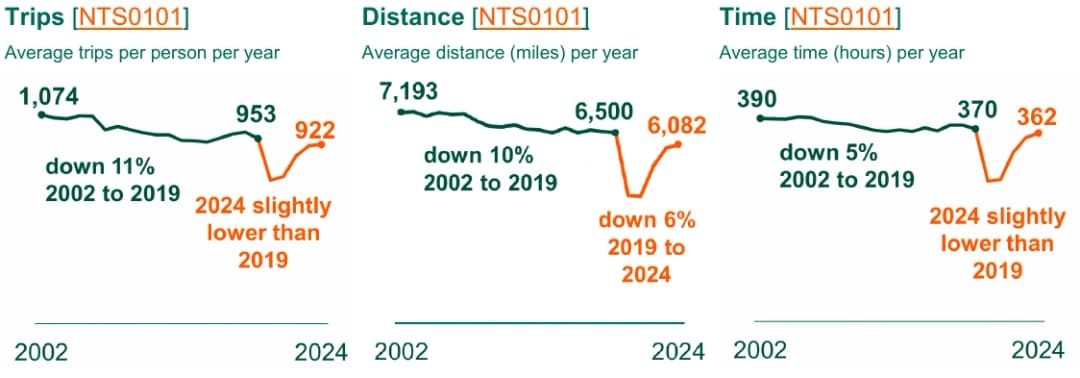
Chart crop from the Department for Transport's National Travel Survey 2024 factsheet, page 1. Crown copyright, reused under the Open Government Licence v3.0. The three panels measure trips, distance, and time per person per year. These are figures for travel in England, with no findings about the made-up campus.
The panels use distinct units: trips, miles, and hours per person per year. None measures how often students report a barrier to attending class. The text version of the main findings gives another way to inspect the figures.
Read the producer's scope and definitions as well as the chart. The survey covers England's private households and excludes people in settings such as student halls. Its overall averages cannot stand in for the campus question's target group.
Write the coverage and limitations note
Turn the table into a short account of what these sources can answer. Here is a worked note for the made-up source set:
This study reviews selected papers and campus reports about travel to R. The sources record travel time and some accounts that may describe barriers. We need to check who took part in the interviews, and the service log covers only people seeking advice. England travel figures give background. The full interview records are not available in this set, and the search has not shown that it covers all studies that could fit.
That note names the scope, the use of each source, and the work still needed. It does not claim that the campus has a known rate of travel barriers. Nor does it guess which way the service log's reach might affect a comparison.
Keep the release date, data period, version, and access date distinct. A new report can describe old events. If you compare years, inspect changes in questions, groups, and data-gathering methods before treating a difference as a change in students' lives.
Avoid combining unlike counts just because they share a travel label. Trips per year and reported barriers measure different things. If a study finds that two things are linked, keep its limits with that finding. Reusing the source does not create proof of cause and effect.
Check selected sources in Atlas
Use Atlas to compare the supplied text and inspect the support for the note. The researcher chooses how to work with raw data and checks its allowed use through the relevant research process.
- Add sources you can use. Put the question, reviewed papers, reports, and methods into one project. Include the actual survey form when you have access to it.
- Select the sources. In Ask a question, use @ to name the items. Project only bounds new retrieval to the project. Earlier chat context remains available.
- Request a source-fit comparison. Ask: "Compare these sources against this student travel question. Cite who they cover, their dates, what they record, and their methods. Mark missing details unknown and separate background from support for the question."
- Read the supporting material. Select Send, then open each important citation. Read the surrounding text and check that the right source supports the judgment. A PDF can open a precise location when one is available.
- Correct and save the note. Revise overclaims and flag open questions. Choose New, then Note, save the checked table and scope paragraph, and wait for Saved.
Suppose a draft answer says that the England averages describe R's commuter students. The scope passage covers a broader group of households.
Correct the wording to: "The England averages give background. These overall totals do not describe the target student group." Keep the passage and the reason for the change beside that row.
Check R-Survey's measure in the same way. If item 8 asks only journey time, remove a claim that it directly measures barriers. An open source-fit question should stay open until suitable text or a further source resolves it.
Revisit fit when the evidence changes
Return to the affected rows when a survey form, data version, access decision, or reviewer comment arrives. Update the judgment from the new source and keep its past basis visible so another reader can follow the change.
For example, the full methods could show who took part in the interviews. That might resolve one fit question while leaving access to the full records unchanged. Revise those points on their own, then choose a method the sources can support.
Keep the search record, source versions, and checked note together. The guide to organizing research notes helps keep the passages and open questions for later review. Your final method should explain the source choices and limits that shaped the answer.
Check secondary research sources in Atlas
Compare selected studies and save a checked source-fit note.