
Competitive landscape analysis checks which firms and other choices meet a buyer's need. It helps you choose what to pursue and which claims need more proof. The useful result is a source-backed view of the buyer's choices, with gaps marked for further work.
Start with a buyer and a choice, then build a table of checked claims. Give each key claim a source, date, and any terms that limit it. Keep a firm's promise apart from your own view of what that promise means.

Check competitor claims in Atlas
Compare selected competitor documents and inspect the support for each finding.
What the analysis should tell you
The work should explain who meets the need, how their offers differ, and what you still need to find out. It may help you choose a buyer group to serve, test a new offer, or check a claim in a sales pitch. A list of famous firms alone will not answer those questions.
Use a narrow question to guide the work. For a meal service, you might ask whether to test bringing meals to office staff after work in one district. That sets the place, time, buyer, and offer to check. It also tells you when a rival is out of scope.
The SBA's market and competitor guidance asks firms to define their market and consider direct and indirect rivals. Use that as a starting point, then keep a record of how you chose the scope.
Define the market and decision
A study of meal services could include restaurants, meal kits, grocery stores, and firms that sell ready meals. They do not all serve the same need. A buyer who wants a hot meal tonight may make a different choice from one who wants to cook for the week.
State the choice your work should guide before gathering claims. Use that scope to choose which evidence belongs in the research. A short scope note should include:
- Buyer and need: who buys, what they need, and when.
- Place and channel: where they buy and which routes to purchase matter.
- Choice to make: what the team will use the work to decide.
- Dates: when the source claims were current.
- Out of scope: which firms or offers you left out and why.
A restaurant outside the district may be out of scope. A grocery store inside it may belong if buyers use its ready meals instead. Keep those reasons in your note so a teammate can challenge them.
The SBA's research questions also ask about demand, market size, and prices. Those are separate facts to check. Do not treat your list of rivals as proof of how many buyers exist or what they will pay.
Include competitors and substitutes
Direct competitors sell much the same kind of offer to much the same buyers. Substitutes meet the need in another way. Harvard's Five Forces model includes the threat from substitutes alongside rivalry among firms.
For an after-work meal, another ready-meal firm may be a direct rival. A grocery counter could be a substitute. Cooking at home can also replace the purchase, even though it does not look like a competing firm.
Build the list from more than one source. Ask buyers which options they weigh. Read public lists, product pages, and sales notes you are allowed to use. Add a reason beside each name: it serves the district, meets the need, or came up in a buyer's account.
Spend more time on firms the buyer often weighs than on a large brand with little overlap. There is no fixed number of rivals that ensures a complete view. Keep an extra note for new or excluded choices so you can revise the scope when the market changes.
If you need help choosing tools for the research, the market research AI tools guide separates desk research, survey work, and source review. The tool should fit the question and the data you need.
Collect comparable source evidence
Choose sources that answer the same question for each firm. To check meal drop-off times, read the order terms and service area. To check the firm's pitch, read what it says to buyers and the examples it uses. Xero's competitor guide covers these kinds of offer and price checks.
Keep five fields with each claim:
- Claim: the narrow fact the source supports.
- Source: the URL, page, or section where you found it.
- Date: when it was posted, if known, and when you checked it.
- Limits: the place, plan, buyer, or terms that shape the claim.
- State of the check: what the firm says, what another source confirms, what you infer, or what remains unknown.
A firm's price page shows its public offer. It does not prove that all buyers pay that price. A client story reports one case. Read its scope before treating it as the norm.
Make price units match. A price per meal, a monthly plan, and a fee to bring food to the door describe different costs. Xero's price-comparison advice is a useful prompt to check what each offer includes. Note order size, plan terms, and short-term discounts where they affect the choice.
AFFiNE's template guidance includes source links and assumptions. Keep those fields in your own table so the numbers can be checked later.
Market share needs data for the whole market you claim to measure. Define the place, period, and whether the share is based on sales or buyers. Page views, reviews, staff counts, and funding do not supply that missing total. Mark share unknown if you cannot support it.
When reports clash, check their dates and scope before choosing a number. The guide to market research challenges covers the wider task of working with mixed sources and gaps.
Competitive landscape analysis example
Imagine a ready-meal firm weighing an after-work drop-off service. All firms, source extracts, and findings below are fictional teaching material. No market data was collected for this example.
The team has three sources:
- Meal Firm A, order terms, section 2: orders placed before noon can arrive that day in District One. There is no stated arrival window.
- Meal Firm B, product sheet, page 1: members get chilled meals on set days in Districts One and Two.
- Grocery Counter C, pickup page, hours section: buyers can collect meals in District One until 8 p.m. The page does not address drop-off service.
Keep the support and the missing facts in the same table.
| Buyer choice | Supported finding and locator | Limit or gap | Checked meaning |
|---|---|---|---|
| Meal Firm A | Food can arrive that day (terms, section 2) | Noon cutoff, no arrival window | Service stated, speed rank unsupported |
| Meal Firm B | Chilled meals on set days (sheet, page 1) | Members only, two districts | Covers the target district |
| Grocery Counter C | Pickup until 8 p.m. (hours section) | Drop-off service not addressed | Pickup option, other service unknown |
| Proposed after-work offer | No buyer proof in this source pack | Demand and costs untested | Idea to test with buyers and cost data |
Table 1: Suppose a draft calls Firm A the fastest choice because it offers same-day delivery. The terms give no arrival time and no basis for a speed rank. Keep the supported same-day claim with its noon cutoff. Remove the rank.
The grocery page raises a different issue. Silence about bringing meals to buyers does not prove that the store lacks that service. Mark it unknown and add a task to check its terms or ask the firm through a permitted research process.
The sources show several ways to get a meal. They do not prove an unmet need after work. The next question is whether buyers want the new offer enough to pay its costs. Keep that question open rather than turn a blank cell into a market gap.
Choose a framework after checking claims
Use a matrix when you need to compare the same traits across firms. The table above serves that role while keeping the source evidence behind each row visible.
Use SWOT to group strengths, weaknesses, opportunities, and threats. Explain who benefits from each strength and why a missing feature matters. The ChatPRD report template shows how a report can bring competitor findings and SWOT together.
A positioning map plots firms on two axes, such as total order cost and choice of arrival time. Define each axis and how you measure it. An empty part of the map is a prompt for research. Ask whether buyers want that offer and whether you could serve them at a viable cost.
Use Five Forces for questions about industry pressure from buyers, suppliers, new entrants, substitutes, and rivals. Those pressures may be missed by a feature table. Keep source notes behind the model so readers can trace the judgments.
Check the comparison in Atlas
Atlas can compare selected project sources and provide citations for review. First gather the competitor files you are allowed to use and write the question they should answer.
Open the project and confirm that source processing has finished. Start a chat, then type @ in Ask a question to select each source. Choose Project only to keep new retrieval within the supplied files. Enter the question and select Send.
For the teaching example, you could ask:
Compare these sources for office staff who want meals after work in District One. Use one row per choice. Give the stated service, buyer and place limits, citation, and open question. Keep source claims apart from your own inferences. Do not rank speed unless the sources support that rank.
The prompt shows a task you could use with that source pack. Its answer would still need human review. The AI source-checking guide explains how to test whether a citation supports the claim beside it.
Open each numbered citation and read the surrounding passage. Check the source, claim, and limits. If an answer calls Firm A fastest, ask it to revise the row from the order terms and remove the rank.
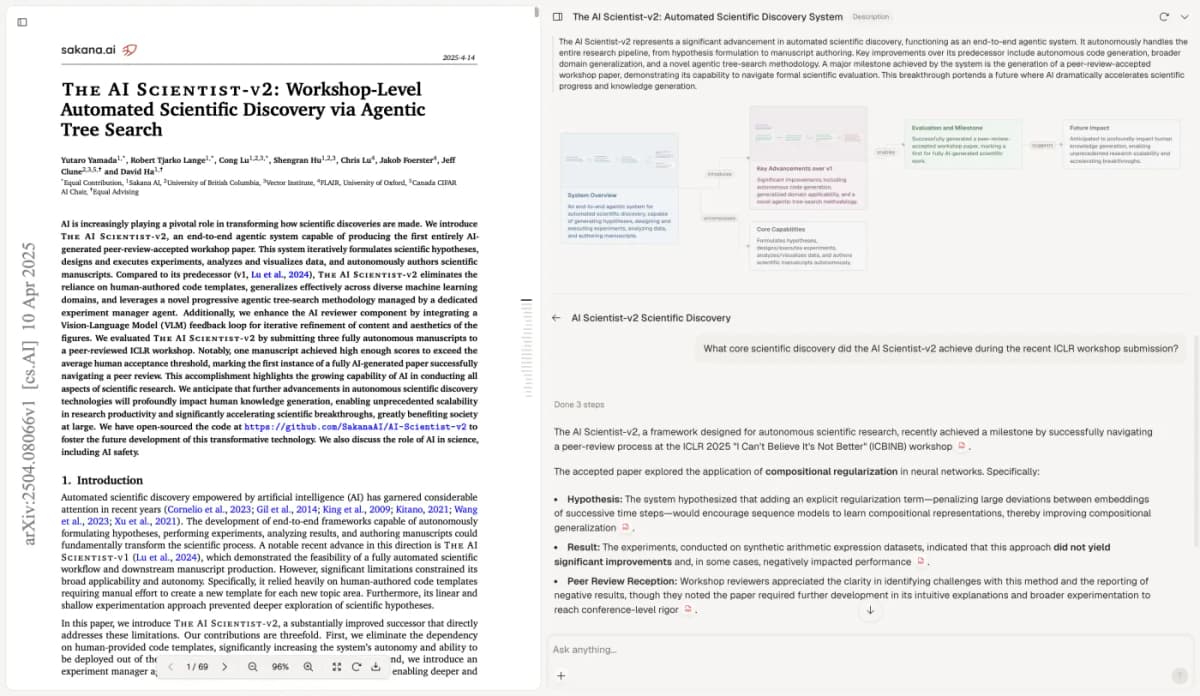
Keep the source open while checking what the answer claims.
This screenshot illustrates source review beside The AI Scientist-v2 by Yamada and colleagues, whose paper is licensed under CC BY 4.0. The screenshot is unchanged. The invented meal corpus does not appear in it, and no market test is claimed.
When support is missing or unhelpful, keep the row open until you can check it yourself. Ask for support from the named file and remove any claim you cannot trace.
Select New, then Note to save the checked table. Include the scope, sources, dates, exclusions, and open questions. Wait for Saved before closing the note. A teammate should have enough context to update the work without guessing why a row was included.
Turn findings into testable decisions
A useful conclusion links the checked facts to a choice and says what could change it. In the teaching example, you might propose testing an after-work offer in District One. The source pack leaves both the arrival window and buyer demand unclear.
Ask buyers whether the current options meet their needs. They may prefer pickup or already use set-day meals. Check the cost to serve them and the price they would pay before changing the offer.
Give each open question an owner and a next source or test. Refresh the work when a key offer changes, a new rival appears, or the team considers a new market. Keep past versions so readers can see which facts changed the choice.
Check competitor claims in Atlas
Compare selected competitor documents and inspect the support for each finding.