

Empirical research builds claims from observed or measured data. To identify it in a paper, find what the authors studied, where the data came from, how they analyzed it, and which results follow. A title or abstract can help you start, but the methods and results let you check the label.
The hard cases often contain both theory and data, or discuss methods used elsewhere. This guide works through three real papers and corrects a data-inclusion error.
Use the same table to review your own sources, keeping unknown details open until you find the supporting passage.

Trace paper evidence in Atlas
Compare selected papers and check the passages behind each data-to-result claim.
What makes research empirical
An empirical claim draws on data about the world. The data can be words as well as numbers: speech, field notes, test readings, or survey answers. The interview study used below is one real case. You do not need a lab test or a chart of numbers for a study to be empirical.
The key question is what the authors do with the data. They may test a claim, explore people's views, or describe a pattern. Follow the route from the question through the source to the finding. A study that seeks to learn how people see an issue need not start with a claim to test.
Empirical work spans more than health studies. Harvard's research guidance covers design, data, analysis, and results, with text and map-based methods among its services. These are Harvard's services. They show the range of work that can use data; they are not a list of Atlas tools.
A conceptual paper can build theory without a new study of people or events. Jaakkola's guide to conceptual papers sets out ways to do that work with care. Ask what kind of claim the paper makes and what supports it. The label alone cannot tell you which paper is best.
Trace the data behind a claim
Start with a claim you need to understand. If your task is to find empirical articles for a course, write down the eligibility rule first.
If your task is to compare findings, use the same fields for each paper so an appealing abstract does not receive less scrutiny than a difficult one.
- Name the observation. What was recorded or measured? Use a concrete phrase such as interview transcripts or survey responses, not just “research data.”
- Find its origin. Who collected it, when, and for what purpose? Keep the original data collector apart from the team using it in this paper.
- Identify the unit. Is the row about a person, event, document, or site? Note any filters that change which units enter the analysis.
- Locate the analysis. Find how the authors turn observations into findings. Record the method they report without adding procedures from a cited paper.
- Locate the result. Find a result produced by that analysis, then check the limits placed on it in the discussion.
Save section names with each field. Page numbers are helpful for a fixed PDF, while HTML may be easier to revisit through a heading and a nearby phrase.
A useful note lets another reader find the basis of your decision in the same source version.
Read the methods before turning to a broad synthesis of research papers. Otherwise, a review can merge conclusions from very different designs. Your first table should preserve those differences even if a later note groups the papers by theme.
Compare 3 real paper examples
These reading notes compare three real papers. Each row shows the data behind the claims and where to check them. Use the linked methods to verify each reading decision.
| Paper | Data basis | Where to check | Bounded reading decision |
|---|---|---|---|
| Sheikh and colleagues, recruitment case study | Interviews with academics and community leaders | Methods opening, Study Design, and analysis paragraphs | Empirical qualitative work; separately reported patient focus groups are excluded from this paper |
| Chastin and colleagues, daily activity analysis | Existing NHANES observations, including activity monitoring and reported sleep | Methods: Design, Participants, and Data analysis | Empirical analysis of reused data; original collection and this analysis are distinct |
| Jaakkola, conceptual article design | Selected theories, concepts, and illustrative published examples | Introduction, Research design, and Conclusions | Conceptual methods contribution; do not label the examples a new participant dataset |
Table: Source-located identification notes. These are reading decisions for this guide, not a validated classification benchmark or an appraisal score.
The first row uses words as data, while the second uses data that already exist. Both show why you should trace the source rather than look only for numbers or a new survey. The third row builds theory; a methods heading and a long source list do not turn it into a study of new observations.
The reused-data paper's Design section names secondary analysis of the 2005–6 NHANES cycle. Note that source before describing what this team did with it. You can show who gathered the data and who used them without copying a sample size or health estimate.
The conceptual paper's design section explains how to choose theories and concepts. That can be careful, useful work. Drawing on earlier studies does not mean the author has built a new set of data about people. Check what is new in this paper before choosing its label.
Correct a tempting label
A fast scan can lead to this note: “Qualitative study using interviews and focus groups.” Both methods appear in the paper, so the note seems fair. But it mixes data from the wider project with data used here. A list of all the methods you spot cannot resolve which ones support this paper's claims.
Use two criteria: are the data part of the analysis in this paper, and does the result follow from that analysis? The start of Methods places the focus groups outside this report. That clear limit matters more than a search match on the name of a method.
Revise the note to: “This paper uses interviews with academics and community leaders; patient focus groups are outside this analysis.” Keep that limit in a scope field where the next reader can see it. A shorter row that hides the reason for the change would be less useful.
The error changes whose views seem to support the claim. If your note adds patient focus groups, a reader may think this paper draws on patients' own speech in those groups. It does not. You can misstate the data behind a claim without ever copying a false number.
Use this check for a method cited as background, a planned measure with no result, or a study outside your scope. Ask whether it was named, done, or used here. Those are distinct states. When the source leaves the answer unclear, keep the field open instead of guessing from nearby text.
Keep evidence type and quality separate
An empirical label tells you that the claims draw on data. It does not tell you if the authors chose a sound sample, used good measures, or made a claim their results support. Review those points in their own right. A paper can use real data and still have flaws.
The CASP qualitative checklist helps you ask how an interview study was done. Keep those review notes next to this table, with a clear label for each task. If a study has a flaw, describe it without losing the record of what data the authors used.
Cause needs its own checks too. Apply the activity paper's limits section when taking notes, since it warns about causal claims from its cross-sectional analysis.
The fact that the paper is empirical does not make every claim about cause sound, and these notes are not health advice.
A review or meta-analysis can draw on empirical findings without gathering new data from people.
Whether it counts for a course task depends on the rule you were given. Keep a new study, a new use of existing data, and a synthesis of studies apart when that rule calls for it.
Missing detail can mean several things. A method may be absent from the paper, shown in a linked extra file, or unclear in the copy you have. State what you found. “Not found in this text” leaves room to check further; “the team did not do it” makes a much broader claim.
When sources disagree, compare the exact claim and data scope before seeking a single verdict. They may study different groups or use different measures. Preserve that difference in a field of its own so your next reader can see why the findings should not be merged without further work.
Check paper passages in Atlas
Add the selected papers to a project and wait until they have finished processing. Start a chat and type @ to select each source. Naming them helps make the comparison explicit; a file with a similar title should not stand in for the paper you intended.
If you want to stop new outside retrieval, choose Project only beside +. Earlier conversation context remains available, including outside evidence already present. Use a fresh chat when that earlier material could confuse the scope, and name the exact papers in your question.
Ask for a bounded comparison that keeps source fields separate:
For each selected paper, identify the observations used in this paper, who collected them, the reported analysis, and a result supported by that analysis. Cite the passage for each field. Separate methods mentioned as background or reported elsewhere. Mark missing details as not found; do not infer them.
Open each citation and read the surrounding methods or results text. The citation-tracking guide explains the value of keeping claims connected to sources. A citation is a route for inspection, not evidence that the proposed row is correct.
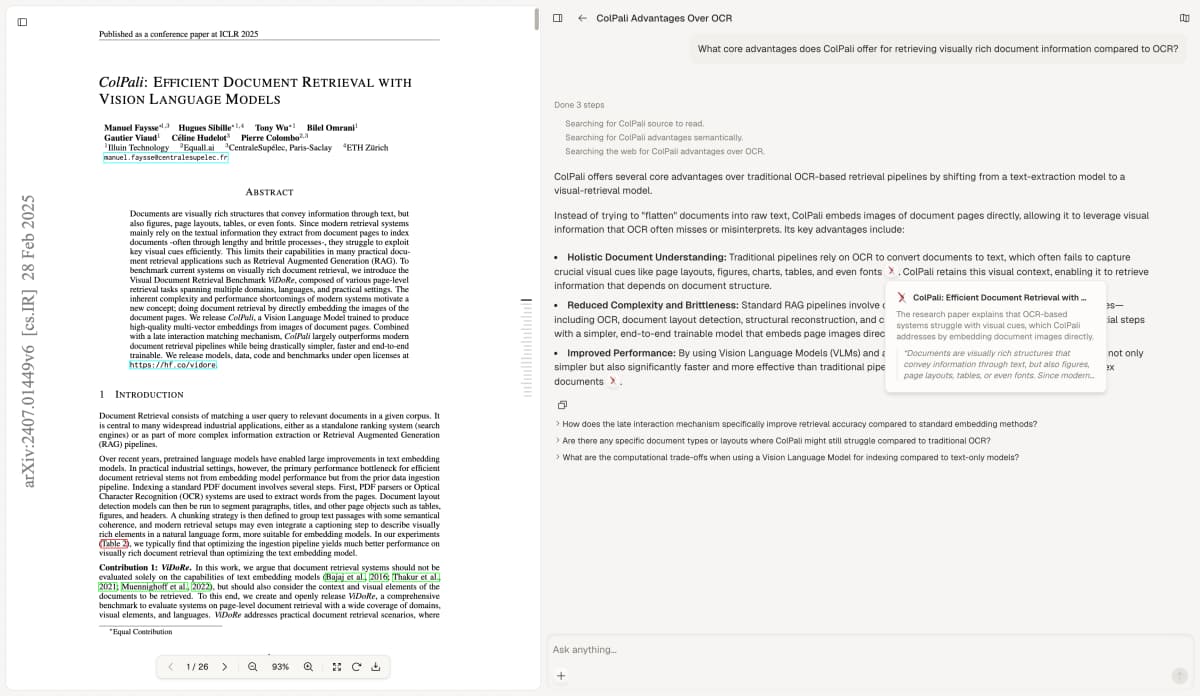
Inspect the cited passage in the ColPali PDF. This capture uses a separate paper from the worked examples: ColPali by Manuel Faysse and colleagues, CC0 1.0. The paper content is unchanged.
Correct a row if the cited passage describes the wider project instead of this paper. You can ask a follow-up focused on that conflict, then check the replacement passage. Keep your own explanation of why the label changed rather than accepting a cleaner table without a source-level reason.
For difficult scans or dense layouts, the AI PDF reader guide can help you assess reading needs.
Whatever tool you use, confirm the source version and inspect the relevant page. Atlas assists comparison and notes; it does not run the study, calculate statistics, or certify the evidence type.
Save a defensible evidence note
Before saving, choose one row and follow its chain from observation to result. Check the data origin, the analysis actually used, and any exclusion that limits the claim. If the row cannot survive that check, revise it or leave a visible question for later review.
Create a note through New then Note, and wait for Saved before closing. Retain the paper title, source location, your classification, and the reason for any correction. A short explanation of the focus-group exclusion is more useful than a bare “empirical” label.
If a venue asks for an extended abstract, use the checked note to keep the data, methods and claim scope clear in that shorter report. The format changes how much you can say, not what the evidence supports.
Share the table with its unresolved fields intact. The next reader should see what you checked and what remains uncertain. When a new paper or supplement arrives, update the relevant row after checking it; do not let one confirmed classification stand in for reading the rest of the source set.
Trace paper evidence in Atlas
Compare selected papers and check the passages behind each data-to-result claim.