
Exit Interview Analysis: Trace Reasons to Evidence
Analyze exit interviews by coding reasons, checking contrary accounts, and building a source-linked evidence table before recommending a retention fix.
- Byline

Summary
Exit interview analysis finds patterns in what leavers said. It also shows which accounts differ and what needs a closer look.
For each theme, save the source text, who spoke, a case that differs, and what HR needs to check next. A quote alone does not show why people left.
Atlas can compare files you add and link answers to source text. An HR lead must check the text before sharing a finding.
Exit interview analysis starts with a narrower question than “Why do people leave?”: Which explanations recur in the accounts we have, and which accounts complicate them? Read each response in context, label the passage, and compare it with other accounts.
Keep the source text close at hand. A theme can point to a question worth checking. It cannot, by itself, show what made people leave.
Suppose your team has cleared two exit notes for this use. One says an employee could not see a path to a senior role. Another says the rules for promotion were clear, but the employee preferred a new field.
“Career growth” may be a useful topic code, yet those accounts point to different questions. Preserve both before anyone proposes a policy change. Confirm that the notes may be used and shared for this purpose before adding them to a project.

Atlas

Compare exit accounts in Atlas
Add permitted transcripts, check cited themes, and save a reviewed memo.
Define the analysis question
Decide what the report must help someone investigate. “What obstacles to advancement did employees describe this quarter?” may be more useful than “What were the top exit reasons?” The interviews may contain different combinations of pay, workload, supervision, and career plans.
HR Acuity’s exit-interview guidance notes that reasons for leaving are often mixed. Reducing each account to one cause can erase that context.
Write the question and set the scope before you code. Note the time span and teams in the set. Record who was asked to take part, who did, and whether you have full text or short notes.
Short notes show what the person who asked the questions wrote down. They are not word-for-word records. Mark which type of source backs each finding.
Prepare comparable exit accounts
Use a consistent core of open questions when collecting future interviews. A semi-structured interview guide can hold those shared prompts and planned follow-ups while leaving room for each person to explain what mattered to them.
UK government guidance for social-work employers recommends comparable questions and careful recording so feedback can be analyzed. Its sector advice offers a method example; it is not a rule for every employer.
Qualtrics' exit-interview guide favors open answers when teams need more than a checkbox reason. Use the same core prompts so the accounts can be read side by side.
For accounts you already have, list the source ID, date, role or group, question asked, kind of note, and any gaps. Give each account a stable ID such as E-01.
Before you upload or share a source, check its allowed use with HR. Keep the ID key in a separate, restricted place and avoid details that could point to one person in a small team. Even a redacted note may reveal who spoke.
The staff who check the themes need access to the source text. Others may need only the reviewed finding. Ask the HR or privacy owner when that boundary is unclear.
The prompts can change what appears in the answers. If only one person was asked about a manager, a count of manager mentions is hard to compare. Note the gap in the prompts.
The social desirability bias guide explains how interviewer presence and workplace pressure may also shape an answer, without treating any employee's account as false.
Mark questions with no answer and interviews that did not take place. They show what the set does not cover.
Code reasons and compare cases
Read each account once for the whole story. On a second pass, mark text that answers the question with a short code such as “shift changes” or “career path.” Keep the source ID with it; a label found in several rows is not yet a finding. For more on the method, see AI interview analysis.
If the question is how a person tells a departure story—its sequence, turning points, and audience—narrative analysis keeps that case structure in view. Use the cross-account codes here when the job is to compare recurring exit reasons.
Keep the coding record
The exit-specific task is to keep what the person said apart from the analyst's view. A coding note needs four fields:
- Account: what the person said, or what the interviewer recorded.
- Code: a short label for a passage, such as “unclear promotion rules.”
- Meaning: how the analyst thinks related passages fit together.
- Follow-up: a question or check the employer can pursue.
If a reviewer disputes the meaning, they can return to the account without losing the code or the next question.
Then compare cases. What did “career path” mean to each person? Was there no chance to move up? Were the rules hard to see? Did a new field appeal more?
Look for accounts that do not fit the initial explanation. Such a case may narrow a theme, split it into two, or show that the question needs another source of evidence.
A topic groups similar words. A theme makes a more precise claim about the pattern and its context. “Management” is a topic. “New managers changed shift assignments without explaining the criteria” is a possible theme when the accounts support it.
Check that claim against the nearby text and people whose views differed. SHRM’s guide treats coded text and counts as two forms of analysis. Both can help, but they answer different questions. For the researcher-led method, see our inductive thematic analysis guide.
If you report counts, state the denominator and coding rule: “five of twelve reviewed responses mentioned schedule changes,” for example. That describes this reviewed set.
It does not estimate the rate among everyone who left or show that schedule changes caused five departures. People who agreed to an interview may differ from those who declined.
A UK justice-system report says its exit talks were optional, so they do not speak for all leavers. Use the same care with a small in-house set.
Build an exit-theme evidence table
The table below is hypothetical. Its source IDs and sample text show a review method. They are not real employee words or an Atlas product test. In real work, keep the source text for staff who may read it. Swap each sample phrase for a link to checked text.
| Proposed theme | Source trace and context | Contrary case or caveat | Follow-up question |
|---|---|---|---|
| Promotion decisions felt opaque | E-01, departure note from a senior analyst: the employee did not understand how candidates were chosen. | E-02 understood the criteria but wanted a different career path. | Were criteria communicated consistently across teams and application rounds? |
| Last-minute shifts disrupted plans | E-03, interviewer summary from a rotating-shift role: schedule changes were described as hard to plan around. | The summary lacks the interviewer’s exact question; other roles may have different schedules. | What do schedule records and current staff accounts show for this role? |
| Support varied after a manager change | E-04, transcript passage tied to a specific handover period: the employee described losing a regular check-in. | One account cannot establish a team-wide change or a manager’s intent. | Did check-in practice change, and how did other team members experience it? |
Table 1: Use one row per explanation, not one row per employee. Link each supporting and challenging account, then read the source text before sharing the claim.
That source trace lets a reviewer check the theme. If the only evidence is a short interview summary, mark that limit rather than inventing a quotation.
Check themes in Atlas
Atlas can compare text sources that your team has cleared for this use. Once the files are in a project and ready, mention the accounts you want to compare in chat. The aim is to check source support, so ask a focused question:
Compare these selected exit accounts on career progression. Keep each account separate. For each proposed pattern, show the supporting passage, any contrary passage, the interview prompt when available, and what remains unknown. Do not infer motives or a cause of departure.
Open the citations for every claim that may appear in a report. Check that each cited passage belongs to the intended account and read the surrounding text.
Revise the theme if the citation does not support it. Save only the checked comparison in a note so later reviewers can distinguish an initial answer from an approved finding.
The screenshot shows an Atlas answer beside an open source document. It uses a research paper, not an employee account. In an exit-interview review, use the same citation-opening step to inspect the permitted transcript passage before accepting a theme.
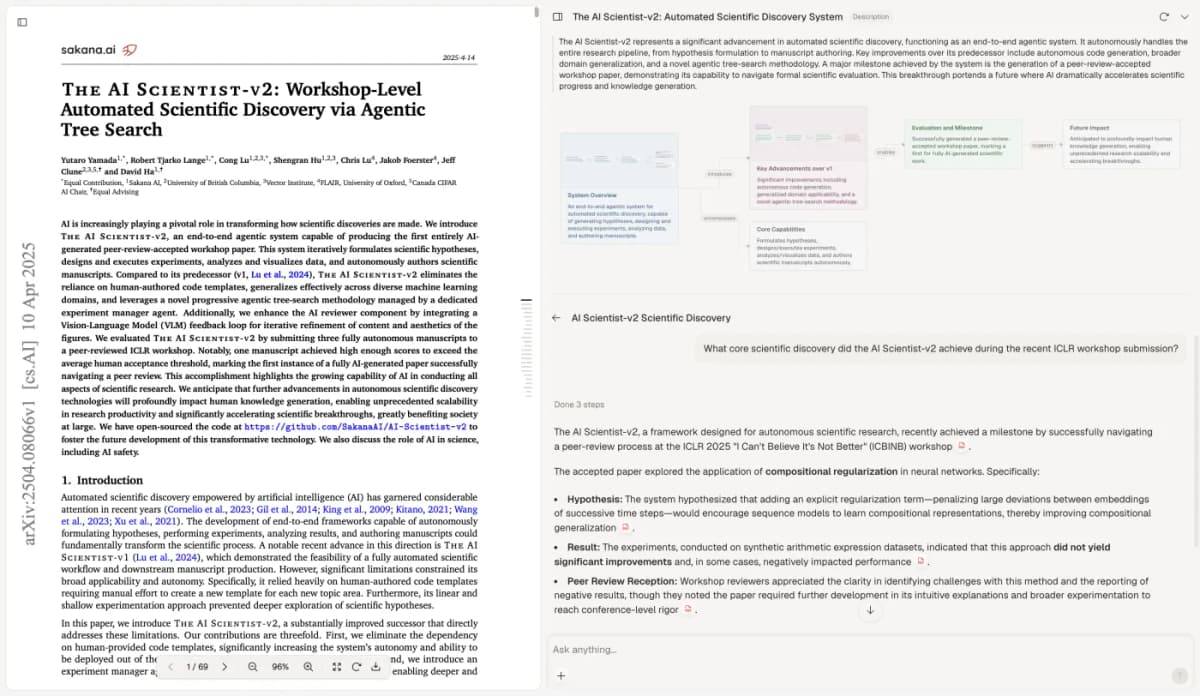
An Atlas citation can take you back to a source passage; it does not decide whether that passage supports the HR interpretation.
If the source text is incomplete, ask a narrower question or return to the file. A missing citation may mean the content was not retrieved as expected. It does not show that an employee never raised the issue.
Atlas does not conduct exit interviews, establish the cause of turnover, score employees, or connect this analysis to an HR dashboard.
Next steps after exit interview analysis
An exit theme is a reason to investigate. Before proposing a change, check for a team restructure, a change in prompts, or a small set of respondents. Acas describes exit feedback as one way to learn whether exclusion affected a leaver.
Check records and current staff feedback where that use is allowed. The problem may also affect people who stayed. Keep a reported experience distinct from a condition checked through other evidence.
Make the final memo useful to the decision owner. State the question, source boundary, number of eligible and reviewed accounts, coding approach, strongest themes, cases that challenge them, and open questions.
Give each recommendation an owner and a way to check the action. The CIPD's people-profession report cautions that exit data arrives late; pair it with feedback gathered while people still work there. Do not turn a sensitive account into a public example without review.
If you still need to turn recordings into text, compare the constraints in our interview transcription guide first. For broader methods, see qualitative data analysis with AI.
Atlas
Compare exit accounts in Atlas
Add permitted transcripts, check cited themes, and save a reviewed memo.
Frequently Asked Questions
Set a focused question, prepare comparable and permitted accounts, code passages, compare themes and exceptions, and check every conclusion against the original response before recommending a follow-up.