

Horizon scanning is a planned search for early signs of change and what they could mean for your work. A useful scan gives you a set of changes to look into, with a source and a reason to care about each one.
A report might describe a pilot of a new tool. That fact could prompt you to ask whether the tool will affect your service. It takes more proof to claim that most teams already use it.
A signal register keeps what the source says apart from what you think it could mean. The team can then question your view without losing the facts behind it.
The Institute of Risk Management's practitioner guide treats scanning as a way to explore doubt and prepare for change. It does not promise to predict one future. The steps below help you turn a source set into records you can check.

Build a scan you can check
Compare publications and save a checked signal register.
What horizon scanning is for
Horizon scanning helps a team spot changes its plans may overlook. Fraunhofer ISI groups this work into scoping, scanning and sensemaking. First define the search, then find signals, then judge which ones matter to your plans.
An early sign of change whose meaning is still unclear is often called a weak signal. A single pilot might raise a question about a new service. Check whether it worked and how well it fits your team.
Forecasting estimates what might happen under stated assumptions. Scenario work explores how different futures could unfold. A scan can feed either task, but finding a signal does not tell you how likely an outcome is.
For a team making a training plan, the task might be to find new skills worth looking into before the next budget cycle. A useful scan points to the facts behind that question and what remains unknown.
Define the decision and search boundary
Write the question before gathering sources. A small foresight team might ask which new ways of reviewing sources it should look into for next year's training plan. The question gives the scan a user, a purpose and a time frame.
Choose sources that can reveal different parts of the answer. A guide can explain a method. A study can report a test, while a record of a real deployment can show how the method worked in that setting.
These sources do different jobs. A guide and a test report may appear in the same search results, but they cannot support the same claims.
For a scan that draws on many papers, use a research paper organization workflow to keep source details and reading notes together. Record why each paper belongs in the scan, so the team can trace an entry back to its source at the next review.
For the worked example, write a scope note with the following details.
- Decision: identify topics for the next training-plan discussion.
- Coverage: public guides and study records about horizon-scanning methods.
- Capture date: 2 October 2026 for the worked example below.
- Exclusions: surveys of tool use, tests of tool quality and private team records.
- Missing views: people using the methods, staff affected by them and reports of what happened in practice.
These choices fit the example's task. A different question could need a different source set. If you are looking at a proposed law, for instance, you would need to check where it applies and whether it is still a proposal.
The European Environment Agency's practical guide looks across changes in society, technology, the economy, the environment and politics. Use these categories to spot gaps in your search, while keeping each source tied to your question.
The diagram in the Government Office for Science's Futures Toolkit shows how a scan can reach beyond familiar sources, views and time frames. For the example team, news of new tools is only part of that search. Reports from people using the tools can reveal needs that a launch announcement leaves out, giving the team a reason to seek those views before choosing its training topics.
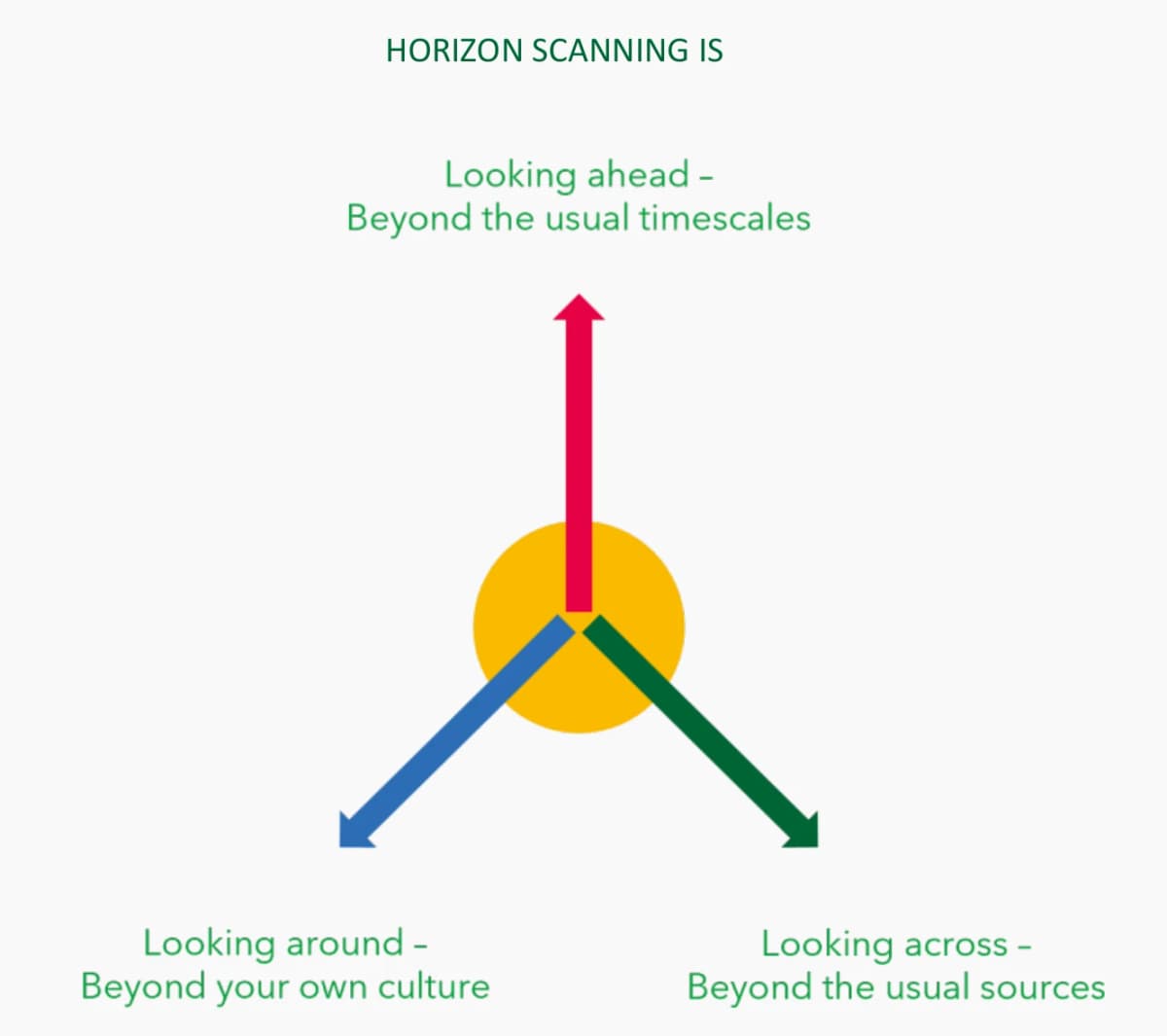
The three arrows show how to broaden the scan. Government Office for Science, Crown copyright 2024, reproduced under the Open Government Licence v3.0.
Record evidence before interpreting it
A record needs enough detail for someone else to find the source and question your view. The Government Office for Science template has fields for the scan question, date, impact, certainty, time horizon and sources.
The record needs two distinct dates: when the source appeared and when you read it. Neither has to be the date when the change began. If the source has no stated date, record that gap rather than fill it with today's date.
A source claim must stay within what the text supports. A study abstract that introduces AI in scanning shows that its authors discuss the topic. It does not prove that most teams use AI or that it finds better signals.
Explain your view of what the source could mean for your work. A proposed training need rests on a view about the team and the method's value. Put that reasoning beside the source claim so others can check it.
A useful follow-up names the next fact to seek. A request to watch a change leaves the next reader guessing. Asking for a test report that lists missed signals gives someone a clear task.
When several articles report the same news, link them to one event. Ten articles copying a press release still trace to that one release. Keep repeated reports apart from facts gathered by different people or methods.
Follow a worked signal register
Suppose a small foresight team is choosing methods to look into before revising its training plan. This register uses four real source pages, captured on 2 October 2026.
The observations in the table come from those sources. The possible implications and next steps are the team's imagined reasoning for this exercise.
| Source and publication date | Observation supported by the source | Possible implication for the team | Evidence to seek next |
|---|---|---|---|
| EEA practical guide, 16 August 2023 | The agency published practical guidance intended to equip horizon-scanning practitioners. | A structured introductory exercise may be useful for staff starting a scan. | Review the guide's exercises against the team's decision and available time. |
| US Forest Service research record, 2024 | The abstract describes signal collection and says the paper briefly discusses AI in scanning. | AI-assisted source review deserves investigation as a possible training topic. | Read the full paper and seek evaluations relevant to the team's source set. |
| Government Office for Science template, 29 August 2024 | The template separates impact, certainty, time horizon and source information. | Staff may need practice distinguishing uncertainty from potential impact. | Try the fields on a permitted source and review where team judgments differ. |
| Fraunhofer ISI method page, publication date unstated | The page describes scoping, scanning and sensemaking with expert involvement. | Training should retain explicit source-selection and interpretation steps. | Find a documented application and examine how expert review changed the result. |
Table 1: Each record preserves a publication observation, a possible consequence for one team and a question that remains open.
This exercise contains background guides as well as a study record discussing AI. The team must keep that background apart from proof of a new change, such as a report showing that people now use a method in a new way.
A draft memo might claim that AI has replaced expert review in scanning and that staff should train only on tools. The study record gives no proof of that shift. Fraunhofer's page still describes expert involvement.
The draft training choice thus rests on a claim the sources do not support. A corrected memo could read:
The sources discuss both AI and scanning with expert input. Check whether AI would help us review sources, and what skills we need to check its output. We still need to find out how well it works in our setting.
The revised memo gives the team a task it can act on. It also keeps an open question from becoming a claim about a settled future.
The Futures Platform practitioner guide shows how a team can frame questions, gather signs of change and assess them together. Bring the register to that discussion so people can check the facts and reasoning behind each entry.
Check selected publications in Atlas
Atlas can help compare project sources and keep a checked view in a note. Here, the task is to trace each source claim back to its text before using it in the training discussion.
- Create a project for the scan and add the sources you want to compare. Check that they have finished processing before asking about them.
- Check the source content. A page or abstract can support only the text it contains. Add and read the full document when the question calls for more detail.
- Start a chat. In Ask a question, type @ and select the sources.
- Choose Project only before sending a question about just these sources. This limits new retrieval, though earlier chat context can still be used.
Compare these sources for our training-plan discussion. For each one, keep what it states apart from what that could mean for our team. Cite the source claim, explain what remains unknown and suggest one next check. Do not infer how widely a tool is used or how well it works from a method guide.
Open the citation beside the claim about AI. Check whether the passage describes a method, a proposal or a measured result. Read the text around it for limits on the claim.
If the answer says AI has replaced experts, ask for the passage that proves this. Remove the claim if the sources do not support it. Check which source the citation opens, especially if the chat has discussed outside sources.
Save the corrected result in a note with the scope, source links, capture date and open questions. At the next review, you can compare new facts with the reasons behind the earlier view.
Challenge signals and choose follow-up
Review an entry with someone who can question its fit and the assumptions behind it. Ask what the source proves and what other view could fit the same facts.
What new fact would make the proposed effect less likely? If reviewers disagree, keep the reason for that disagreement beside the record.
Choose a next step for each entry.
- Retain as background: the source explains a known method but does not show a new change.
- Keep under review: the fact could matter, but its meaning or fit for your team is still unclear.
- Reject the implication: the proposed effect does not follow from the source or falls outside the scan's scope.
- Seek expert help: the facts raise a question that needs a check by someone with the right skills.
Give someone the next check and set a review date that fits the planning cycle. Define what would prompt an earlier review, such as a new test report, a failed pilot or a change in a key assumption.
Keep the earlier view when you revise the record, so readers can see why it changed. A new source may weaken a claim you once kept, or give you grounds to revisit one you rejected.
Before the training meeting, the example team should be able to point to a source for each fact it keeps. It should also name the open question behind each proposed topic. When that link is missing, seek more facts before making the claim stronger.
For a broader policy-reading task, AI policy analysis tools explains how source checks affect tool choice. When you need to combine research findings, use the research synthesis workflow to organise claims across sources.
Build a scan you can check
Compare publications and save a checked signal register.